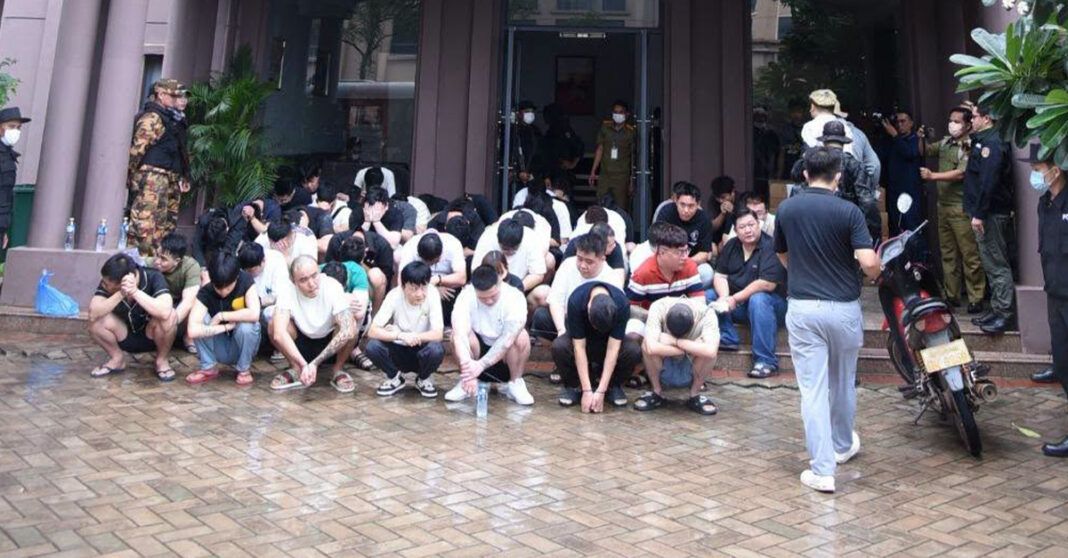
Vientiane's law enforcement moved swiftly in early August to dismantle a major international fraud syndicate operating brazenly within a special economic zone, signalling an escalating regional problem that demands coordinated action across Southeast Asia. The operation, conducted on 8 August at a facility in the Thatluang Lake Special Economic Zone, netted 261 suspects engaged in telecommunications fraud and illegal online gambling activities. The scale of the detention underscores how these scam networks have evolved into sophisticated, multinational enterprises capable of establishing physical infrastructure across porous borders.
The nationality breakdown of those detained reveals the transnational nature of these criminal enterprises. Chinese nationals comprised the overwhelming majority at 153 individuals, reflecting how Mandarin-speaking criminal syndicates have become the dominant players in Southeast Asian cybercrime. Vietnamese represented the second-largest contingent with 61 people, while Thai nationals accounted for 36 of those detained. The remaining suspects included five Taiwanese, two Malaysian, two South Korean, and two Myanmar nationals, painting a picture of a truly pan-regional criminal ecosystem that exploits supply chains of skilled operatives and victims across multiple countries.
Law enforcement's seizure of technological hardware demonstrates the industrial scale at which these operations function. Police recovered nearly 500 computing devices—a mix of desktop computers and laptops—along with 2,355 mobile phones, all configured for executing scams across multiple jurisdictions. This cache represents not merely tools for crime but rather the physical manifestation of a sophisticated infrastructure designed to target vulnerable populations, likely including Malaysian victims given the significant numbers of such scams reported across Malaysia in recent years. The equipment seizure indicates these were not opportunistic criminals but rather well-organised units with dedicated technical support and operational capacity.
Authorities have traced ownership of the raided facility to Lao Thatluang Investment Development Co., Ltd., raising questions about regulatory oversight within special economic zones and how criminal elements exploit the comparative laxity of enforcement in such areas. The involvement of a registered entity suggests either deliberate penetration of legitimate business structures for cover or inadequate vetting mechanisms that allow shell companies to establish operations without proper scrutiny. Laotian investigators have indicated they are pursuing leads to identify the operation's ringleaders and key accomplices, a process that could take months given the international dimensions involved and the need to coordinate across multiple police forces.
The Thatluang Lake raid represents merely one component of a broader enforcement surge across Laos. Just two days later, on 10 August, authorities deported 41 Thai suspects through the 1st Lao-Thai Friendship Bridge, consolidating Thai custody over individuals detained during previous operations. This handover followed an earlier transfer of 32 Thai nationals via the same crossing on 6 August, bringing cumulative deportations to at least 73 individuals. The rapid succession of deportations indicates the scale of Thai involvement in these networks and suggests bilateral coordination, a positive sign for regional security but also an acknowledgment of how porous borders enable criminal movement.
The broader context for these August operations traces back to an earlier, even more expansive raid conducted on 18 July at the ST Vegas complex in Dongphosy village, Hatsayfong district, Vientiane. That operation proved far more sprawling, netting 589 suspected scammers in a single sweep. Thai nationals again dominated the detainee population, though the operation also apprehended Laotian, Vietnamese, and Cambodian nationals, demonstrating the networks' capacity to recruit operatives from throughout the subregion. The July raid's magnitude—nearly 600 arrests in one operation—dwarfs what many other Southeast Asian nations have achieved in similar crackdowns, suggesting either exceptional enforcement effort by Laotian authorities or an exceptionally large concentration of scam infrastructure within their borders.
For Malaysian readers, these developments carry immediate relevance. Malaysian victims have increasingly reported falling prey to telecommunications fraud and online gambling scams originating from Indochina, with many perpetrators operating from Laotian safe havens where regulatory oversight remains limited. The dismantling of these operations, while welcome, represents only temporary disruption rather than systematic eradication. Criminal syndicates possess the financial resources and organisational sophistication to reconstitute operations elsewhere, potentially shifting infrastructure to Cambodia, Myanmar, or Thailand as enforcement pressure changes. The Malaysian police and Bank Negara would be wise to monitor whether scam volumes from Laotian sources diminish in coming months or merely relocate.
The enforcement surge also reflects Laotian recognition that scam networks pose existential threats to the country's international reputation and development prospects. When hundreds of foreign nationals operate illegal gambling and fraud enterprises from within special economic zones, it damages the nation's credibility with foreign investors and trading partners. The Thai government's willingness to conduct rapid deportations of citizens indicates diplomatic coordination that, despite periodic tensions between Vientiane and Bangkok, prioritises transnational criminal threats. However, critics might question whether deportation alone suffices—these individuals will likely face minimal consequences in their home countries and could eventually return to criminal activity elsewhere.
The investigation now pivots toward identifying the masterminds orchestrating these networks, work that will require sophisticated financial forensics and intelligence sharing among Laotian, Thai, Vietnamese, Chinese, Malaysian, and other relevant authorities. The seizure of computing equipment provides investigative leads—hardware often contains metadata revealing communication networks, financial flows, and victim information. Whether Laotian prosecutors possess the technical expertise to fully exploit this evidence remains uncertain, potentially necessitating international technical assistance.
These raids underscore a critical vulnerability afflicting the entire Mekong region: the ease with which international criminal syndicates can establish operational bases, recruit local complicity, and execute global fraud campaigns from facilities in jurisdictions with limited law enforcement capacity or political will. While the August arrests and deportations demonstrate that enforcement action remains possible, the sheer volume of suspects—hundreds detained in just weeks—suggests these represent merely visible portions of much larger networks. For Malaysia and other Southeast Asian nations, sustained vigilance and proactive intelligence sharing represent the only realistic defences against the steady flow of scams originating from transnational operations ensconced in the border regions of Indochina.

