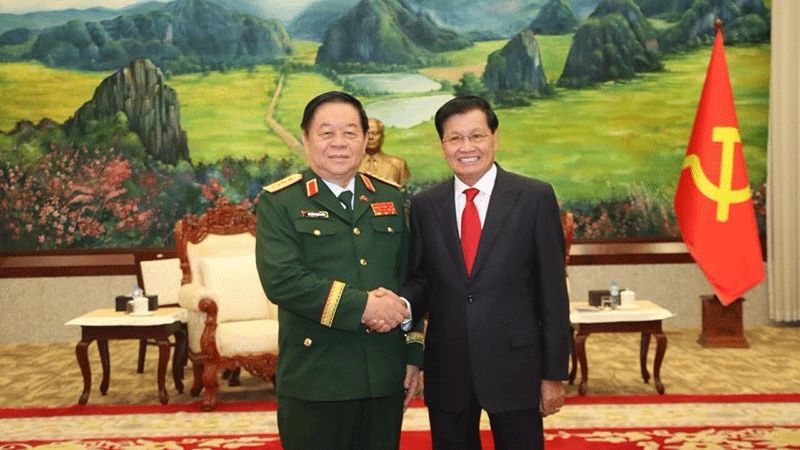
Laos and Vietnam have signalled renewed commitment to their defence relationship through high-level military discussions held this week in Vientiane. During an official visit spanning August 5–7, General Nguyen Trong Nghia, Chairman of the General Department of Politics of the Vietnam People's Army, received formal reception from Lao President Thongloun Sisoulith, who also serves as Secretary General of the Lao People's Revolutionary Party Central Committee. The visit culminated in discussions centred on broadening practical military cooperation and reinforcing the historical ties binding the two Southeast Asian neighbours.
President Thongloun extended a warm welcome to the Vietnamese delegation, underscoring the strategic importance attached to the visit by the Lao leadership. In remarks to General Nguyen Trong Nghia on Thursday, the Lao leader characterised the engagement as a significant milestone in deepening what he termed the great friendship, special solidarity, comprehensive cooperation and strategic cohesion shared between the two nations' political parties, governments, armed forces and populations. This language reflects the depth of integration between Laos and Vietnam at institutional and diplomatic levels, extending far beyond conventional state-to-state relations.
The military talks themselves produced concrete outcomes that both sides deemed successful. Discussions between the General Departments of Politics of the Lao People's Army and the Vietnam People's Army focused on mechanisms for expanding practical cooperation while sustaining the bilateral relationship built over decades of shared history. President Thongloun indicated that these conversations would catalyse further development of defence sector initiatives and strengthen institutional bonds that have become foundational to how Laos and Vietnam conduct their relationship.
General Nguyen Trong Nghia's itinerary included engagements with multiple layers of the Lao defence establishment, reflecting the comprehensive nature of the military relationship. Beyond his meeting with President Thongloun, the Vietnamese general paid a courtesy call on Lao Deputy Prime Minister and Minister of National Defence General Khamlieng Outhakaisone, and held substantive talks with Lieutenant General Vongsone Inpanphim, Deputy Minister of National Defence and Director General of the General Department of Politics of the Lao People's Army. This multi-level engagement structure ensures that defence cooperation receives attention across civilian and military hierarchies.
The specific areas of focus agreed upon during these discussions reveal the breadth of the defence partnership. Both delegations committed to deepening cooperation in political education initiatives, establishing and maintaining military exchanges between personnel, enhancing mechanisms for managing the shared border, and developing training programmes for military officers. The emphasis on political education and generational engagement suggests that Laos and Vietnam view their defence relationship not merely as a contemporary arrangement but as an investment in ensuring younger military and political leaders internalise the historical rationale for close ties.
For Malaysia and the wider Southeast Asian region, the Laos-Vietnam defence partnership carries significant implications. The two countries' relationship has become one of the most institutionalised within ASEAN, characterised by what both nations consistently term a comprehensive strategic partnership. This model of integration contrasts with more transactional defence arrangements common elsewhere in the region, offering a template for how neighbouring states might pursue deeper military cooperation while maintaining ASEAN's principle of non-interference in internal affairs.
Border management cooperation carries particular salience in the Laos-Vietnam context, where the two nations share an extensive frontier. Enhanced coordination on border security addresses mutual concerns about transnational challenges including drug trafficking, arms smuggling, and irregular migration. By institutionalising these arrangements through military channels, Laos and Vietnam are attempting to manage shared security challenges through bilateral mechanisms that complement broader ASEAN frameworks.
The visit underscores Vietnam's strategic interest in maintaining robust relations with its neighbours, particularly given broader regional dynamics. As major powers increase their engagement across Southeast Asia, Vietnam's cultivation of deep partnerships with immediate neighbours like Laos serves to reinforce its own regional standing while ensuring that smaller neighbours do not become overdependent on relationships with external actors. For Laos, deepening defence ties with Vietnam provides reassurance regarding security guarantees from a larger, more powerful neighbour with which it shares significant historical and political connections.
The reference by both General Nguyen Trong Nghia and Vietnamese officials to preserving and promoting the special relationship demonstrates Vietnamese commitment to this partnership despite shifting regional circumstances. General Nguyen Trong Nghia explicitly reiterated Vietnam's pledge to further strengthen the great friendship and special solidarity between the two nations' parties, governments and peoples. Such reaffirmations, while diplomatically standard, carry weight in contexts where bilateral relationships face external pressures or where domestic political transitions might otherwise create uncertainty.
The timing of the visit in early August reflects ongoing efforts by both governments to maintain regular high-level military exchanges that prevent relationships from atrophying through neglect. Regular visits and talks at various hierarchical levels serve as confidence-building mechanisms and forums for addressing emerging issues before they escalate into disputes. For Malaysia, observing how Laos and Vietnam manage their relationship offers insights into regional diplomatic practices and the mechanisms through which smaller states maintain agency despite proximity to larger powers.
Moving forward, the outcomes of these talks will likely translate into tangible initiatives across the agreed-upon cooperation areas. Military training exchanges, enhanced border coordination procedures, and strengthened political education programmes will deepen the operational links between the two armed forces. These practical developments, though less visible to outside observers than high-level diplomatic statements, constitute the substance of bilateral military relationships and shape how security challenges are managed in frontier regions.

