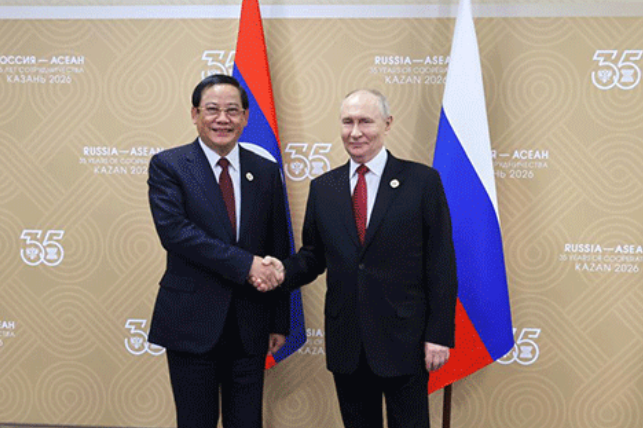
The relationship between Laos and Russia has entered a new phase of substantive cooperation, with Prime Minister Sonexay Siphandone's first official visit to Moscow as head of government producing tangible agreements that extend far beyond diplomatic courtesy. During meetings held alongside the Russia-ASEAN Summit in Kazan from June 14-17, Sonexay and Russian President Vladimir Putin outlined an ambitious agenda for deepening bilateral ties across multiple sectors, framing the partnership as a cornerstone of Laos's foreign policy orientation and Russia's regional engagement strategy.
The centrepiece of the discussions was an intergovernmental agreement on nuclear energy cooperation that will provide the legal framework for constructing a small nuclear power plant utilising Russian technology within Laos. Putin characterised this accord as a significant milestone in bilateral relations, underscoring Russia's role as a potential technological partner for the landlocked Southeast Asian nation's energy infrastructure development. For Laos, which faces mounting energy demands as its economy diversifies beyond hydropower, the arrangement offers access to advanced nuclear capability without the burden of independently developing domestic expertise. This move also positions Russia as a serious infrastructure investor in the region, competing with Chinese and Japanese interests that have traditionally dominated such projects in Southeast Asia.
The diplomatic engagement reflects a broader pattern of Russian engagement with ASEAN members, particularly those historically aligned with Moscow during the Cold War era. Putin explicitly acknowledged Laos's constructive role in facilitating Russia-ASEAN cooperation, noting that 2026 will mark the 35th anniversary of formal relations between Russia and the regional bloc. By highlighting this institutional longevity, the Russian leader sought to distinguish Moscow's involvement from that of more recent geopolitical competitors, emphasising a foundation of sustained engagement rather than transactional interest.
Cultural and historical symbolism permeated the visit, with Putin thanking Lao President Thongloun Sisoulith for his attendance at Russia's Victory Day commemoration in May and for dispatching a Lao People's Army contingent to participate in last year's parade marking the 80th anniversary of Soviet success in World War II. These gestures carry weight beyond ceremonial significance, indicating that Laos continues to accord Russia recognition as a historical ally and a counterweight to Western influence in the region. The symbolic dimension—coupled with the subsequent handover of two elephants from Laos to Kazan Zoo as gifts marking the 65th anniversary of bilateral relations—suggests both capitals are cultivating public narratives of enduring friendship for domestic and international consumption.
Prime Minister Sonexay's meetings with Russian Prime Minister Mikhail Mishustin expanded the agenda to encompass practical cooperation mechanisms. The two premiers identified energy, industry, agriculture, mining, digital economy development, banking infrastructure, transport systems, tourism, and educational exchange as priority domains for expanded collaboration. Notably, the emphasis on human resource development through annual scholarship allocations and training opportunities for Lao officials addresses a longstanding Vientiane priority: building institutional capacity through foreign assistance that does not impose the debt burdens associated with infrastructure loans from other sources.
The construction of the Laos-Russia Friendship School in Vientiane exemplifies the soft power dimension of the relationship. Educational institutions bearing bilateral nomenclature function as permanent reminders of international partnership while simultaneously serving practical purposes. Sonexay specifically thanked Russian authorities and people for their sustained assistance in human capital development, framing education as central to Laos's modernisation trajectory. This emphasis reflects Vientiane's recognition that development gains depend fundamentally on skilled personnel capable of managing complex technologies and systems.
Prime Minister Sonexay's participation in a Laos-Russia business forum during his Kazan visit signals an attempt to commercialise the relationship beyond government-to-government channels. By convening business communities, both sides sought to identify investment opportunities and trade mechanisms that could generate economic returns for private enterprises alongside state objectives. In practice, such forums often produce limited tangible outcomes, but they communicate commitment to economic integration and create space for future commercial engagement.
From a Malaysian and Southeast Asian perspective, the Laos-Russia developments warrant careful observation. They demonstrate that despite Western pressure and sanctions, Russia maintains sufficient diplomatic capacity and economic resources to cultivate regional partnerships based on historical legacy and mutual strategic interest. The nuclear energy agreement particularly signals that Russia views Southeast Asia not merely as a contested geopolitical space but as a market for advanced technology exports that can generate revenue while advancing Moscow's regional influence. For Malaysia and other ASEAN members pursuing diversified foreign policy, the Laos-Russia experience illustrates both opportunities and complexities inherent in balancing relationships with multiple major powers.
The timing of Sonexay's visit—concurrent with the Russia-ASEAN Summit—underscored Laos's dual positioning as both a bilateral partner to Russia and a participating member of the regional bloc. Laos holds significant symbolic importance to ASEAN as the organisation's current chair, making its positioning on Russia-ASEAN relations consequential for collective bloc dynamics. By hosting substantive bilateral engagements while chairing regional mechanisms, Sonexay navigated the delicate balance between demonstrating autonomous foreign policy agency and maintaining ASEAN consensus on international issues.
The comprehensive nature of the cooperation framework—spanning nuclear energy, education, business, and cultural exchange—suggests that both governments envision a sustained relationship not dependent on any single sector. This diversification insulates the partnership from external pressure targeting specific domains and provides multiple channels through which engagement can continue even if particular initiatives face obstacles. For Laos, this multiplicity of cooperation mechanisms reduces dependency on any single partner while demonstrating pragmatic openness to engagement with major powers across the ideological and geopolitical spectrum.
Looking ahead, the significance of these arrangements will depend substantially on implementation capacity and resource availability on both sides. Russia faces considerable economic constraints due to international sanctions, while Laos confronts substantial development challenges that limit absorptive capacity for foreign assistance. Nevertheless, the symbolic and substantive commitments articulated during Sonexay's visit reaffirm that Russia remains an engaged actor in Southeast Asian affairs and that Laos continues to prioritise the relationship forged during the Cold War era. The nuclear energy agreement, in particular, represents a commitment that will bind the two nations through decades of technical cooperation and infrastructure development, ensuring that bilateral ties remain substantive rather than purely rhetorical.