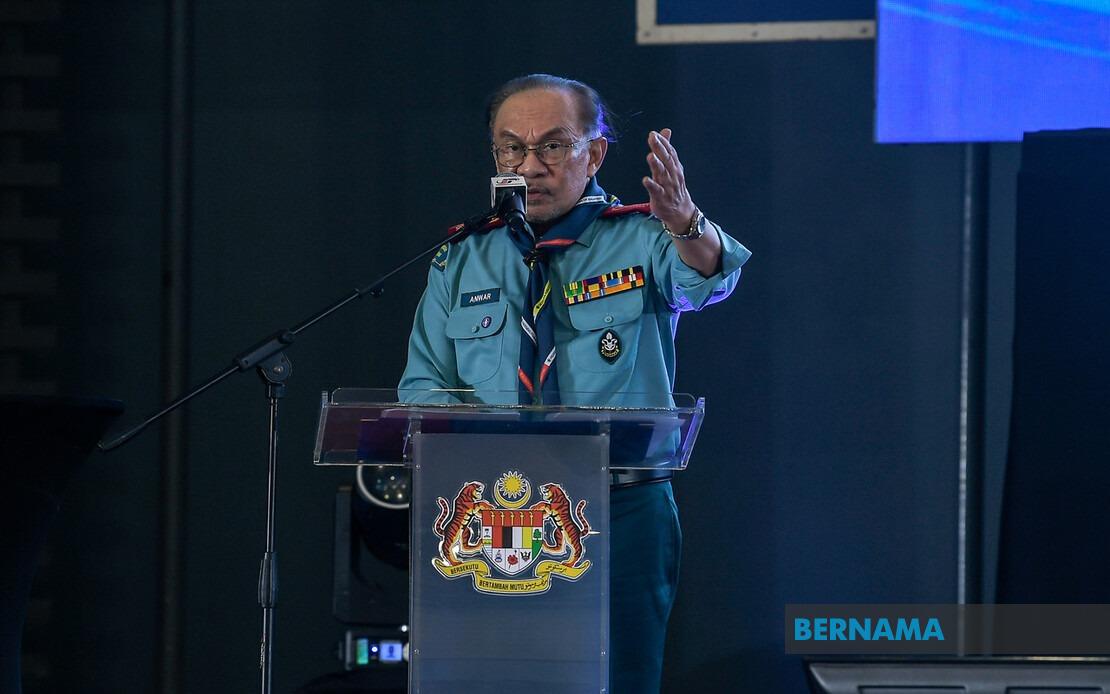
Prime Minister Datuk Seri Anwar Ibrahim has moved to defuse potential tensions over language policy, asserting that the push to strengthen Malay as Malaysia's official language need not come at the expense of proficiency in other tongues. Speaking at the Ambang Merdeka Sahabat MADANI 2026 highlight programme at Universiti Teknologi MARA (UiTM) Permatang Pauh on August 29, Anwar reframed the national language debate in inclusive terms, presenting multilingualism as complementary pillars of national development rather than competing priorities.
The Prime Minister's intervention signals a deliberate attempt to address sensitivities that have periodically surfaced in public discourse around Malaysia's linguistic identity. By emphasizing that all citizens should maintain strong command of Malay regardless of ethnic background, while simultaneously encouraging mastery of regional and global languages, Anwar articulated a vision where language acquisition operates on a both-and rather than either-or framework. This nuanced positioning acknowledges historical anxieties about cultural preservation while avoiding the nationalist rhetoric that can alienate non-Malay-speaking communities and investors.
In particular, Anwar identified English as an indispensable global medium that should enhance rather than displace Malay within the nation's educational and professional ecosystems. He characterized English not as a threat to national linguistic sovereignty but as a practical instrument for participating in international commerce, technology and diplomacy. This stance reflects pragmatic recognition that Malaysia's economic competitiveness depends on citizens who can operate fluently across multiple linguistic registers, a reality that resonates strongly with the country's multinational corporate sector and digital economy ambitions.
The Prime Minister also highlighted Mandarin Chinese as a strategically vital language whose importance has grown substantially given its role as a major commercial medium throughout Southeast Asia and beyond. Rather than framing Mandarin acquisition as culturally divisive or economically threatening, Anwar positioned it as an avenue for Malaysian businesses and professionals to deepen engagement with the region's largest economic powerhouse. This acknowledgment potentially bridges longstanding divides between communities interested in Chinese education and those prioritizing English-medium instruction, by suggesting both serve complementary national interests.
Equally significant was Anwar's inclusion of Tamil within this multilingual framework, recognizing that Indian Malaysians and others continue to value proficiency in their ancestral language. By explicitly mentioning Tamil alongside Mandarin and English, the Prime Minister signalled that language preservation transcends ethnic majority concerns, extending to minority communities seeking to transmit cultural and linguistic heritage to younger generations. This inclusive formulation distinguishes his approach from narrower nationalist agendas that may unconsciously marginalize non-Malay languages.
Crucially, Anwar recast multilingualism as an economic imperative rather than a luxury or cultural indulgence. His framing emphasizes that families and individuals who equip themselves with diverse linguistic competencies expand their employment prospects, entrepreneurial possibilities and access to global knowledge networks. This utilitarian argument carries particular resonance in Malaysia, where parents across different communities routinely weigh educational investments in terms of tangible life outcomes. By positioning language learning as a vehicle for securing personal futures and contributing to national prosperity, Anwar anchored his policy vision to concrete material concerns.
The Prime Minister's remarks also carried an implicit warning against exploiting language issues to inflame intercommunal tensions. He cautioned citizens against sowing discord among different ethnic groups, emphasizing that social cohesion cannot be assumed as permanent but requires active, sustained cultivation. This message appears calibrated to preempt any attempts by political actors to weaponize language policy debates for electoral gain, a pattern that has occasionally surfaced in Malaysian politics. By stressing the fragility of harmony, Anwar implicitly called for responsible political conduct and rhetoric.
An underlying theme in Anwar's intervention concerns inclusive development and equitable distribution of economic opportunities. He advocated for a system wherein all citizens, irrespective of racial or ethnic identity, can benefit from national growth and advancement. This egalitarian framing suggests that language policy should serve as a mechanism for social inclusion rather than demarcation, ensuring that competency in Malay does not create barriers for non-Malay speakers seeking full participation in Malaysian society. The emphasis on shared benefit and mutual caring reflects the MADANI framework's broader commitment to social solidarity.
For Southeast Asian observers, Anwar's position offers a model for managing linguistic diversity within multilingual, multiethnic nation-states. As other regional countries grapple with tensions between promoting national languages and enabling international communication, Malaysia's approach—positioning languages as complementary rather than competitive—provides a potentially replicable template. The speech suggests that mature language policy need not choose between cultural preservation and economic pragmatism, but can pursue both simultaneously through comprehensive, well-designed educational systems.
The timing of these remarks, delivered at a university forum, underscores their relevance to Malaysia's education sector, which faces ongoing pressures to balance Malay-medium instruction with English proficiency and optional mother-tongue education. Universities particularly occupy a crucial position in this ecosystem, as they prepare graduates for both domestic professional contexts and international scholarly and commercial networks. By articulating clear support for multilingual competency at the tertiary level, Anwar signalled that his government's language policies should not constrain institutional autonomy in language instruction.
Moving forward, the practical challenge lies in translating this rhetorical commitment into coherent curriculum design, teacher training, and resource allocation. Malaysian educational planners will need to determine optimal sequences and weightings for Malay, English, Mandarin and Tamil instruction across primary, secondary and tertiary levels. The Prime Minister's framing provides political cover for such decisions, but success ultimately depends on execution by education officials, school administrators and educators working within Malaysia's complex federal-state governance framework and diverse community preferences.

