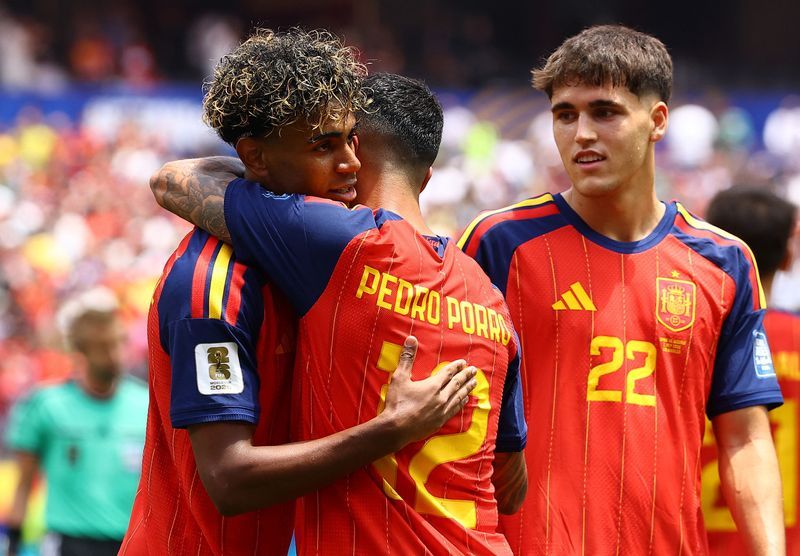
Spain have rediscovered their championship pedigree in the knockout stages of the World Cup, dismantling Austria 3-0 in a performance that underscored just how much the nation's prospects have improved since the return to full fitness of their 18-year-old sensation Lamine Yamal. The Barcelona winger's presence on the pitch has fundamentally altered the trajectory of Luis de la Fuente's squad, transforming them from a team struggling to impose itself into one playing with the verve and control that made them continental champions only months earlier.
Spain's campaign began inauspiciously when they drew goalless with Cape Verde, a result that exposed concerning gaps in their attacking rhythm and intensity. That uninspired performance came with Yamal sidelined by a hamstring injury picked up before the tournament, forcing Fuente to begin the competition without one of his most influential players. The absence of the young talent meant Spain lacked the unpredictable spark on the flanks that has become central to their identity, leaving midfielders Gavi and Ferran Torres to carry the creative burden out wide—a burden they could not adequately shoulder against a well-drilled Cape Verdean defence.
The contrast between that opening fixture and the rout of Austria demonstrates the extent to which Yamal's fitness and sharpness have become intertwined with Spain's collective performance. As the teenager accumulated minutes and regained his rhythm through successive matches, the entire team seemed to elevate its play in synchronisation. This is not merely correlation; opposing defences have found themselves pulled entirely out of shape by Yamal's presence, creating space and opportunity throughout the pitch that teammates have ruthlessly exploited. The player's exceptional ability lies in his capacity to make highly structured, possession-based football appear instinctive and spontaneous, allowing Spain to function both as a cohesive unit and as a vehicle for individual brilliance.
Yamal's centrality to Spain's success became apparent during their Euro 2024 triumph in Germany, where he appeared in every match as La Roja played the most attacking, high-scoring football of any team in the tournament. That campaign established him as a generational talent even at such a tender age, yet his absence through injury in the early stages of this World Cup forced Spain to improvise tactically. The introduction of Alex Baena alongside Yamal on the left wing has proven the crucial adjustment, finally providing the dual attacking threat down both flanks that Fuente's system demands. With Baena stretching the pitch and Yamal operating on the right, Spain suddenly possessed the geometric balance required to unlock even determined defensive opponents.
The manner in which Yamal earned player-of-the-match honours despite neither scoring nor assisting a goal reveals something profound about how Spain are approaching their World Cup challenge. Rather than relying solely on their attacking talents to generate goals—the conventional burden placed on leading forwards in tournament football—Spain are succeeding through the more subtle contributions that Yamal provides: the positioning that forces defenders into impossible decisions, the one-on-one duels won through superior technique, the intelligent drift into midfield that collapses opposing structures. This tactical flexibility allows reinforcements like Rodri and Pedri to orchestrate play with the tempo and precision for which Spanish football has become internationally renowned.
Defensively, Spain's performance against Austria reached defensive standards rarely seen in knockout-stage World Cup football. Austria failed to register a single shot on target, an achievement unmatched by any team in World Cup knockout matches since Germany's shutout against Argentina in the 2014 final. This comprehensive dominance reflects not only superior attacking prowess but also disciplined, organised defending across the entire pitch. The full-back pairing of Marc Cucurella and Pedro Porro functioned almost as additional attacking midfielders, stretching Austrian formations vertically and horizontally while maintaining sufficient positional awareness to snuff out counterattacking threats.
Spain's defensive record extends well beyond this single encounter. The team has surrendered no World Cup goal since their defeat by Japan in 2022, a statistic that places them among the tournament's most resilient defences. Combined with their current 34-match unbeaten run, Spain have constructed a foundation of stability that transforms them into genuine contenders for the trophy. The psychological advantage of operating without conceding goals whilst generating copious attacking opportunities cannot be underestimated; it allows a team to play with greater attacking ambition, knowing that defensive lapses are not being punished.
Rodri's increasingly influential performance as the match progressed particularly merits attention. The Manchester City midfielder struggled to impose himself early on, yet as Spain adjusted their positioning and Yamal's penetrative running created more central space, Rodri blossomed into the controlling presence his side requires. His ability to recycle possession, distribute accurately over varied distances, and transition swiftly from defence to attack represents precisely the kind of multifaceted excellence that marks Spain's approach to the modern game.
Mikel Oyarzabal's decisive contribution to goals underscores a broader strength: Spain possess multiple attacking options capable of capitalising on the opportunities their system creates. Rather than depending entirely on Yamal or any single player to manufacture victory, La Roja can distribute attacking responsibility across numerous personnel. This depth ensures that opponents cannot simply mark one player out of the game; they must respect the collective threat posed by an entire framework designed to break down defensive structure.
For Malaysian and Southeast Asian observers of tournament football, Spain's resurgence offers instructive lessons about the relationship between individual excellence and tactical coherence. Yamal's brilliance does not operate in isolation from Spain's midfield control; rather, it exists in constant dialogue with it, each element reinforcing the other. As Spain progress deeper into the competition, their capacity to sustain this balance—maintaining the possession-based control that has defined European football's aesthetic whilst accommodating moments of individual inspiration—will prove decisive.

