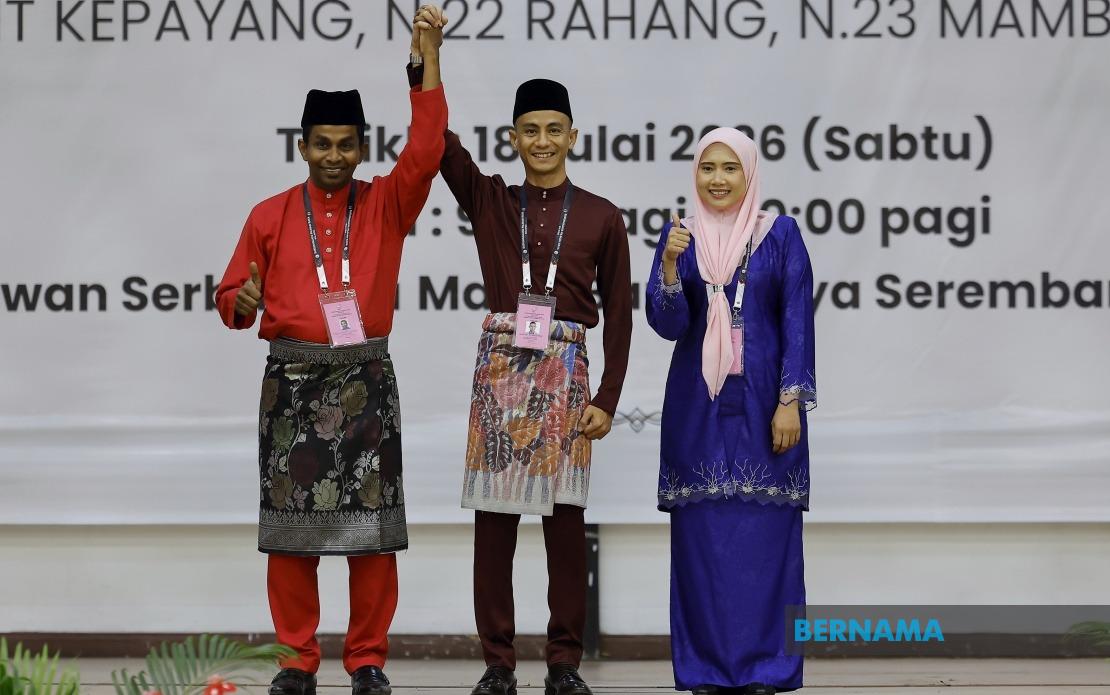
Pakatan Harapan's nominated contender for the Labu state assembly seat in the forthcoming Negeri Sembilan election, Datuk Ahmad Faez Abdul Razak from PKR, has centred his campaign on managing the constituency's rapid expansion while safeguarding community interests. Speaking after nomination proceedings in Seremban on July 18, the property developer acknowledged a mixture of anticipation and apprehension as he embarks on his inaugural electoral campaign, yet expressed confidence in reclaiming what PH views as a winnable seat.
Ahmad Faez's electoral strategy rests substantially on the groundwork undertaken across Labu over nearly three years, during which he claims to have built sufficient community rapport to secure voter backing. The candidate's premise appears rooted in the observation that public sentiment has progressively shifted in PH's favour, a development he credits partly to aligned governance initiatives between the Negeri Sembilan administration and the federal administration. This alignment narrative is significant for Malaysian readers, as it reflects the broader consolidation of PH's political positioning across state and national levels—a key dynamic in contemporary Malaysian politics where federal-state coordination can substantially influence electoral prospects.
The Labu constituency presents a distinctive electoral challenge shaped by its geographic positioning within the broader Malaysia Vision Valley development corridor. This vast industrial and residential development zone, spanning approximately 11,000 to 12,000 hectares, projects substantial economic transformation for the region through manufacturing and residential expansion. Ahmad Faez's professional credentials as a property developer position him to articulate a nuanced understanding of such megaprojects, potentially resonating with voters concerned about balancing prosperity with livelihood preservation. His campaign pledge centres on translating sectoral expertise into governance that simultaneously facilitates development while preventing the marginalisation of established community structures.
A cornerstone of Ahmad Faez's platform involves establishing dedicated youth infrastructure—specifically a community centre and recreational facility—which he identifies as conspicuously absent from current provision in Labu. This focus addresses a demographic concern often overlooked in infrastructure discourse: the social and recreational needs of younger residents in rapidly urbanising constituencies. For Malaysian observers, this reflects evolving electoral attention to quality-of-life considerations beyond employment generation, particularly as constituencies like Labu experience accelerated demographic shifts accompanying industrial growth.
The electoral contest itself carries considerable implications for PH's standing in Negeri Sembilan. In the 2023 state election, the incumbent Bersatu member Mohamad Hanifah Abu Baker prevailed with a 1,640-vote margin against PH-PKR's Datuk Ismail Ahmad, who garnered 10,021 votes. The slenderness of this majority suggests the seat remains competitive, though Ahmad Faez must overcome both the incumbent and BN's nominated challenger, Siti Nur Umaira Hasim, in a three-cornered contest. Notably, the 2023 outcome reflected broader Negeri Sembilan dynamics where Bersatu maintained relevance despite national political realignments, complicating PH's recapture efforts.
The electoral mathematics favour neither incumbent nor challenger decisively. The Labu constituency comprises 32,884 registered voters according to the Election Commission's rolls updated to May 31, 2026, with virtually all constituting ordinary voters except for fifteen police personnel and relatives. This relatively stable voter base lacks the turnover that might dramatically alter electoral dynamics, suggesting the contest will likely be determined by persuasion and engagement rather than demographic flux. For Malaysian election observers, such constituencies represent core battlegrounds where campaign intensity and candidate visibility prove decisive.
Ahmad Faez's emphasis on development stewardship resonates within a broader Southeast Asian context where rapid industrialisation frequently generates social tensions between growth proponents and preservation advocates. His positioning as someone capable of navigating this tension through professional experience addresses a governance challenge increasingly evident across Malaysian urban constituencies. The Malaysia Vision Valley corridor, while economically promising, requires careful management to ensure resident welfare keeps pace with industrial expansion—a managerial imperative Ahmad Faez repeatedly stresses.
The candidate's acknowledgment of electoral nerves despite prior community engagement reflects authentic campaigning realities. Contesting for the first time introduces variables—voter turnout patterns, last-minute messaging dynamics, opponent strategies—that even extensive grassroots work cannot fully predict. This vulnerability, however, may paradoxically enhance his appeal to constituencies seeking candidates perceived as earnest rather than politically jaded. For Malaysian voters evaluating candidates, such candour can counter perceptions of insincerity that plague electoral discourse.
Timing significantly influences this election's trajectory. The early voting scheduled for July 28 and polling day on August 1 afford limited campaign windows for messaging penetration. Ahmad Faez's existing two-year-plus constituency presence provides marginal advantage in compressed timelines, as his name recognition may exceed that of opponents less embedded in Labu's social fabric. This temporal constraint underscores why pre-election groundwork often outweighs final-stage momentum building in Malaysian state contests.
For PH's broader ambitions in Negeri Sembilan, recovering Labu represents strategic importance beyond singular seat mathematics. Demonstrating capacity to recapture seats lost in 2023 reinforces narrative momentum as the coalition approaches potential federal electoral contests. Conversely, Ahmad Faez's defeat would provide Bersatu with evidence of continued voter faith despite political volatility, while strengthening BN's multi-cornered contest competitiveness. These state-level reverberations should concern observers monitoring PH's institutional recovery following recent electoral setbacks.
Ahmad Faez's campaign ultimately encapsulates contemporary Malaysian electoral preoccupations: reconciling rapid economic transformation with community stability, leveraging professional credentials in political campaigns, and securing voter confidence through engagement authenticity. Whether his balanced-development message persuades sufficient Labu residents will reveal itself on August 1, with implications extending well beyond a single constituency.

