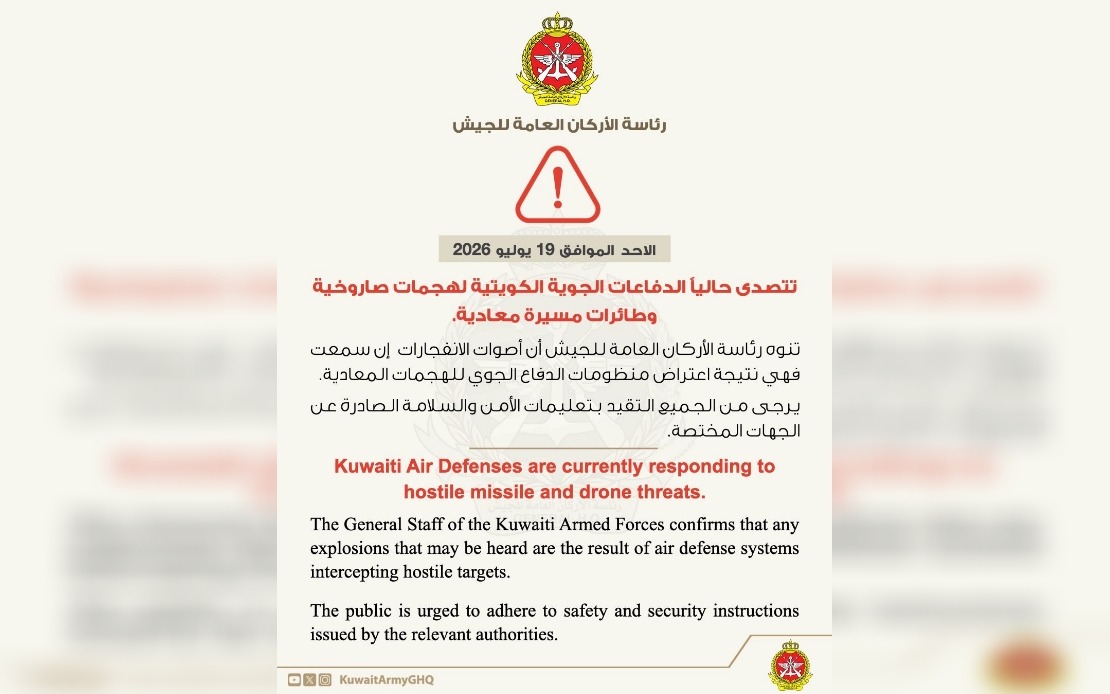
Kuwait's military establishment confirmed on Sunday that the country's defence forces were engaged in active defensive operations against incoming hostile weaponry, including both ballistic missiles and unmanned aerial systems. The Kuwaiti army made the announcement through its official social media channels, stating that personnel and residents should expect to hear explosions in the coming hours as its air defence infrastructure worked to neutralise threats in airspace above the country. Residents were simultaneously advised to remain vigilant and adhere strictly to all security directives issued by state authorities.
The disclosure comes amid a dangerous cycle of military escalation that has gripped the broader Persian Gulf region over the past week. The underlying conflict pits the United States against Iran, with both nations conducting successive strikes on targets they claim are militarily significant. Iran has sought to broaden the geographic scope of its retaliation by targeting what it describes as American military infrastructure across multiple regional countries, creating a ripple effect that has drawn neighbouring states into the conflict's dangerous orbit. Kuwait, which hosts numerous American military personnel and installations, has become collateral terrain in this tense standoff.
The timing and scope of these developments underscore how quickly regional security situations can deteriorate. What began as tit-for-tat strikes between Washington and Tehran has evolved into a more complex web of military operations spanning several countries. For Malaysian policymakers and observers monitoring the region, the situation illustrates the vulnerability of smaller nations caught between competing great power interests. The Gulf remains a critical shipping corridor for Southeast Asian trade, particularly for energy supplies flowing to countries throughout the region.
Despite formal diplomatic efforts to contain the conflict, the escalation continues unabated. In June, Pakistan's government facilitated negotiations that produced a memorandum of understanding explicitly designed to halt the military exchanges and establish a pathway toward sustainable peace between Washington and Tehran. That agreement has demonstrably failed to arrest the cycle of violence, suggesting that underlying grievances and strategic calculations run far deeper than any single diplomatic initiative can address. Both sides appear committed to maintaining military pressure while publicly maintaining that they remain open to resolution.
The implications for regional stability are profound and multifaceted. For countries like Malaysia with significant economic interests in the Middle East, including energy investments and substantial expatriate communities, the escalating military situation poses genuine risks. Any further widening of the conflict could disrupt global energy markets and create humanitarian crises that would ripple across Asia. The presence of American military bases across the Gulf region means that any Iranian retaliation strategy inherently involves states that host these installations, transforming them into inadvertent participants in great power competition.
Kuwait's position is particularly precarious given its geographic proximity to Iran and its substantial hosting of Western military assets. The country has historically attempted to balance between its security relationships with Western powers and its need to maintain workable relations with its powerful neighbour. The current crisis tests that delicate equilibrium, forcing Kuwait to openly acknowledge military defence operations while attempting to reassure its population and international partners of the situation's manageability.
The reliance on air defence systems to intercept incoming threats represents a significant dependency on advanced military technology. Kuwait, like many smaller Gulf states, must import sophisticated defence capabilities rather than manufacture them domestically. This technological dependence shapes strategic calculations, as countries must maintain relationships with suppliers while navigating the geopolitical consequences of those partnerships. For Southeast Asian nations similarly dependent on military technology imports, Kuwait's experience offers instructive lessons about the constraints imposed by such dependencies during periods of heightened regional tension.
The broader context reveals how regional security architecture in the Middle East remains fragile and incomplete. Unlike Northeast Asia, where multilateral security dialogues and institutionalised mechanisms exist to manage great power competition, the Gulf region lacks comparable frameworks for managing crisis communication and preventing escalation spirals. The absence of established protocols for managing military incidents, deconflicting operations, and de-escalating tensions creates environments where miscalculation becomes increasingly probable as military operations intensify.
For Southeast Asia and ASEAN, which has long advocated for dialogue-based approaches to regional security challenges, the Middle Eastern situation underscores the costs of allowing military tensions to spiral without institutional safeguards. The failure of the Pakistan-brokered agreement suggests that bilateral diplomatic channels, however well-intentioned, prove insufficient when fundamental strategic interests collide. This reinforces arguments for the development of more robust multilateral mechanisms capable of imposing circuit-breakers on escalation cycles before they spiral beyond control.
Looking forward, the trajectory of these developments will likely shape not only Gulf security dynamics but also broader international stability and economic conditions that affect Asia-Pacific prosperity. Should the conflict expand geographically or intensify militarily, the consequences for global energy supplies, shipping security, and economic growth would be immediately felt throughout Southeast Asia. Malaysian stakeholders, whether in government, business, or civil society, would be wise to monitor developments closely while advocating through appropriate diplomatic channels for restraint and renewed commitment to negotiated solutions.

