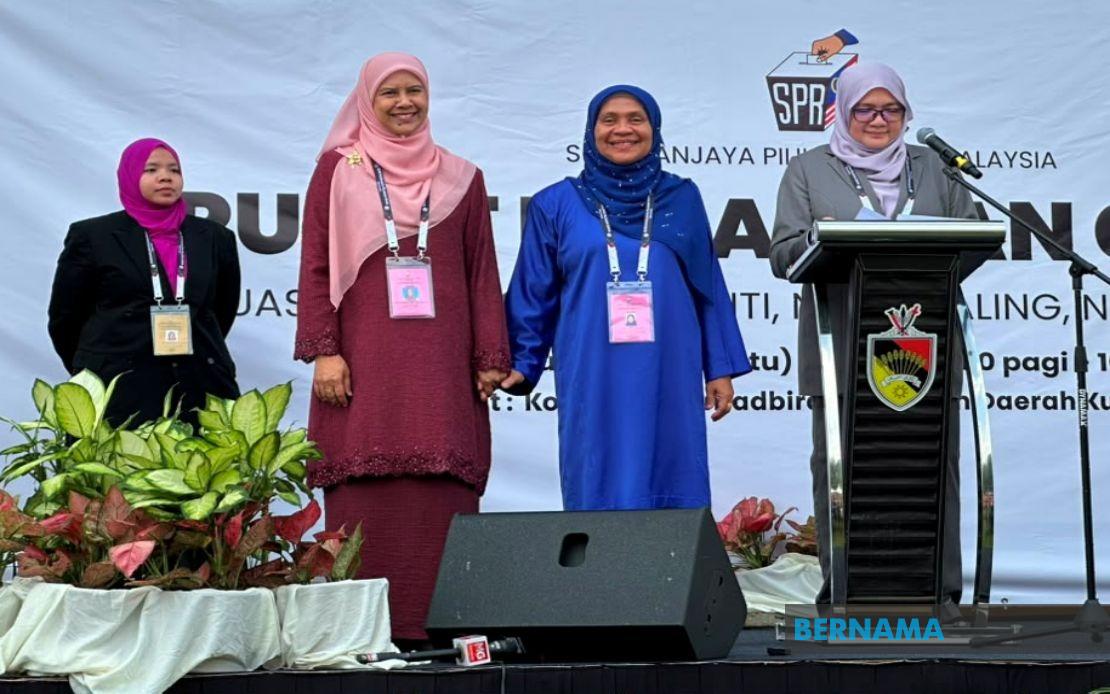
The Negeri Sembilan state election will deliver a rare political spectacle in the Kuala Pilah constituency, where two female candidates will compete directly for the seat in a straight fight that underscores the growing prominence of women in Malaysia's electoral arena. Incumbent Datuk Noorzunita Begum Mohd Ibrahim, representing the Pakatan Harapan coalition, will square off against Barisan Nasional's S. Leza Md Yasin following the completion of nominations at the District and Land Office here. Returning officer Nawal Mohammed Amin confirmed the contest structure after the nomination process concluded on July 18, with Noorzunita Begum filing her papers at 9:03 am and S. Leza following at 9:09 am.
The Pilah contest reflects a broader pattern emerging across the Negeri Sembilan state assembly, where competition will take diverse structural forms across the five seats up for contention. While Kuala Pilah presents a binary choice between two opposing alliances, the remaining constituencies will feature more complex electoral dynamics that could amplify voter choice and complicate campaign strategies. Across the state, the competition reflects the current fragmentation in Malaysian politics, with established coalitions and splinter parties all vying for representation in what observers view as a critical test of voter sentiment in one of Malaysia's smaller states.
Juasseh will emerge as a genuine three-way battleground, pitting Pakatan Harapan's Mohd Aidil Abdullah against the incumbent Datuk Ismail Lasim of Barisan Nasional and Bersatu's Mohd Zuhami Md Yusof. This configuration mirrors similar contests seen in other recent state elections, where the Bumiputera Empowerment Party has carved out electoral space by positioning itself as an alternative to the two traditional superpowers. The presence of multiple candidates potentially fragments the vote and creates opportunities for unexpected outcomes, particularly if either incumbent party faces a divided opposition or if Bersatu can consolidate support among specific demographic groups.
The Seri Menanti seat will witness comparable complexity, with Pakatan Harapan's Mohd Kamarul Arifin Mohd Wafa challenging the incumbent Muhammad Sufian Maradzi of Barisan Nasional while Bersatu's Datuk Seri Megat D. Shahriman Zaharuddin contests from the third corner. Megat D. Shahriman's entry into the race adds an additional layer, as his status as a senior party figure suggests Bersatu views this seat as strategically significant and worth committing high-profile candidates. The outcome in Seri Menanti could provide crucial signals about whether Bersatu's electoral medicine continues to work in Negeri Sembilan or whether the party faces headwinds in retaining relevance outside its stronger bases.
Senaling similarly will feature a three-cornered affair involving Mohd Hanis Mohd Alimin of Pakatan Harapan, Mohamad Qayyum Abd Jalil representing Barisan Nasional, and Bersatu's Mohd Izzafi Khan. The consistent appearance of Bersatu candidates across multiple constituencies suggests a coordinated effort by the party to establish itself as a meaningful force in the state legislature, though success remains contingent on translating organisational effort into voter support. Each of these three-way contests carries implications for understanding how Malaysian voters will navigate the increasingly crowded political marketplace.
In contrast, the Johol seat will revert to the traditional binary format, with Pakatan Harapan's Mohd Zailan Mohd Munawar confronting the incumbent Datuk Saiful Yazan Sulaiman of Barisan Nasional in a straight fight. The absence of a third candidate in Johol may suggest either lower confidence among Bersatu strategists regarding their prospects or a deliberate calculation to avoid splitting votes in constituencies where their chances appear limited. Such seat-by-seat variations in candidate fielding demonstrate the sophisticated targeting that major parties now employ in state elections.
The high-profile presence of federal ministers accompanying candidates during the nomination process underscored the national significance attached to this state election. Pakatan Harapan deployed Education Minister and PKR Wanita chief Fadhlina Sidek to oversee the submission of nomination papers, accompanied by Youth and Sports Minister Dr Mohammed Taufiq Johari and Deputy Investment, Trade and Industry Minister Sim Tze Tzin. This ministerial involvement reflects both the coalition's desire to maintain momentum and its recognition that state elections serve as important barometers of federal-level political health.
Barisan Nasional similarly mobilised federal-level figures for the occasion, with Deputy Home Minister Datuk Seri Dr Shamsul Anuar Nasarah and Perak Menteri Besar Datuk Seri Saarani Mohamad shepherding the coalition's candidates through the nomination process. The deployment of the Perak Menteri Besar demonstrates the interconnectedness of state politics in the northern region of the peninsula, where leadership often pivots between several states to maintain cohesion across multiple administrations. Such coordination speaks to the operational sophistication of Malaysia's major coalitions, even as their electoral fortunes fluctuate.
The electoral calendar established by the Election Commission provides voters with an unusually compressed timeline for campaign activity. Early voting has been scheduled for July 28, while polling day itself falls on August 1, meaning the entire campaign period spans roughly two weeks from the close of nominations. This compressed timeframe intensifies the pressure on candidates to build name recognition and mount effective messaging campaigns, favoring well-resourced campaigns with established machinery and forcing less-organised challengers to maximise limited opportunities for public engagement.
The Negeri Sembilan state election serves as a significant data point for understanding electoral dynamics in Malaysia's smaller states, where individual candidate quality often matters more than in larger constituencies with more abundant resources and established power structures. The presence of two women competing directly for Kuala Pilah represents progress in female political representation, though observers will likely scrutinise whether such contests translate into meaningful increases in women holding elected office across the state assembly. The composition of the new legislature may influence resource allocation and policy priorities across Negeri Sembilan for the coming legislative term.

