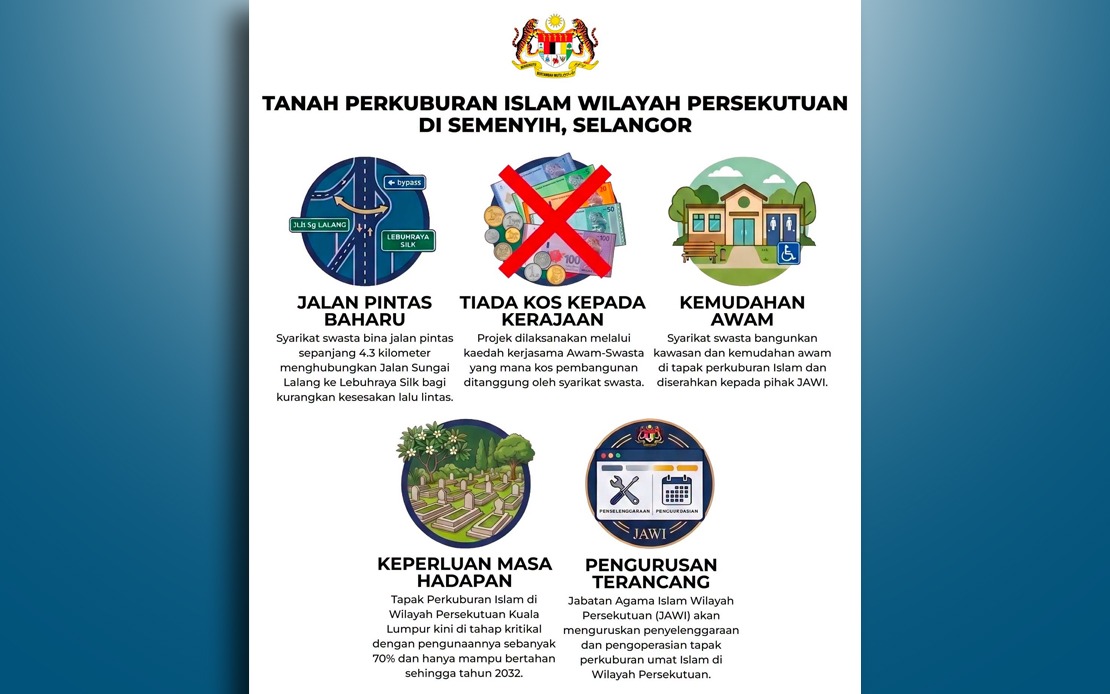
The Malaysian government has moved to clarify the scope and timeline of the Federal Territory Muslim Cemetery Development Project in Hulu Semenyih, Selangor, following widespread social media confusion about the initiative. Minister in the Prime Minister's Department (Federal Territories) Hannah Yeoh released a statement on July 8 emphasizing that this development has its roots in planning undertaken since 2005, driven by a genuine and pressing need to secure adequate burial space for Kuala Lumpur's Muslim population. The clarification underscores how long-term infrastructure challenges sometimes require extended gestation periods before implementation becomes feasible.
The cemetery shortage facing Kuala Lumpur has reached critical proportions. Data presented by the minister reveals that existing Islamic burial grounds in the Federal Territory have surpassed 70 per cent occupancy, with only around 29 per cent of capacity—equivalent to 34,496 plots—still available. At current rates of utilization, these remaining spaces will be exhausted by approximately 2032, creating a genuine emergency for funeral arrangements and family planning in the Muslim community. This gap between demand and supply explains why the government has prioritized the Hulu Semenyih project despite the logistical complexities involved.
The development will span 332.6 acres of land owned by the Federal Lands Commissioner and will ultimately provide 104,470 Muslim burial plots dedicated to residents of the Federal Territory of Kuala Lumpur. However, the project extends beyond purely addressing the city's internal needs. Hannah Yeoh emphasized that 10 per cent of the cemetery's total capacity has been allocated for residents of surrounding areas in Selangor, demonstrating a regional approach to what is fundamentally a metropolitan-scale infrastructure problem. This allocation reflects the reality that burial practices often transcend administrative boundaries, with families dispersed across the Klang Valley and neighbouring districts.
The implementation structure relies on a public-private partnership model, which has become increasingly common for large infrastructure projects in Malaysia. Under this arrangement, a private developer will shoulder the entire cost of building the necessary facilities and infrastructure, including staff quarters, a prayer facility (surau), administrative offices, cafeteria, toilet blocks, a guardhouse, and the earthworks required to develop the cemetery site. Notably, the developer bears these costs as a condition of the development agreement, rather than as a government expenditure. This approach allows the public sector to meet critical infrastructure needs without immediately burdening the federal budget.
A crucial safeguard in the project structure is that ownership of the land will remain with the Federal Lands Commissioner, preserving public control over what is ultimately a sensitive community asset. Furthermore, the Federal Territories Islamic Religious Department (JAWI) will retain exclusive responsibility for the management, administration, and day-to-day operations of the cemetery. This arrangement ensures that Islamic religious affairs remain under the authority of the appropriate government agency rather than being delegated to a commercial entity. Such clarity in governance prevents potential conflicts of interest and ensures that religious protocols are properly observed.
A complementary infrastructure component involves the construction of a link road connecting Jalan Sungai Lalang to the SILK Highway, stretching 4.3 kilometres. This road development carries a total cost of RM93.89 million and is intended to alleviate traffic congestion in the Semenyih area while providing residents with a smoother alternative route. Importantly, this road infrastructure cost will also be borne entirely by the private developer as a condition imposed by the Selangor state government, rather than being funded by either federal or state treasuries. The integration of transportation planning with the cemetery project demonstrates coordination between multiple layers of government and consideration of broader regional impacts.
The project has undergone rigorous evaluation before reaching this stage. Hannah Yeoh emphasized that the development has passed technical assessments and been subjected to a Value Management Lab evaluation, which are standard processes for major infrastructure projects. Both the Selangor state government and the Federal Government have provided formal approval, indicating that the project meets regulatory standards and planning requirements at both state and national levels. This multi-stage vetting process provides assurance that decisions have not been made hastily or without proper scrutiny.
For Malaysian readers, particularly those in the Klang Valley and surrounding regions, this project addresses a fundamental demographic reality: populations grow, and infrastructure must adapt accordingly. The Muslim community in Kuala Lumpur and Selangor faces a concrete problem that cannot be ignored or deferred indefinitely. The government's response, while not without complexity, demonstrates an attempt to balance fiscal responsibility with genuine public need. The public-private partnership model also reflects broader trends in how Southeast Asian governments address infrastructure gaps in an era of constrained public finances.
The timing of the clarification, coming after social media confusion, suggests that communication around major projects remains a challenge for Malaysian authorities. Future government initiatives might benefit from more proactive public engagement and clearer explanations of the rationale, timeline, and structure of large developments. Transparency about long-term planning horizons—such as the fact that cemetery planning has extended across nearly two decades—can help communities understand that infrastructure challenges often require patient, methodical approaches rather than hasty reactions.
The Hulu Semenyih cemetery project ultimately reflects how Malaysia's rapid urbanization has created infrastructure demands that transcend traditional administrative categories. With Kuala Lumpur's population projected to continue growing and diverse communities requiring appropriate facilities, similar multi-stakeholder partnerships may become increasingly necessary. For families making long-term decisions about burial arrangements or property investment in the region, the news that adequate cemetery capacity will be secured beyond 2032 provides important reassurance about the government's commitment to serving all communities.

