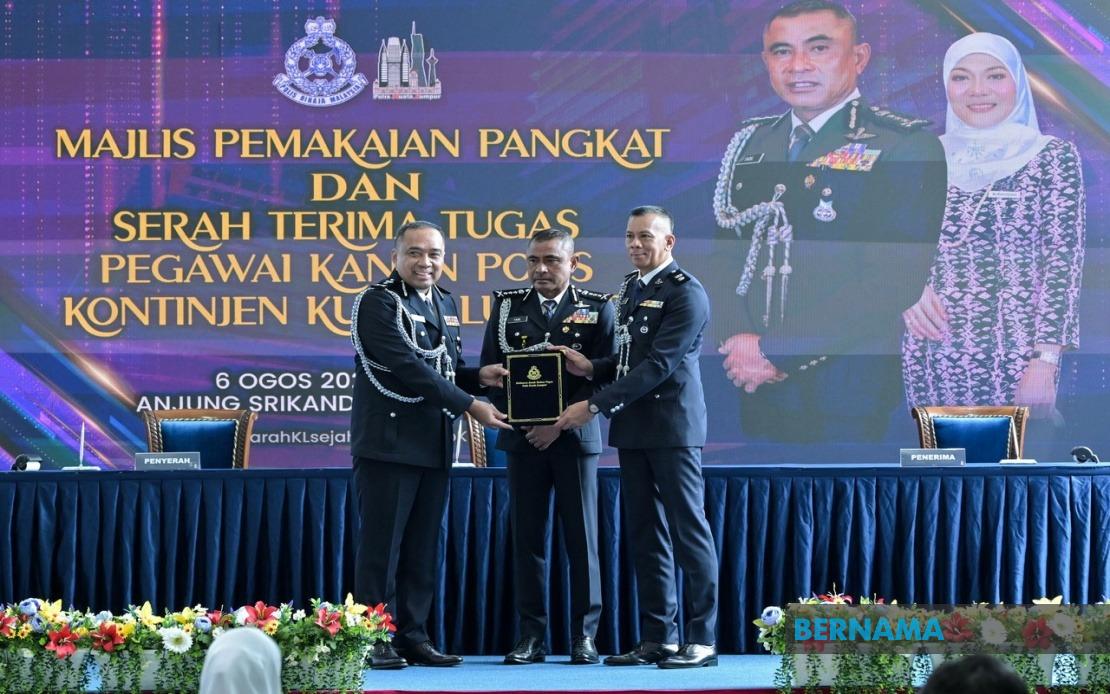
The Royal Malaysia Police (PDRM) has initiated significant changes in its Kuala Lumpur contingent, with Kuala Lumpur police chief Datuk Fadil Marsus presiding over a formal handover ceremony on August 6 involving six senior postings at the Kuala Lumpur police contingent headquarters. The moves span critical operational units including criminal investigation, narcotics enforcement, and district policing, signalling a structured approach to leadership renewal within the force's most visible command structure.
The restructuring touched multiple levels of the police hierarchy and reflects the force's commitment to systematic talent rotation. Senior Assistant Commissioner Zulkarnain Samsudin relinquished his position as head of the Criminal Investigation Department (CID) to Senior Assistant Commissioner Sazlee Adam, marking a transition in an office responsible for managing major crime operations across the federal territory. Concurrently, Senior Assistant Commissioner Haslah Bachok stepped down as head of the Narcotics Crime Investigation Department (NCID), with Assistant Commissioner Kee Hang Kee assuming control of an agency tasked with combating drug trafficking and abuse across the capital.
At the district level, Superintendent Nuzulan Mohd Din took charge of the Dang Wangi district police office, a jurisdiction covering central Kuala Lumpur's commercial and administrative core, succeeding Senior Assistant Commissioner Sazlee Adam in that role. Separately, Superintendent Jasni Zolpa moved into the Sentul district police chief position, replacing Senior Assistant Commissioner Basri Sagoni. These appointments carry particular weight given that district-level policing remains the direct interface between the force and residents, making the appointment of capable officers crucial to community safety perception and crime management at the grassroots.
The ceremony also included transitions in specialist support functions critical to investigative operations. Senior Assistant Commissioner Kamaruzaman Md Alib handed over his duties as Special Branch deputy chief responsible for intelligence and operations to Assistant Commissioner Saefuddin @ Mohd Fitri Abdul Rahman. Additionally, Senior Assistant Commissioner Zulkarnain Samsudin transferred from his position as CID deputy chief (Intelligence/Operations) to Superintendent Ong Seng Keong, ensuring continuity in sensitive intelligence coordination that underpins criminal investigations. Kuala Lumpur deputy police chief Datuk Mohd Azani Omar attended the proceedings, affirming the significance of the occasion within the capital's police establishment.
In remarks delivered at the ceremony, Fadil characterised the appointments and promotions as more than routine administrative matters, framing them instead as recognition of professional achievement coupled with enhanced responsibility. He underscored that the process of advancing officers carried implications extending beyond individual recognition—it represented an institutional commitment to upholding standards of integrity, professionalism, and sincere public service. This framing suggests the police leadership views appointments as opportunity moments to reinforce organisational values across the rank structure.
Fadil further contextualised the leadership transitions within a broader organisational philosophy centred on institutional continuity and progressive development. The succession of new faces in key positions, he argued, embodied more than mere procedural rotation; rather, it enabled the force to introduce fresh perspectives, accumulated experiences from officers' prior postings, and innovative operational methodologies. Critically, Fadil emphasised that these structural changes were designed and managed to ensure no degradation in service delivery to the public—a reassurance that acknowledges civilian concerns about operational disruption during leadership transitions.
The Kuala Lumpur police chief's remarks also reflected awareness of the metropolitan and security environment in which the force operates. He referenced the increasingly sophisticated nature of criminal activity and security challenges facing the capital, implicitly justifying the investment in leadership renewal as essential to organisational adaptation. This framing resonates with Malaysian public discourse around rising crime concerns and the perceived need for police modernisation and effectiveness.
Fadil issued a specific call to all personnel within the Kuala Lumpur contingent to intensify their commitment across multiple operational fronts. His agenda encompassed traditional police priorities—crime suppression, drug abuse prevention, and investigation quality—alongside emerging emphasis on enhancing operational readiness in response to complex threats. Notably, he elevated community relations to explicit strategic importance, identifying stronger ties with residents as integral to the force's mission architecture. This reflects a shift in Malaysian policing rhetoric toward community-oriented approaches, moving beyond reactive law enforcement toward preventive partnership models.
The reshuffle occurs against the backdrop of broader scrutiny of Malaysian police performance in addressing persistent public concerns around crime prevalence, investigation efficiency, and officer conduct. Leadership transitions in Kuala Lumpur, as the nation's capital and commercial hub, carry symbolic significance beyond operational impact, influencing public perception of institutional competence and reform momentum. The deliberate ceremonial nature of the handover—with formal attendance by deputy leadership and structured speeches—suggests the police department views the event as opportunity for messaging about organisational renewal and professional standards.
For the Malaysian public and business community operating in the capital, these leadership changes carry practical implications. District-level transitions particularly affect residents' direct experience of police visibility, responsiveness to complaints, and crime prevention effectiveness. Narcotics enforcement changes may influence drug-related crime trends in specific precincts, whilst CID leadership transitions influence investigation rates and case closure performance—metrics that matter substantially to victims and to crime perceptions in urban constituencies.
The appointments also reflect the police force's internal management of talent progression. The movement of officers across different specialisms—from CID to district postings, for instance—suggests a developmental approach wherein officers broaden experience across operational domains, building versatility and comprehensive understanding of police work before assuming higher posts. This internal mobility, if sustained systematically, potentially strengthens institutional culture and prevents dangerous siloed thinking within specialist units.
Stabilising institutional operations whilst introducing new leadership constitutes the central challenge the Kuala Lumpur contingent now faces. The six transitions occur simultaneously rather than sequentially, concentrating change whilst theoretically leveraging collective institutional memory from retained senior personnel. Success will depend upon whether incoming officers receive adequate orientation, whether outgoing officers provide thorough briefings, and whether the force maintains oversight during the adjustment period. For Malaysian observers, monitoring the subsequent crime statistics, investigation efficiency metrics, and community feedback around police responsiveness will provide practical evidence of whether leadership renewal translates into improved policing outcomes.

