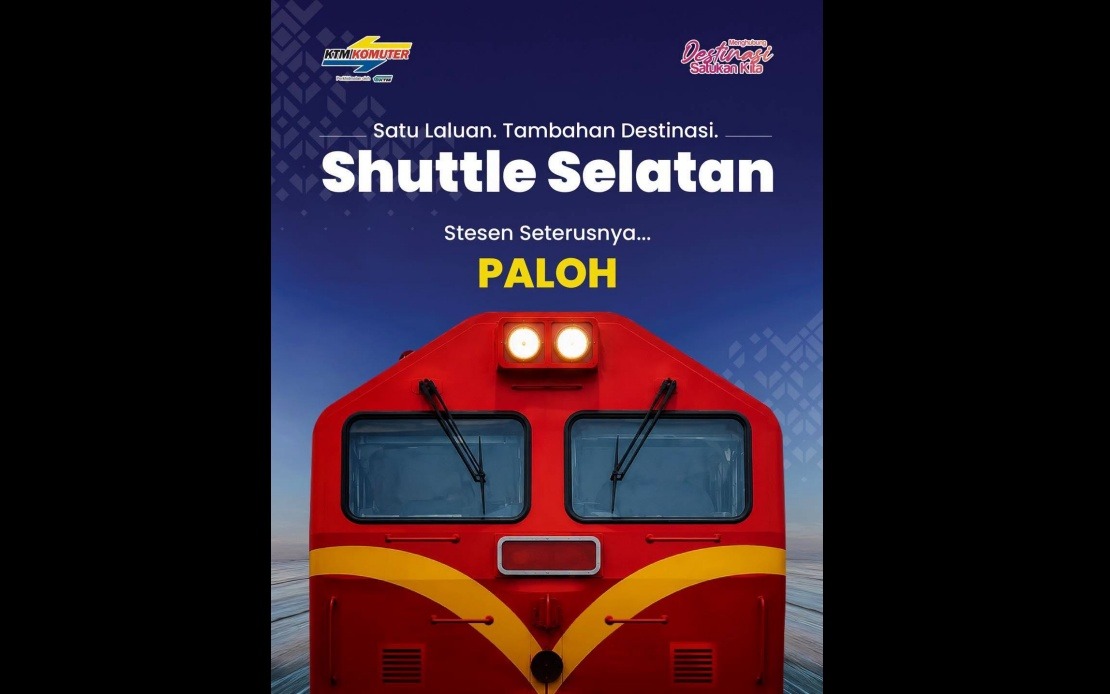
Keretapi Tanah Melayu Berhad (KTMB) is rolling out an extended Southern Shuttle rail service beginning August 8, marking a significant expansion of the operator's regional connectivity just under three months after the initial phase launched. The new service will span seven stations across central Johor, linking Paloh with JB Sentral via Kluang, Renggam, Layang-Layang, Kulai, and Kempas Baru, with the full journey taking approximately two hours. This represents a strategic push by the Transport Ministry to deepen rail penetration into suburban communities while strengthening connections to major economic centres along the peninsula's southern corridor.
The infrastructure underpinning this expansion draws from the Gemas-Johor Bahru Electrified Double-Track Project (PLBEGJB), illustrating how Malaysia's government is leveraging existing rail infrastructure investments to maximise public utility. Rather than developing entirely new tracks, KTMB is intelligently repositioning portions of this broader electrification initiative to serve commuter populations previously underserved by modern rail transport. This approach reflects pragmatic resource allocation at a time when transport authorities across Southeast Asia face mounting pressure to upgrade ageing rail networks whilst managing budgetary constraints.
Operational frequency will reach ten daily trips in each direction, with each train carrying up to 400 passengers. The schedule is carefully calibrated around commuter rhythms: the earliest departure from Paloh leaves at 3.55 am, arriving at JB Sentral by 5.52 am, whilst the final northbound service departs JB Sentral at 8.30 pm and completes the run by 10.27 pm. This timetabling strategy explicitly accommodates workers traversing the Johor Bahru border checkpoint into Singapore, acknowledging the deep economic interdependencies between Malaysia's southern regions and Singapore's employment markets. For tens of thousands of cross-border workers, such scheduling can reduce commute times by a significant margin compared to road travel, which remains vulnerable to congestion and delays along the busy causeway routes.
Pricing remains promotional during the transition to new electric train procurement. KTMB has reduced the full Paloh-JB Sentral fare to RM7.70, down from RM15.30 one-way, a competitive gesture designed to build ridership momentum and establish the service within public consciousness before permanent pricing takes effect. This pricing strategy is particularly important given Malaysia's competitive transport environment, where private vehicles and informal ride-sharing services remain entrenched consumer habits. By anchoring fares at psychologically attractive levels, KTMB hopes to convert trial passengers into sustained commuters.
The MyRailLife Pass programme, which already provides free or subsidised travel across KTMB's network, will encompass the Southern Shuttle from August 8 through December 31. Children aged four to six, students from primary through secondary levels (Year One to Form Six), and persons with disabilities will gain free access subject to standard terms. This inclusivity approach—particularly the universal inclusion of school-age children—signals recognition that sustainable ridership growth requires embedding rail use into younger commuters' habits while reducing household transport costs for families with multiple school attendees. The disability provisions also reflect Malaysia's broader accessibility commitments under the Persons with Disabilities Act.
Connectivity infrastructure extends beyond the primary Paloh-JB Sentral corridor. Kempas Baru Station will function as an interchange hub allowing seamless transfers to the Kempas Baru-Pasir Gudang-Kempas Baru route, thereby knitting together the central Johor commuter corridor with the Pasir Gudang industrial region. This intermodal approach multiplies the service's utility: a worker in Pasir Gudang can now reach JB Sentral via Kempas Baru; simultaneously, suburban Paloh residents gain improved access to Pasir Gudang's substantial manufacturing and petrochemical employment base. Such network effects are critical to raising overall system utility beyond what individual route improvements might achieve in isolation.
The performance metrics from KTMB's initial Southern Shuttle phase already signal receptive demand. The two original routes cumulatively transported 3,209 passengers, a foundation that validates the government's confidence in service expansion. Whilst headline ridership figures from newly launched services often appear modest, the consistency of early adopters typically predicts sustained demand once network coverage widens and service familiarity spreads. The rapid decision to expand within three months reflects either strong internal demand signals or management confidence grounded in demographic and commuter data analysis.
This extension holds particular significance for the emerging Johor-Singapore Special Economic Zone (JS-SEZ), which encompasses manufacturing clusters, logistics hubs, and technology parks distributed across both sides of the border. Improved public transport connectivity between residential areas like Paloh and employment concentrations in Kulai and JB Sentral reduces the zone's operational friction: companies can recruit from wider labour markets without requiring employees to maintain private vehicles, whilst workers gain time savings and cost relief. For a zone still establishing competitive positioning against alternative Southeast Asian investment locations, labour mobility advantages carry measurable weight in attraction strategies.
The broader sustainability calculus also favours this expansion. KTMB characterises the service as supporting efforts to reduce private vehicle dependency across southern Johor. Whilst individual rail services appear symbolically modest against the region's total transport demand, cumulative modal shifts across multiple improved services compound environmental benefits. Southern Johor's chronic congestion along major routes—particularly during cross-border commute hours—creates economic drag through lost productivity, increased logistics costs, and elevated emissions concentrations. Public rail expansion, even at incremental scales, chips away at this burden whilst distributing benefits across multiple constituencies: workers enjoy cheaper, faster commutes; employers gain accessible talent pools; and governments reduce infrastructure pressure on road networks built to twentieth-century volume assumptions.
From a Malaysian transport planning perspective, the Southern Shuttle expansion exemplifies the evolving priority accorded to commuter rail as distinct from longer-distance intercity services. KTMB's historical focus centred on express trains serving tourist and business travellers between major urban hubs. This shift toward frequent, shorter-distance services addressing daily commuter needs represents institutional recalibration toward utilitarian transport delivery. The model increasingly resembles that of successful regional operators elsewhere in Asia—Singapore's MRT system, Bangkok's BTS, or Tokyo's regional networks—where frequent, affordable services generate the ridership density necessary for financial sustainability and environmental impact.
Implementation within a formal timeline—August 8 rather than indefinite target dates—also signals operational maturity. The Transport Ministry and KTMB have committed to a specific date with publicly accountable performance metrics. This approach contrasts with historical Malaysian transport projects notorious for timeline slippage and scope creep. For potential commuters deciding whether to alter established commute patterns, such definitional clarity carries practical weight: workers can adjust schedules and plan accordingly only when departure dates are firm rather than provisional.
Looking forward, the Southern Shuttle expansion's success metrics will extend beyond simple ridership tallies. Indicators including sustained passenger growth through promotional period conclusion, cross-border commuter adoption rates, industrial park employment accessibility metrics, and private vehicle reduction on southern routes will collectively determine whether this represents a sustainable transit innovation or a temporarily subsidised service. Simultaneously, successful operation along the PLBEGJB alignment would validate the infrastructure's broader utility and potentially support business cases for parallel services along other electrified routes. Malaysia's transport evolution increasingly hinges on such intermediate projects: neither headline-capturing mega-infrastructure nor negligible marginal interventions, but practically transformative services with compound regional benefits.

