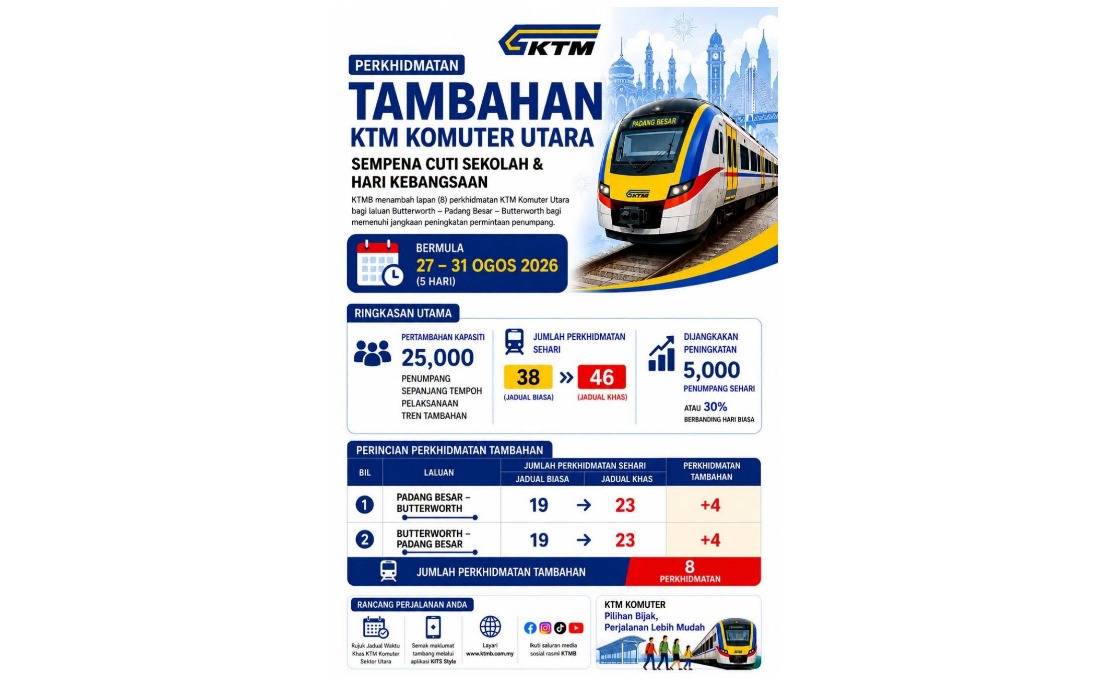
Keretapi Tanah Melayu Berhad (KTMB) is rolling out a reinforced timetable across its Northern Sector network, introducing eight supplementary train services on the Butterworth-Padang Besar route to handle the seasonal surge in travellers from Thursday through Monday, August 27-31. The expansion comes as Malaysian families prepare for school holidays coinciding with National Day celebrations, traditionally prompting significant increases in inter-state movement across the north.
The enhanced schedule represents a strategic operational response to predictable demand fluctuations during holiday periods. By implementing a dedicated KTM Komuter Northern Sector Special Timetable, KTMB aims to alleviate congestion while maintaining service reliability across the corridor connecting Penang, Kedah, and Perlis—three states that form a crucial transport corridor for both leisure and commuter traffic. The railway operator estimates this burst in capacity will prove essential for accommodating families and holidaymakers traversing the northern peninsula.
Under the revised arrangement, daily services between Butterworth and Padang Besar will jump from the standard 38 to 46 trains, representing a 21 percent increase in operational frequency. This expansion subdivides into two directional components: the Padang Besar-bound trajectory adds four trains, raising that direction's daily count from 19 to 23 services, while the southbound Butterworth route similarly gains four additional trains to reach 23 daily departures. The symmetrical boost across both directions underscores KTMB's commitment to maintaining balanced capacity in each direction.
Ridership projections underlying this expansion offer insight into the scale of anticipated demand. KTMB forecasts a 30 percent elevation in passenger numbers compared with ordinary weekday traffic, translating to an estimated 5,000 additional daily travellers throughout the five-day promotional period. Extrapolating across the implementation window yields an aggregate capacity boost of approximately 25,000 passenger movements—a substantial volume that necessitates the additional rolling stock deployment. These figures highlight how concentrated holiday travel becomes during school breaks in Malaysia's transportation ecosystem.
The practical implications of this service enhancement extend beyond mere numerical capacity. For residents of northern states who depend on rail connectivity, the expanded timetable provides meaningful flexibility in journey planning. Rather than forcing passengers into constrained peak-hour slots, additional mid-day and evening services distribute demand across a broader temporal window. This design element reduces crowding, improves comfort levels, and creates breathing room for commuters who might otherwise face standing-room-only conditions during traditional travel peaks.
For Malaysian rail operators, managing seasonal demand spikes represents an ongoing operational challenge distinct from other transport modes. Unlike highway systems where additional capacity emerges through dynamic routing, rail services operate within fixed infrastructure constraints. This makes strategic deployment of available rolling stock critical during predictable congestion periods. KTMB's decision to activate reserve capacity during school holidays reflects mature operational planning rather than reactive crisis management.
The Northern Sector specifically merits this attention given its demographic and economic characteristics. The Butterworth-Padang Besar corridor serves populations across three states with varied economic profiles and tourism attractions. Penang's established tourism infrastructure, Kedah's agricultural and small-business communities, and Perlis's border-region characteristics all generate distinct travel patterns. Consolidating these movements onto reliable rail services reduces road congestion, supports environmental sustainability objectives, and provides accessible transport options for residents lacking private vehicles.
Passenger information dissemination plays a crucial supporting role in the service expansion's success. KTMB has committed to publishing the special timetable through multiple channels including the KITS Style mobile application, its official website, and social media platforms. This multi-channel approach acknowledges varied technological adoption rates across the travelling public, ensuring both digitally-native younger passengers and others reliant on traditional information sources can access scheduling details. Clear communication reduces confusion and encourages modal shift toward rail from road transport.
The strategic timing of this announcement—made in late August ahead of the holiday period—allows sufficient notice for travellers to plan journeys. This advance communication signals KTMB's operational readiness and professional approach to capacity management. For tourism operators, transport coordinators, and families planning trips within the northern corridor, this transparency enables more efficient logistics and scheduling downstream.
For Malaysian transport policy observers, initiatives like this special timetable illuminate the relationship between infrastructure investment and operational agility. While additional trains require capital expenditure and maintenance commitments, the rental or deployment of existing rolling stock represents economically efficient demand management. This approach suggests KTMB possesses sufficient fleet capacity to accommodate reasonable demand surges, though capacity constraints during peak periods remain evident across Malaysia's rail network.
Beyond the immediate holiday period, this operational exercise provides KTMB with valuable data regarding actual demand elasticity, passenger distribution patterns, and service reliability under elevated volumes. Such information feeds into medium-term planning for potential permanent timetable adjustments if demand justifies expanded regular service. The five-day trial essentially functions as operational research into sustainable capacity management.
For travellers in the northern region, the expanded service availability removes a traditional constraint on holiday mobility. School breaks and national celebrations warrant family trips and social visits, activities that contribute meaningfully to social cohesion and regional economic activity. By removing transport barriers through enhanced rail capacity, KTMB indirectly supports broader national objectives around holiday participation and inter-regional connectivity.

