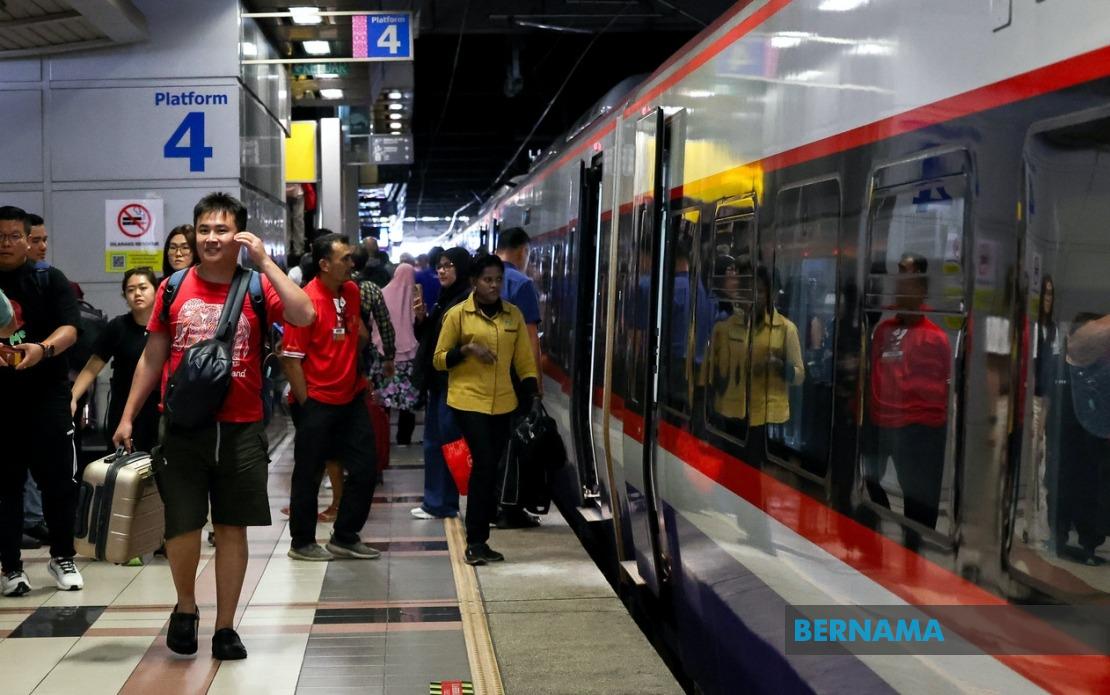
Keretapi Tanah Melayu Berhad (KTMB) has announced a significant expansion of rail capacity ahead of this weekend's Johor state election, introducing 7,464 additional seats across key Electric Train Service routes as the railway operator seeks to manage the anticipated surge in voter movement. The move represents a second wave of service enhancement after initial extra tickets released in June were swiftly exhausted by the travelling public, signalling robust demand for rail transport during electoral periods in the region.
The expanded service comprises eight additional train runs across two primary southern corridors: the KL Sentral - JB Sentral - KL Sentral route and the JB Sentral - Gemas - JB Sentral route. Each day of operation from July 10 to 12 will add 2,488 seats, with four additional services per route designed to distribute capacity evenly and prevent bottlenecks at major terminals. This three-day window captures the critical travel period immediately before and after voting, when Malaysians typically depart urban centres to cast ballots in their constituencies of origin.
KTMB's strategic deployment reflects the established pattern of election-driven migration within Malaysia, where voters from Johor working in the Klang Valley return home for major polls. The rapid depletion of the previous allocation of supplementary tickets, launched just over two weeks earlier on June 19, demonstrated that standard peacetime capacity proves inadequate during electoral events. This recurring phenomenon has prompted major infrastructure operators to develop contingency frameworks that activate automatically when elections are called, ensuring accessibility remains a priority.
To incentivise rail usage and offset the operational costs of the expanded service, KTMB is offering a uniform 20 per cent fare reduction across all additional ETS train runs throughout the three-day period. This discount strategy serves a dual purpose: it makes rail travel more economically attractive relative to driving, potentially reducing highway congestion and improving safety during the busy election weekend, while also demonstrating public service commitment by the national railway operator. For budget-conscious voters, this represents meaningful savings on what are already competitive fares compared to fuel costs and highway tolls for the roughly 400-kilometre journey between Kuala Lumpur and Johor Bahru.
Ticket distribution has commenced in phases to manage the administrative load and prevent system crashes. Sales for the JB Sentral - Gemas - JB Sentral route opened at 3 pm on July 7, while the KL Sentral - JB Sentral - KL Sentral route sales commenced the following morning at 9 am. This staggered release, coordinated with KTMB's digital infrastructure capacity, ensures the booking system remains stable and accessible to the travelling public. The railway operator has encouraged advance purchases through multiple channels to further distribute demand and reduce congestion at physical ticket counters during the election weekend itself.
KTMB has emphasised the use of cashless transaction methods to streamline the purchasing process and accommodate the volume of ticket seekers. Three primary channels are available: the KITS Style mobile application, which offers the convenience of booking and digital ticketing from anywhere; the KTMB official website, providing a web-based alternative for desktop users; and physical kiosk machines stationed at selected major terminals. This multi-channel approach reflects best practices in transportation infrastructure management, where digital adoption reduces friction and accelerates transactions during peak demand periods.
The railway operator has issued operational guidance advising passengers to arrive at stations at least half an hour before their scheduled departure time, a standard precaution during high-capacity operations. Notably, KTMB has clarified that platform access will close just five minutes prior to train departure, a firm measure designed to prevent late boardings that could compromise scheduling and create cascade delays throughout the network. For Malaysian travellers accustomed to the flexibility of road transport, this represents a significant difference in operational discipline, requiring greater temporal precision from those unfamiliar with railway travel.
The expansion of ETS capacity demonstrates how electoral cycles create natural stress tests for Malaysia's transport infrastructure, revealing both the capability of operators to scale operations and the persistent demand from citizens to access voting opportunities. The Johor election, as one of the country's largest state polls, typically generates substantial internal migration patterns that can overwhelm standard transport services. KTMB's proactive response, supported by government coordination, illustrates institutional learning from previous electoral events and a commitment to facilitating democratic participation.
For Southeast Asian observers, Malaysia's approach to election-related infrastructure management offers a regional benchmark. Unlike some jurisdictions where electoral periods see minimal adjustment to transport services, the government-linked operator's willingness to deploy additional resources at subsidised fares underscores a public service ethos oriented toward enabling voter participation. This contrasts with purely commercial transportation models that might prioritise profit over accessibility during surge periods, potentially creating barriers to political engagement for lower-income voters.
The initiative also highlights the interconnectedness of Malaysia's economic geography. The concentration of employment in Kuala Lumpur and the Klang Valley, coupled with electoral constituencies based on ancestral towns and hometowns across Johor, creates cyclical migration flows that infrastructure operators must accommodate during political events. As Malaysia urbanises further and more young people move to major employment centres, these patterns are likely to intensify, requiring long-term planning beyond ad hoc weekend responses.
KTMB has established a dedicated communication channel for public enquiries regarding the expanded service through its Call Centre at 03-9779 1200 and via official social media platforms. This accessibility infrastructure ensures that less tech-savvy travellers or those without internet access can obtain information through traditional channels, reflecting inclusive service design principles. As the weekend approaches and voters begin planning their journeys, these support mechanisms will prove essential for managing the practical logistics of moving large population segments across significant distances.
The announcement underscores the broader question of whether Malaysia's transport infrastructure is adequately dimensioned for normal operations or whether electoral events represent genuine anomalies requiring temporary scaling. Industry analysts have noted that permanent expansion of ETS capacity to accommodate peak electoral demand would likely prove economically inefficient, leaving significant unused capacity during ordinary periods. This tension between service adequacy and financial prudence will continue to shape how KTMB and other operators calibrate their strategic planning in future cycles.

