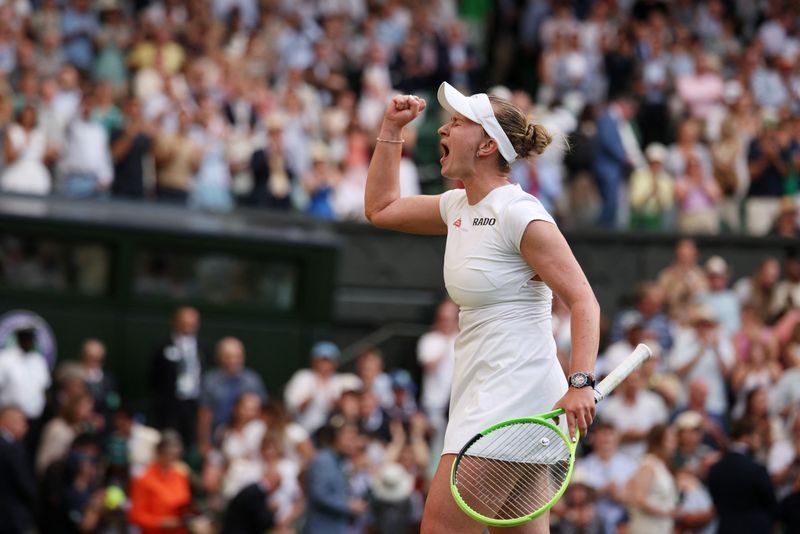
Barbora Krejcikova demonstrated the resilience that defines champions on Wednesday, rallying from a set down to eliminate fifth seed Mirra Andreeva at Wimbledon and advance into the third round. The Czech veteran's 4-6 7-5 6-4 victory over the 19-year-old Russian showcased both the mental fortitude required in elite tennis and the generational battle unfolding at the All England Club this fortnight.
The match began promisingly for Krejcikova, who seized an early advantage with her trademark aggressive baseline play. However, momentum shifted unexpectedly as the former champion's intensity wavered at 3-0 up in the opening set. Andreeva, buoyed by her recent maiden Grand Slam triumph at the French Open, capitalized on the lapse in concentration, eventually claiming the set 6-4 and establishing herself as a genuine threat.
Andreeva's ascent in professional tennis has been meteoric. At just nineteen, she has already proven capable of competing with the sport's established elite, demonstrated most vividly by her breakthrough victory in Paris. Her presence among the tournament's top seeds reflected not merely seeding protocols but genuine competitive parity—she arrived at Wimbledon with confidence bolstered by her maiden major crown.
Krejcikova's response in the second set underscored why she remains a formidable force despite facing younger, physically fresh opponents. Rather than panicking after losing the first set, she recalibrated her strategy and executed with precision, breaking through Andreeva's defence to force a deciding third set. This ability to adjust and regain momentum separates experienced campaigners from promising newcomers.
The decider evolved into a test of mental stamina and competitive spirit. Andreeva demonstrated exceptional resolve by saving six match points, reflecting the maturity beyond her years that has characterised her recent rise. Yet against Krejcikova's sustained pressure and unwavering focus, even such heroic resistance proved insufficient. The Czech player maintained her composure through the critical moments, ultimately converting her seventh opportunity to secure victory.
In the post-match moment, Krejcikova acknowledged both the magnitude of her achievement and Andreeva's promise. Speaking on Centre Court, she reflected on their competitive history, noting this represented only her second victory across five encounters. Her remarks emphasised the exceptional nature of Andreeva's talent and her status as a generational prospect, suggesting respect born from genuine competition rather than mere courtesy.
Andreeva, by contrast, appeared visibly frustrated as the final point elapsed. Her gesture of frustration—throwing her racket toward her chair—captured the disappointment of coming so close to eliminating a former champion. For a teenager still establishing her place among tennis's elite, the loss represents a learning opportunity rather than a career-defining moment, yet the immediate sting was evident.
Krejcikova's path forward at this year's Wimbledon now intersects with fellow Czech Nikola Bartunkova in the third round, creating an all-Czech clash that reflects the depth of talent within Central European women's tennis. The victory also cemented Krejcikova's status as a genuine contender this fortnight, despite the younger generation's encroachment on the sport's hierarchy.
For Malaysian and Southeast Asian tennis enthusiasts, this match illuminated broader trends in professional tennis. The dominance of younger players—particularly from emerging tennis nations—versus established champions represents a compelling narrative. Andreeva's breakthrough at the French Open signalled that the traditional tennis powerhouses no longer hold monopolies on Grand Slam success, a theme with resonance throughout the region as nations invest in developing their own elite players.
Krejcikova's resilience also offers instructive lessons in competitive sport beyond tennis. Her ability to recover from adversity, maintain focus under pressure, and execute during critical moments exemplifies traits that transcend individual sports, applicable across athletic disciplines developing in Malaysia and the wider Southeast Asian context.
The match demonstrated why Wimbledon retains its status as tennis's premier event. Centre Court provided the stage for genuine sporting drama—not merely the outcome, but the manner in which both competitors fought until the concluding point. Such contests remind audiences why they invest emotional energy in following professional sport, creating narratives that extend beyond rankings and statistics.

