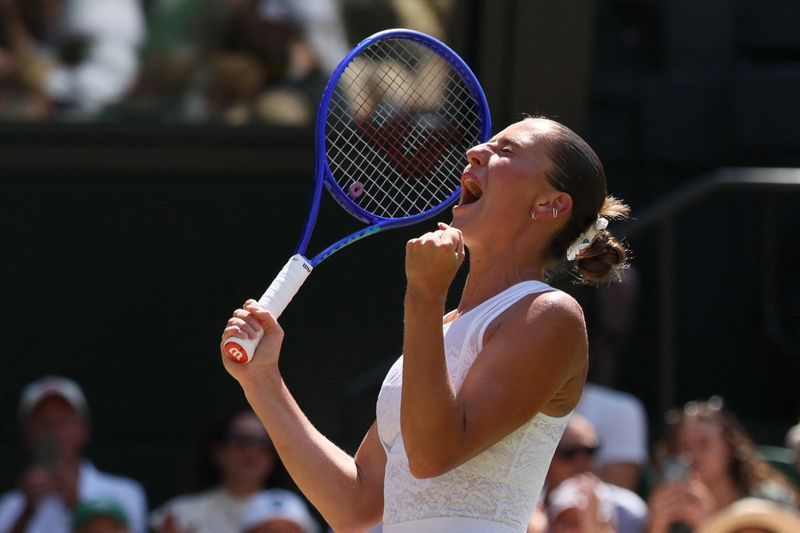
Ukraine's Marta Kostyuk produced a commanding display on Centre Court to eliminate Italy's Jasmine Paolini and secure her place in the Wimbledon semi-finals on Wednesday. The 12th seed dismantled her 13th-seeded opponent with a convincing 6-3 6-2 scoreline in humid conditions, signalling her emergence as a serious contender at the year's third Grand Slam tournament.
Kostyuk's aggressive approach defined the encounter from the outset, as she raced through the opening set in just 36 minutes. The Ukrainian dictated play with her powerful forehand, breaking Paolini's serve twice—once to establish a 3-2 advantage and again at 5-3—to secure the first set with clinical efficiency. Her confidence appeared to grow with each successful stroke, placing immense pressure on her opponent from the baseline.
Appearing in a Grand Slam quarter-final for the first time and making her debut performance on the sacred Centre Court, Kostyuk carried that momentum into the second set. She immediately struck for another break to lead 3-1, further rattling an increasingly frustrated Paolini, who could not manufacture a single break point opportunity throughout the entire match. The Italian's inability to apply pressure on Kostyuk's serve proved catastrophic to her chances of mounting any meaningful comeback.
The 24-year-old from Kyiv had previously lost consecutive encounters against Paolini before this meeting, making her comprehensive victory all the more impressive. She clearly studied her opponent's strengths and exploited the weaknesses effectively, using her court positioning and aggressive shot selection to dictate the rhythm of play. Paolini, who reached the French Open final and finished as runner-up at Wimbledon in 2024, found herself outplayed by a younger, hungrier competitor.
Kostyuk sealed her advancement in 69 minutes total, converting a second match point on Paolini's serve to end the contest decisively. The victory demonstrated remarkable composure for a player appearing on Centre Court for the first time in such a high-pressure fixture. Rather than succumbing to nerves or the weight of the occasion, she channelled the atmosphere to elevate her performance, maintaining her intensity throughout without allowing her opponent any reasonable opportunity to alter the trajectory of the match.
For Southeast Asian tennis enthusiasts, Kostyuk's progression represents another illustration of emerging talent capturing attention on the world's most illustrious grass courts. The Ukrainian's ascent through the tournament ranks demonstrates how players from outside traditional tennis powerhouses continue to challenge established hierarchies at major championships. Her breakthrough on Centre Court in particular holds symbolic significance, marking a generational shift in competitive women's tennis.
The crowd, despite attempting to support the underdog Paolini with encouragement from the stands, could only witness a masterclass in dominant tennis execution. Queen Camilla's presence in the Royal Box added ceremonial gravitas to proceedings, though the outcome never appeared in doubt once Kostyuk established control early. The Ukrainian's composure in front of royalty and thousands of spectators revealed a player comfortable at the highest level of competition.
Kostyuk's semi-final berth carries substantial implications for women's tennis at Wimbledon. Her performance suggests that Paolini's apparent emergence as a consistent Grand Slam contender remains incomplete, particularly on grass surfaces where precision and aggression combine to determine outcomes. Meanwhile, Kostyuk's breakthrough offers motivation to emerging challengers worldwide who aspire to make decisive impacts on the sport's grandest stages.
The Ukrainian's pathway to the final now becomes clearer tactically. Having neutralised Paolini's baseline game and preventing any sustained pressure on her service games, Kostyuk understands precisely which tactical principles will serve her advancing through the tournament. Her aggressive forehand dominance and willingness to attack provide clear blueprints for potential opponents, though converting such tactical advantages into results demands consistency and mental fortitude—qualities she demonstrated in abundance during her dismissal of Paolini.
As the tournament progresses toward its climax, Kostyuk's emergence as a semi-finalist carries broader ramifications for tennis globally. Her success challenges assumptions about which players merit consideration as genuine threats at the sport's elite level, forcing established competitors and analysts alike to reassess rankings and tournament predictions. For Malaysian readers following international tennis, her triumph exemplifies how determination and technical excellence can overcome previous setbacks and elevate unknown quantities into championship contention.

