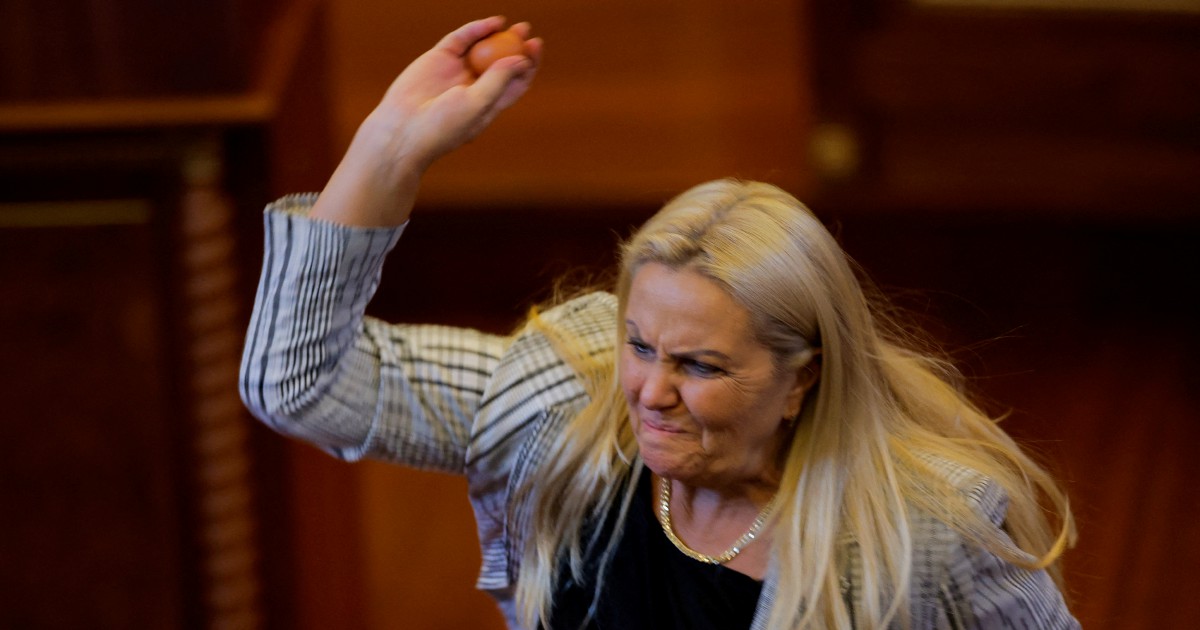
Kosovo's parliament descended into chaos on Saturday when an opposition lawmaker attacked caretaker Prime Minister Albin Kurti with eggs, forcing lawmakers to suspend proceedings and highlighting the severe institutional strain gripping the Balkan nation. The incident, caught on camera, underscores how fractured Kosovo's political landscape has become, with traditional parliamentary decorum abandoned amid intensifying partisan conflict. The attack on Kurti occurred during what should have been routine legislative business, but instead revealed the raw tensions simmering between the government and opposition benches.
The egg attack was not merely a symbolic gesture of disrespect but rather symptomatic of a broader constitutional crisis that has paralysed Kosovo's political system for months. Since negotiations and coalition-building collapsed, the country has been unable to form a stable governing majority, leaving Kurti in a caretaker capacity as he attempts to navigate an increasingly hostile parliament. This institutional limbo has prevented the government from functioning effectively, creating a vacuum that opposition forces have actively exploited to destabilise the administration. The suspension of parliament following the Saturday altercation marks another low point in an already troubled political process.
Kosovo's political dysfunction carries significant implications beyond its borders, particularly for regional stability and European integration efforts. The Balkan state, which declared independence in 2008, remains one of Europe's most fragile democracies, with deep ethnic divisions and weak institutional foundations. A snap election, increasingly likely given the current trajectory, would represent a failure of Kosovo's political class to navigate disagreements through established constitutional channels. Instead, repeatedly returning to the electorate signals that parliament has become incapable of resolving disputes or forming lasting coalitions.
The crisis reflects fundamental cleavages within Kosovo society that electoral processes alone cannot easily resolve. Competition between rival political camps centres not merely on policy disagreements but on questions of legitimacy, representation, and the proper role of international actors in Kosovo's affairs. These existential questions make compromise exceptionally difficult, as each side views major concessions as threats to their core interests. The opposition's resort to physical confrontation suggests that peaceful institutional channels have been exhausted or are perceived as inadequate for expressing political grievances.
For regional watchers, Kosovo's instability presents a worrying precedent. The Balkan region, which experienced devastating wars in the 1990s, remains sensitive to political upheaval that could rekindle historical tensions. Kosovo's large Serbian minority and complicated relationship with Serbia proper mean that any prolonged governmental vacuum could provide openings for external actors to interfere. Furthermore, if Kosovo cannot maintain basic parliamentary civility, questions naturally arise about its readiness for fuller European integration, a goal that requires demonstrated capacity for democratic governance.
The caretaker government structure itself represents an unsatisfactory middle ground. Kurti's administration lacks the legitimacy of a freshly elected government yet continues to exercise executive functions, creating an awkward and increasingly untenable position. This liminal status weakens the government's authority to implement policies or maintain discipline, while simultaneously preventing a new electoral mandate from refreshing parliament's composition. The longer this arrangement persists, the more accusations of illegitimacy accumulate, and the more desperate various actors become to force resolution through confrontation rather than negotiation.
Snap elections, while potentially clearing the political stalemate, carry their own risks for Kosovo. Frequent returns to the ballot exhaust public engagement with democratic processes and can lead to declining participation rates. Voters, observing that multiple elections produce similar deadlocked results, may become cynical about democracy's ability to deliver change or resolve fundamental conflicts. Moreover, electoral campaigns themselves become flashpoints for escalated rhetoric and even violence, particularly in societies where political differences map onto identity divisions rather than purely ideological or policy disagreements.
Kosovo's international partners, including the European Union and United States, face difficult choices about how to respond. These actors have substantial leverage over Kosovo through financial aid, visa policies, and diplomatic recognition, yet heavy-handed intervention can undermine the legitimacy of whatever settlement eventually emerges. At the same time, passivity risks allowing Kosovo's democratic institutions to collapse entirely, which would be far more damaging to regional stability than any short-term political crisis. The international community must calibrate its response carefully, encouraging dialogue while respecting Kosovo's sovereignty.
The path forward likely requires both immediate measures to restore parliamentary civility and longer-term reforms to strengthen Kosovo's political system. Institutional changes such as refined coalition-formation rules, clearer procedures for government formation, or modified electoral systems might reduce the frequency of total collapses. Simultaneously, political actors must recognise that their repeated failures to govern collectively reflect poorly on all of them, not merely their opponents. Unless Kosovo's politicians can find ways to cooperate despite their disagreements, the country faces a troubling cycle of elections, deadlock, and institutional paralysis that will further undermine public confidence in democracy itself.

