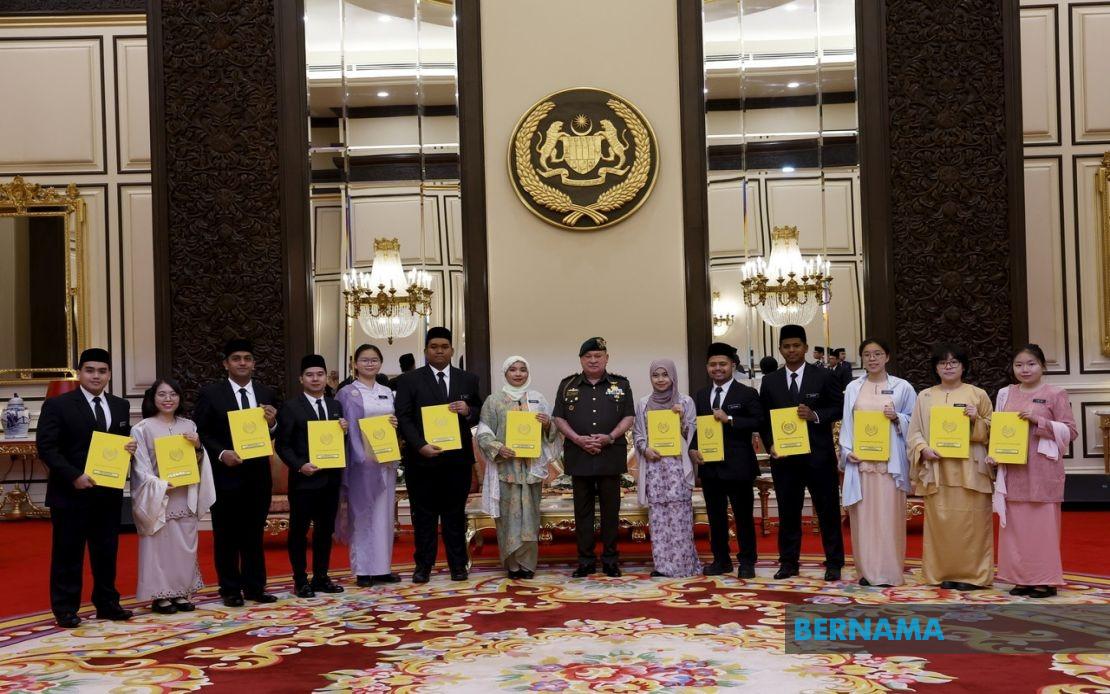
His Majesty Sultan Ibrahim, King of Malaysia, conferred the 2026 Yang di-Pertuan Agong Scholarships (BYDPA) upon 14 accomplished scholars during a formal ceremony at Istana Negara in Kuala Lumpur on June 24, recognising the nation's commitment to nurturing academic excellence at the highest levels.
The recipients represent a cross-section of Malaysia's most promising postgraduate researchers, with the cohort divided evenly between those pursuing doctoral qualifications and those undertaking research-based master's programmes. This distribution underscores the government's dual focus on developing both emerging researchers and seasoned postgraduate scholars capable of advancing Malaysia's knowledge economy and research capacity across diverse disciplines.
The geographical scope of the scholarships reflects Malaysia's strategic approach to research advancement, with four recipients selected to continue their studies at internationally renowned universities abroad, positioning them to acquire cutting-edge knowledge and establish networks within global academic communities. The remaining ten scholars will conduct their research at established domestic research universities, strengthening local institutional capacity and ensuring that premier scholarship funding directly benefits Malaysia's higher education infrastructure and long-term research capabilities.
The BYDPA stands as one of Malaysia's most prestigious and generously funded scholarship schemes administered by the government. Unlike many other state-supported postgraduate programmes, the BYDPA distinguishes itself through substantially higher funding allocations, enabling recipients to focus entirely on their research and academic pursuits without financial constraints. This elevated funding level reflects the scheme's status as a flagship initiative for talent development and its strategic importance in building Malaysia's research and innovation ecosystem.
Tan Sri Wan Ahmad Dahlan Abdul Aziz, the Director-General of the Public Service, emphasised the scholarship's prestige and financial generosity when speaking to reporters following the ceremony. His remarks underscored how the BYDPA occupies a pinnacle position among government scholarship offerings, designed specifically to attract and retain Malaysia's most exceptional academic talent. The prominence afforded to the presentation ceremony, with the King as patron, further demonstrates the national significance attached to supporting advanced research and postgraduate education.
The formal presentation at Istana Negara, attended by senior government officials including Tan Sri Dr Azmi Rohani, the Comptroller of the Royal Household, signalled the monarchy's active endorsement of education and research investment. Such high-level participation in scholarship ceremonies reflects the constitutional role of the Yang di-Pertuan Agong as a custodian of national development priorities and the nation's commitment to building human capital through advanced learning.
For Malaysian readers, this scholarship round carries particular relevance as it demonstrates sustained government investment in postgraduate education during a period when many nations are reassessing research funding priorities. The balance between international and domestic placement reflects a pragmatic strategy: enabling some scholars to benefit from world-class international research environments while anchoring others within Malaysia's university system to strengthen domestic research infrastructure and institutional prestige.
The BYDPA scheme also serves as a pipeline for developing Malaysia's future academic leadership, research specialists, and knowledge workers in critical fields. By supporting researchers at the master's and doctoral levels, the programme addresses a recognised gap in Malaysia's research workforce, where postgraduate researchers form the backbone of institutional research output and innovation-driven development.
From a broader Southeast Asian perspective, Malaysia's continued investment in high-value postgraduate scholarships positions the nation as a regional education hub and strengthens its competitiveness in attracting research talent. When scholars return from international programmes or advance through domestic institutions, they bring enhanced expertise that elevates the regional research landscape and fosters cross-border academic collaboration within Southeast Asia.
The distribution of scholarships across different fields of study, while not detailed in the official announcement, typically spans engineering, sciences, medicine, social sciences, and emerging technological disciplines. This disciplinary diversity ensures that Malaysia's research advancement is not concentrated in single sectors but develops broad-based intellectual capacity aligned with the nation's economic diversification goals.
Looking forward, the 2026 cohort joins previous BYDPA recipients in forming an increasingly influential network of advanced researchers and academics positioned to shape Malaysia's knowledge production and policy advice in coming decades. As these scholars progress through their programmes and transition into academic and professional roles, their contributions will be measured not only through published research and innovations but also through their mentorship of the next generation of Malaysian researchers and their leadership within universities and research institutions.