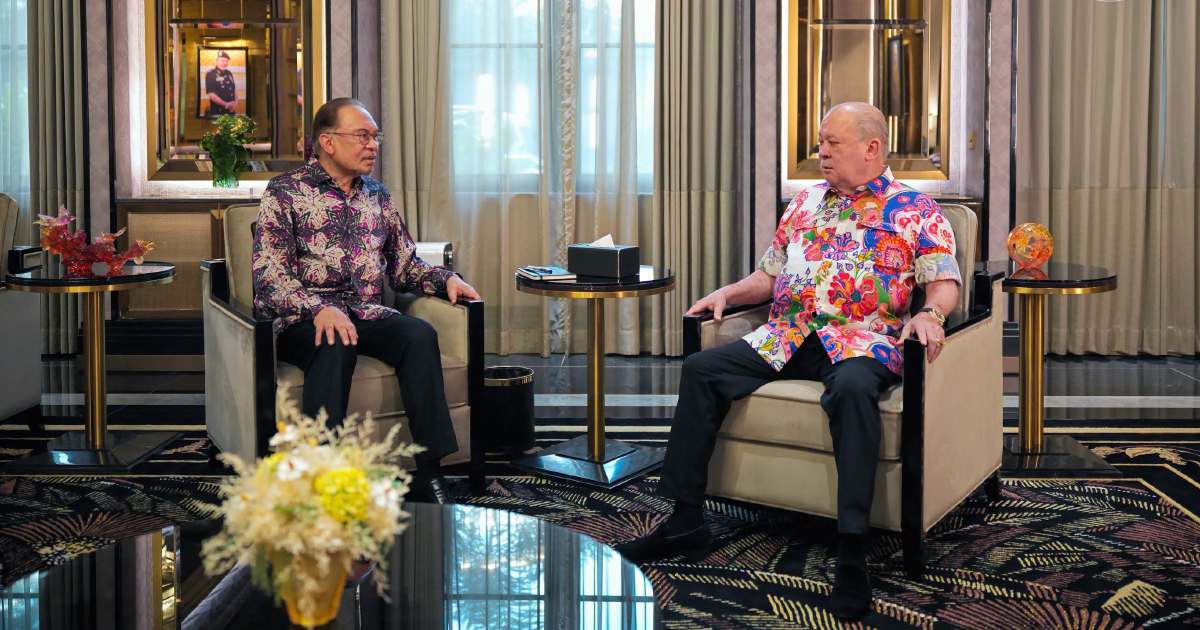
His Majesty Sultan Ibrahim, King of Malaysia, held a formal audience with Prime Minister Datuk Seri Anwar Ibrahim at Istana Bukit Tunku in Kuala Lumpur on the eve of the nation's 69th National Day. The meeting follows customary protocol for senior government officials to present their respects to the Agong before major national commemorations.
The pre-National Day engagement underscores the constitutional framework through which Malaysia's monarchy and executive government maintain institutional coordination on significant state occasions. As the ceremonial head of state, the King traditionally receives the Prime Minister to discuss matters of national importance and ensure alignment on the conduct of major celebrations. This practice reflects the constitutional monarchy model established at independence in 1957, whereby the sovereign plays a symbolic unifying role across the federation's multiethnic and multireligious population.
National Day, marked annually on 31 August, commemorates Malaysia's independence from British colonial rule and remains one of the most important fixtures in the national calendar. The 69th iteration of these celebrations carries particular significance as citizens reflect on nearly seven decades of independence and the nation's evolving development trajectory. For Malaysian readers, such occasions serve as anchor points for national identity, bringing together Malaysians across ethnic, religious, and regional lines around shared historical narratives and collective aspirations.
The timing of this royal audience reflects administrative preparation for tomorrow's festivities. Government agencies, state governments, and civic organizations conduct extensive planning to ensure that National Day ceremonies proceed smoothly and reflect the country's contemporary values. The audience between the King and Prime Minister typically includes briefings on ceremonial arrangements, security measures, and the thematic direction that this year's celebrations will emphasize. Such meetings ensure that the symbolic and practical dimensions of National Day are coherent and convey intended messages to both domestic and international audiences.
Malaysia's National Day celebrations have evolved significantly since 1957. Early commemorations focused primarily on marking the transfer of sovereignty and the nascent federation's early challenges. Over subsequent decades, as the nation developed economically and navigated complex transitions in governance and society, National Day became an occasion for broader reflection on national unity, economic progress, social cohesion, and Malaysia's regional role. Contemporary celebrations increasingly incorporate contemporary themes such as digital advancement, sustainability, and inclusive economic participation alongside traditional patriotic observances.
For regional observers, Malaysia's approach to National Day—combining ceremonial grandeur with substantive national dialogue—offers insights into how the country balances tradition with modernity. Unlike some neighbouring nations where state commemorations can become overtly politicized, Malaysia's National Day framework maintains bipartisan character, with opposition parties and civil society typically participating in or acknowledging the significance of independence commemorations. This inclusive approach has contributed to National Day's resilience as a genuinely unifying occasion across Malaysia's politically diverse landscape.
The audience also exemplifies the formal channels through which Malaysia's constitutional institutions interact during periods of heightened national focus. While day-to-day governance proceeds through cabinet processes and parliamentary procedures, major national occasions often involve more formal and ceremonial interaction between the Agong and senior government figures. These meetings, though not typically generating extensive public commentary, serve important practical functions in coordinating security arrangements, ceremonial protocols, and messaging strategies.
Looking toward the 69th National Day celebrations themselves, Malaysians can anticipate the traditional programme of events across federal territories and state capitals. Parades, flag-hoisting ceremonies, cultural performances, and official commemorations will unfold in Kuala Lumpur and beyond, with particular emphasis likely on visual displays of national symbols and performances representing Malaysia's cultural diversity. The celebration provides opportunities for schools, community organizations, and corporate entities to reinforce patriotic sentiment and civic engagement among younger generations.
From a Southeast Asian perspective, Malaysia's National Day also reflects the region's broader post-colonial trajectory. Across ASEAN, independence days function as moments when nations assert their sovereignty and reflect on achievements since decolonization. Malaysia's 69 years of independence have encompassed substantial economic development, demographic transitions, and shifts in regional geopolitics. National Day observances provide opportunities for political leaders to articulate national narratives and reconnect public discourse with foundational principles of statecraft and national purpose.
The institutional relationship between Malaysia's King and Prime Minister, as demonstrated through this audience, remains a distinctive feature of Malaysian governance. Unlike presidential systems where the head of state and chief executive are unified, Malaysia's constitutional monarchy reserves certain ceremonial and custodial functions for the Agong while concentrating executive power in the Prime Minister. This division of roles requires regular coordination to ensure that ceremonial and executive dimensions of governance complement rather than conflict with each other.
As Malaysians prepare to commemorate 69 years of independence, the foregoing audience between His Majesty and the Prime Minister signals that institutional machinery is functioning appropriately and that the nation enters its National Day with coordinated leadership. While such meetings often escape extensive media scrutiny, they represent the quiet institutional work through which Malaysia's constitutional framework sustains itself. The convergence of ceremonial observance, political messaging, and institutional protocol during National Day demonstrates how contemporary Malaysia continues to synthesize constitutional monarchy, parliamentary democracy, and multiethnic federalism.

