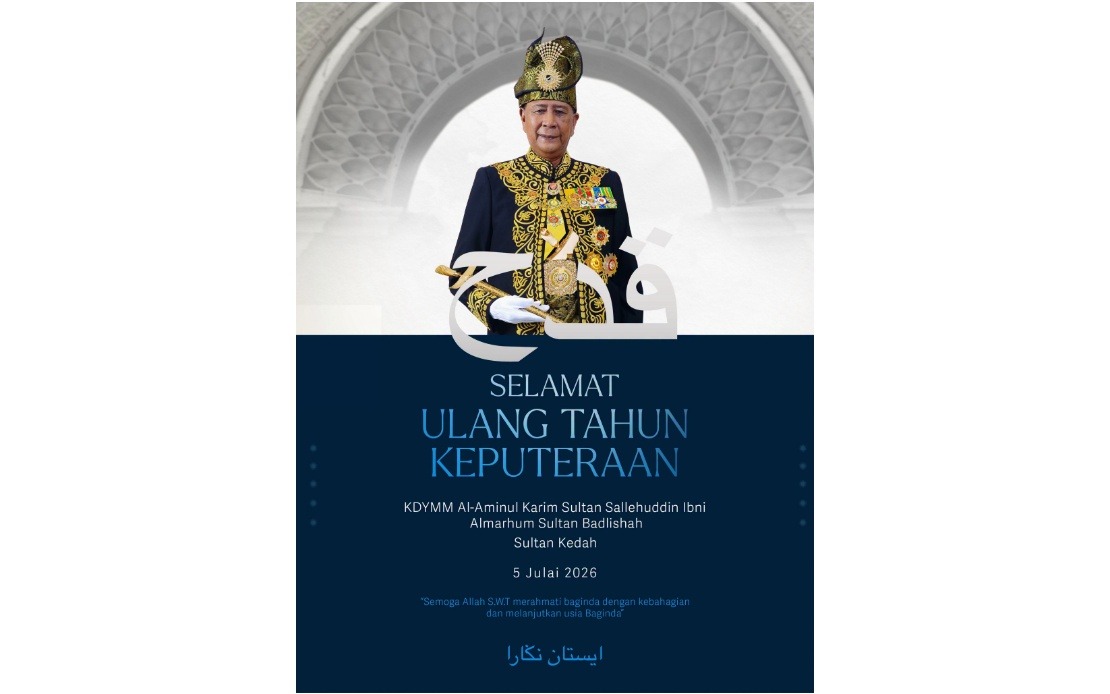
His Majesty Sultan Ibrahim, King of Malaysia, conveyed warm wishes to Sultan Al-Aminul Karim Sultan Sallehuddin Sultan Badlishah of Kedah on July 5 as the Sultan marked his 84th birthday. The greeting, shared through the official social media channels of His Majesty, reflected the ceremonial ties that bind Malaysia's constitutional monarchy and its constituent sultanates in observance of royal occasions.
The King's message centred on spiritual benedictions, with His Majesty invoking divine blessings upon the Kedah Sultan. In keeping with Malaysian royal protocol, the greeting expressed hopes that Sultan Sallehuddin would be granted continued health, happiness and a long and prosperous life by Allah. Such exchanges between the King and state rulers represent an important dimension of Malaysia's federal structure, where the Yang di-Pertuan Agong maintains formal relations with the nine hereditary sultans who collectively form the Conference of Rulers—a body integral to Malaysia's constitutional framework.
Prime Minister Datuk Seri Anwar Ibrahim similarly took the occasion to recognise Sultan Sallehuddin's milestone birthday. The Prime Minister's message extended beyond the Sultan himself, encompassing the broader Kedah royal household, including Sultanah Maliha Tengku Ariff and members of the royal family. This inclusive approach underscores how birthday observances in the Malaysian context often serve to acknowledge not merely an individual but the entire institution they represent.
In his Facebook posting, Anwar Ibrahim invoked traditional Malay royal salutations, closing with the phrases "Daulat Tuanku" and "Dirgahayu Tuanku"—formulations that express loyalty and wish long life upon a ruler. The use of such ceremonial language in public messaging reinforces the cultural and constitutional significance attached to Malaysia's monarchical institutions, particularly at moments when the highest offices of state engage in public expressions of respect and goodwill.
Sultan Sallehuddin's tenure as ruler of Kedah has spanned several decades, making him one of Malaysia's more senior sultans. Kedah, located in the northern peninsula, holds considerable historical significance as an ancient Malay sultanate with roots extending back centuries. The state's ruler traditionally carries weighty responsibilities within both state governance and the broader framework of Malaysia's constitutional arrangements, including participation in matters requiring the consensus of the Conference of Rulers.
The exchange of birthday greetings between national leadership figures and state rulers reflects the ceremonial dimensions of Malaysia's political system, where constitutional monarchy serves as a unifying symbol across the federation's varied regions and communities. Such public acknowledgments, while appearing ceremonial in nature, carry subtle significance in demonstrating the maintenance of formal relationships and mutual recognition between federal and state-level institutions.
In Malaysian political culture, the public acknowledgment of royal birthdays through official channels—particularly via social media platforms—has become a standard practice that reinforces institutional legitimacy and continuity. These messages reach millions of Malaysians and affirm the ongoing relevance of royal institutions in the nation's public life and constitutional order.
The timing of such greetings also reflects the Malaysian calendar's rhythm, which includes numerous royal occasions that punctuate the year and provide opportunities for national reflection on traditions of monarchy and governance. For Kedahans particularly, the birthday of their Sultan represents a moment of regional pride and an occasion when the state's standing within the federation receives national-level recognition.
As Malaysia continues to navigate complex questions surrounding the role and relevance of its hereditary institutions in a modernising society, such visible expressions of respect between the King and state rulers carry weight beyond their immediate ceremonial purpose. They signal continuity within constitutional frameworks and suggest harmony among the various tiers of Malaysia's governmental structure—a message that carries particular importance in a diverse, multi-ethnic federation where institutions must be seen as serving the interests of all communities.

