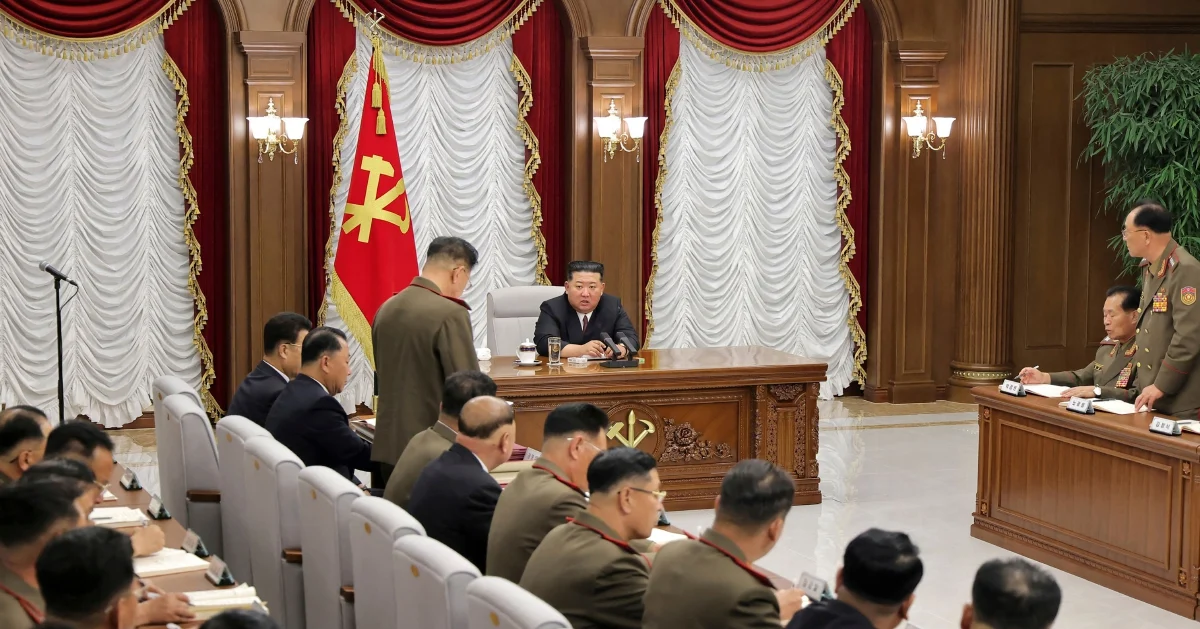
North Korean leader Kim Jong Un has orchestrated the removal of a prominent military official from the ruling Workers' Party of Korea, state media confirmed on Saturday, labelling the official's alleged bribery as a fundamental betrayal warranting classification as a 'political crime.' The decision underscores Kim's ongoing assertion of control over military ranks and his administration's public commitment to rooting out institutional corruption, even at senior levels of governance.
The expulsion from the ruling party represents a significant disciplinary action within North Korea's tightly controlled political apparatus. Such removals typically signal loss of influence and social status within the isolated state, where party membership remains a prerequisite for accessing state privileges and maintaining authority. The characterization of the official's conduct as a 'political crime' rather than merely administrative misconduct suggests the offense carries substantial ideological weight in Pyongyang's hierarchy of transgressions.
Kim's targeting of military corruption addresses longstanding concerns about patronage networks and illicit enrichment within North Korea's armed forces. The military establishment, which consumes a disproportionate share of state resources, has historically served as a base for factional interests competing for influence at the highest levels. By moving against individual officials and framing such actions as principled governance, Kim attempts to demonstrate control while managing the delicate balance between rewarding loyalty and maintaining institutional discipline.
The public announcement of the official's removal through state media serves multiple strategic purposes within North Korea's controlled information environment. Such announcements reinforce the narrative of a leadership committed to rectifying systemic problems while simultaneously warning other officials about the consequences of financial impropriety. In North Korea's context, where transparency remains minimal and official narratives are carefully constructed, the prominence given to anti-corruption messaging indicates Kim's deliberate prioritization of this theme.
Military institutional health has assumed particular importance for Kim Jong Un's government as it navigates international sanctions and attempts to advance nuclear weapons development programmes. The armed forces require sustained internal cohesion to execute complex strategic directives, making corruption that diverts resources or undermines command structures a matter of genuine concern for regime stability. Officials diverting state resources through bribery schemes represent not merely personal enrichment but potential threats to the centralized control upon which the regime depends.
The incident reflects broader patterns within North Korea's governance structure, where periodic purges and disciplinary actions against officials have characterized Kim's tenure since assuming power following his father's death. These actions typically emerge without prior public warning, reinforcing the unpredictability that Kim uses as a management tool. The sudden nature of such removals, communicated through state media rather than through formal institutional channels, maintains an atmosphere of uncertainty that discourages officials from developing independent power bases.
For regional observers and analysts monitoring North Korea, the military official's expulsion provides a window into internal dynamics and the continued priority Kim assigns to consolidating authority over the armed forces. The Korean peninsula's geopolitical significance means that any signals regarding North Korea's internal stability or military command coherence attract careful international scrutiny. Military officials purged for corruption may have also possessed other vulnerabilities or connections to factions that Kim sought to weaken, suggesting the bribery allegations may represent only the stated justification for broader organizational objectives.
The broader implications extend beyond individual personnel changes to questions about systemic functioning within North Korean institutions. While anti-corruption rhetoric projects an image of principled governance, such selective enforcement—whereby some officials face harsh consequences whilst others similarly engaged in questionable practices remain unscathed—reflects the reality that political considerations often outweigh consistent application of rules. The decision to publicly denounce the official's conduct as a 'political crime' rather than criminal wrongdoing suggests ideological dimensions to the offense beyond mere financial impropriety.
For Southeast Asian observers, North Korea's domestic governance patterns carry indirect significance insofar as they illuminate broader dynamics affecting regional stability and the peninsula's strategic trajectory. States throughout the region maintain varying diplomatic relationships with Pyongyang and monitor internal Korean developments for indicators regarding potential crisis scenarios or shifts in military orientation. The military's institutional coherence and command structure directly influence assessments of North Korea's strategic behaviour and nuclear deterrent credibility.
The purge also illustrates enduring challenges within command economies attempting to regulate official behaviour through ideological appeals and selective enforcement. North Korea's chronic resource scarcity creates persistent incentives for officials to engage in unauthorized trading and appropriation, yet the regime's political model depends on maintaining the fiction of a unified leadership committed to collective socialist ideals. Confronting corruption thus requires simultaneously managing expectations about governance standards whilst preserving sufficient flexibility to accommodate the factional accommodations necessary for regime survival.

