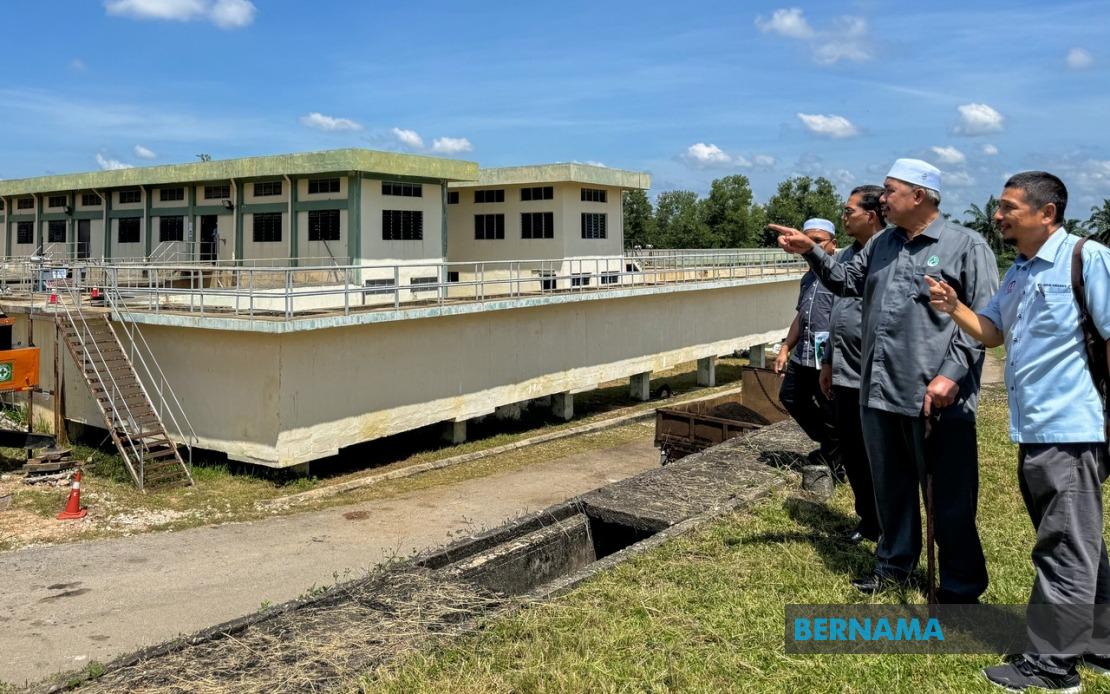
Approximately 34,000 water account holders across three Kelantan districts are set to benefit from significantly improved supply reliability beginning in September, following the completion of a major infrastructure enhancement at the Merbau Chondong Water Treatment Plant. The RM11.5 million upgrade project represents a critical intervention in addressing long-standing water distribution challenges that have plagued the region, with residents in Machang, Pasir Puteh, and southern Kota Bharu standing to gain the most immediate relief.
The centrepiece of the improvement initiative is a dramatic expansion in treatment capacity. Datuk Dr Izani Husin, who chairs Kelantan's Public Works, Infrastructure, Water and Rural Development Committee, outlined how the facility will now process 80 million litres daily compared to the previous 45 million litres—representing a near-doubling of output that addresses the structural constraints that have long limited water availability in these districts. This capacity jump did not occur by accident; Air Kelantan Sdn Bhd had previously resisted increasing production from the plant, fearing that higher throughput would compromise water quality—a legitimate technical concern that the upgrade directly resolves.
The technological solution underlying this expansion centres on the introduction of an advanced Xylem Underdrain Leopold filtration system. This equipment enhancement enables the plant to process between 70 million and nearly 90 million litres of raw water daily, a substantial increase from historical levels. The filtration technology proves particularly significant because it allows operators to maintain rigorous quality standards even at elevated production volumes, directly addressing the quality-versus-quantity trade-off that previously constrained operations.
Quality improvements constitute as much of the upgrade's value proposition as increased volume. The project successfully reduced the Nephelometric Turbidity Unit reading—a technical measure of water clarity and cleanliness—from over 10 NTU to just 3 NTU. This substantial improvement means that water delivered to households will be clearer, cleaner, and more reliably free of suspended particles and contaminants. For consumers accustomed to periodic water discolouration or quality concerns, this represents a tangible enhancement in daily living standards.
The timeline for implementation reflects careful planning and execution. Datuk Dr Izani confirmed that construction work is expected to conclude by the end of July, with the new system commencing distribution to end users in early September. This phased approach allows for comprehensive testing and system validation before consumers depend on the upgraded infrastructure, reducing the risk of operational disruptions during the transition period.
The upgrade represents only the first phase of a more ambitious longer-term vision for Kelantan's water infrastructure. The state government, working in partnership with Pengurusan Aset Air Berhad, is simultaneously planning the Machang 1 Water Treatment Plant—a substantially larger facility requiring RM120 million in investment and targeted for completion by 2030. This new plant will independently supply 50 million litres daily to Machang residents alone, effectively decoupling local supply from the Merbau Chondong facility and allowing the latter to redirect its enhanced capacity toward other underserved districts throughout the state.
The dual-track strategy reflects sophisticated water resource planning. Rather than viewing the immediate upgrade as a final solution, state authorities recognise that Kelantan's growing population and industrial activity require multiple, geographically distributed treatment facilities. The Machang 1 project currently awaits finalisation of contractual agreements between the state government and PAAB before contractor selection can proceed, indicating that while ambitions are substantial, the execution pathway remains subject to negotiation and formalisation.
Broader context reveals the scale of water supply challenges confronting Kelantan. Air Kelantan Sdn Bhd has successfully resolved approximately 70 percent of water supply issues affecting 270,000 account holders statewide, with planners targeting at least 90 percent resolution by 2035. This demonstrates that while the Merbau Chondong upgrade will materially improve conditions for 34,000 beneficiaries, systemic challenges persist elsewhere across the state. The 15-year trajectory toward 90 percent resolution suggests that water infrastructure development remains a multi-year undertaking requiring sustained investment and phased implementation.
For Malaysian readers beyond Kelantan, this project illustrates the technical and financial dimensions of water security increasingly demanding attention across the nation. As urban populations grow and industrial demand expands, treatment capacity constraints become endemic. The Merbau Chondong experience demonstrates that existing facilities can often be substantially enhanced through technological upgrades rather than wholesale replacement, offering a potentially cost-effective model for other water-stressed regions. However, the parallel commitment to the Machang 1 facility suggests that even optimised legacy infrastructure eventually reaches limits requiring new construction.
The upgrade also reflects broader governance patterns in Malaysia's water sector, where responsibility is shared between state authorities, statutory bodies, and specialist operators. The interplay between Kelantan's committee structure, Air Kelantan Sdn Bhd's operational role, and PAAB's asset management function reveals the institutional complexity characterising Malaysia's water management landscape. Successful outcomes depend on effective coordination and aligned incentives across these multiple actors.
From a consumer perspective, the September supply commencement will represent a concrete manifestation of infrastructure investment. The 34,000 account holders in the three affected districts have endured variable supply reliability; the upgrade promises not merely increased volume but also the consistency that allows households and businesses to plan water-dependent activities with greater confidence. In hot, tropical Kelantan, stable water supply carries particular significance for public health, domestic convenience, and economic productivity.
Looking ahead, the success of this project will likely inform planning discussions elsewhere in Malaysia, particularly in other states grappling with similar supply inadequacies. The demonstrated capacity of advanced filtration systems to unlock additional production without compromising quality may encourage similar upgrades in other regions. Simultaneously, the ongoing commitment to new facilities like Machang 1 underscores the reality that technological optimisation, while valuable, cannot indefinitely defer the larger infrastructure investments that growing populations ultimately demand.

