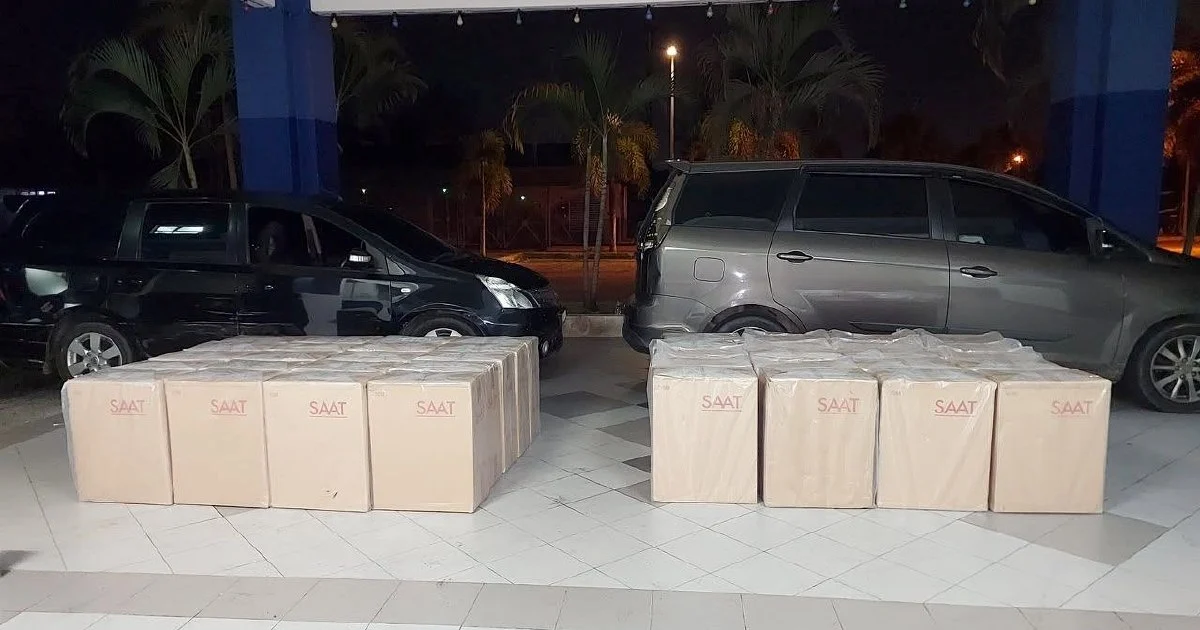
A 29-year-old man was taken into custody at Kampung Pulau Panjang in Kota Baru following an enforcement operation that culminated in a pursuit and the seizure of a substantial quantity of suspected smuggled cigarettes. The haul, comprising 400,000 individual sticks, carries an estimated value of RM813,000 and represents a significant interception in the ongoing fight against illicit tobacco trafficking in the eastern Malaysian states.
The arrest marks another substantial victory for the General Operations Force (GOF), which has intensified its interdiction efforts across Kelantan as part of a broader regional crackdown on contraband activities. The operation, conducted during evening hours, demonstrates the coordination and responsiveness required to combat smuggling networks that frequently exploit porous borders and less-monitored rural areas in the northern corridor of Peninsular Malaysia.
Smugglers operating in this region typically target Kelantan's proximity to Thailand and vulnerable smuggling routes that traverse less densely populated regions. The state has long served as a transit point for illicit goods moving between southern Thailand and major Malaysian distribution hubs, making enforcement operations there particularly critical for national revenue protection and public health objectives.
The sheer scale of the confiscated contraband—400,000 cigarette sticks—underscores the industrial nature of the smuggling operations that authorities contend with. Such volumes suggest the suspect was not operating independently but was likely part of a larger distributional network, raising questions about the source, intended destination, and financial structure behind the shipment.
Cigarette smuggling has emerged as a significant challenge for Malaysian authorities, eroding tax revenues and undercutting legitimate retailers whilst potentially funding organised crime networks. The illicit trade flourishes wherever legitimate cigarettes face high excise taxes, a mechanism intended to discourage consumption but which inadvertently creates profitable opportunities for criminal enterprises capable of sourcing and transporting contraband products.
The RM813,000 valuation reflects current market pricing for legitimate cigarettes, though illicit products typically command lower wholesale prices that still generate substantial profit margins when imported without taxation. The economic incentive structure underlying such smuggling operations remains potent so long as the price differential between taxed Malaysian cigarettes and untaxed imports remains significant.
The pursuit itself, whilst not detailed extensively in initial reports, indicates that enforcement personnel identified the suspect during operations and initiated a chase when he attempted to evade apprehension. Such physical pursuits carry inherent risks and depend upon the tactical skills and local knowledge of enforcement officers familiar with terrain features and road conditions in areas like Kampung Pulau Panjang.
The GOF's involvement in this operation reflects a strategic allocation of military-backed enforcement resources toward civilian smuggling interdiction, a model that has proven effective in Kelantan where terrain and cross-border dynamics present particular challenges for conventional police operations. The force brings specialised training, mobility, and operational capacity suited to rapid-response scenarios involving armed or evasive suspects.
Successful seizures of this magnitude generate important deterrent effects, though they represent merely individual transactions within a much larger illicit market. Intelligence analysts assess that smuggling interceptions typically represent only a fraction of overall contraband flow, suggesting significantly larger volumes move through detection successfully.
The investigation phase now becomes critical as authorities seek to establish the suspect's connections, identify his suppliers and intended purchasers, and determine whether this seizure was part of a larger batch or operation. Such intelligence can disrupt wider networks and lead to additional arrests upstream and downstream in the smuggling chain.
For Malaysian businesses engaged in legitimate tobacco retail and distribution, seizures like this one provide some reassurance that authorities are actively protecting market integrity, though many retailers and industry observers contend that enforcement levels remain insufficient to fully combat the smuggling epidemic. The tax gap between legitimate and illicit cigarettes continues to incentivise smuggling operations despite considerable governmental efforts.
The arrest also reflects heightened vigilance along Kelantan's borders and transit zones, part of a consolidated effort across enforcement agencies to strengthen interdiction capacity. Such operations require coordination between federal and state authorities, intelligence sharing, and sustained resource allocation—commitments that remain challenging amid competing law enforcement priorities across the nation.

