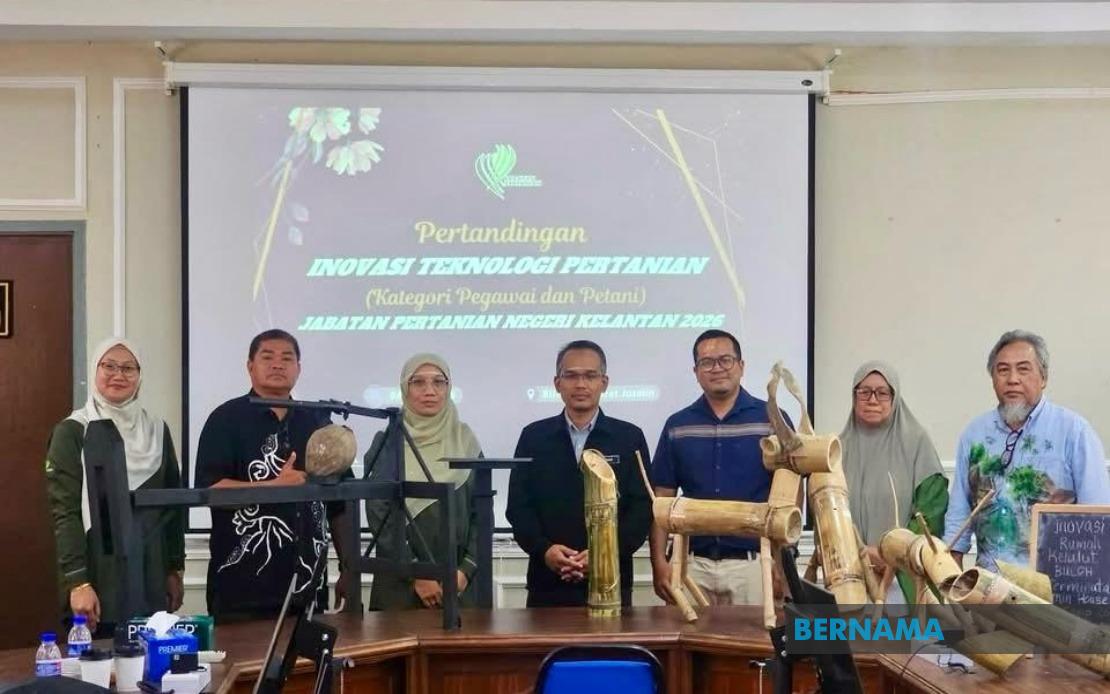
Plantation entrepreneur Che Adnan Che Kadir has caught the attention of Malaysia's agricultural innovation sector with a portable coconut dehusking device that reduced processing time by up to two-thirds on his six-hectare farm in Kampung Chetok, Pasir Mas. The 56-year-old farmer's invention earned a four-star rating at the Kelantan Department of Agriculture's 2026 Agricultural Technology Innovation Competition, positioning him as a candidate to represent the state at the national level during National Innovation Week in Putrajaya at the end of September. The recognition underscores growing interest in mechanising labour-intensive agricultural processes across Southeast Asia's plantation sector.
What makes Che Adnan's achievement particularly noteworthy is that the device emerged from practical problem-solving on his own farm rather than institutional research. Faced with the drudgery and injury risks inherent in traditional hand-dehusking methods, he developed the 3.5-kilogramme machine in 2024 to streamline coconut processing. The impact was immediate and measurable: tasks that ordinarily consumed two to three minutes of skilled labour now take approximately one minute, with experienced operators completing the work in 40 to 45 seconds. This efficiency gain matters significantly in commercial agriculture, where labour costs continue to climb and worker availability remains unpredictable across rural Malaysia.
The judging panel's recommendation to adapt the device for durian processing reflects astute agricultural thinking. Durian extraction is notoriously hazardous, demanding considerable skill to open the fruit's formidable husk safely without damaging the flesh or injuring the handler. Workers frequently sustain cuts and puncture wounds from the spiky exterior, and the physical strain of processing large volumes takes a toll on farm workers' health. A mechanical solution could transform durian cultivation economics, particularly for smallholder farmers who currently rely entirely on manual labour. This aligns with Malaysia's broader push to modernise agricultural production and reduce occupational injuries in the sector.
Che Adnan's enthusiasm for the expansion opportunity reflects the mindset increasingly necessary in Malaysian agriculture. He expressed surprise that his farm-level invention garnered serious consideration for wider commercialisation, indicating that innovation pathways between individual farmers and institutional development remain relatively underexplored. The Kelantan Department of Agriculture's engagement with polytechnics and the Malaysian Agricultural Research and Development Institute (MARDI) during the evaluation process suggests a coordinated effort to identify practical innovations worthy of scaling. This institutional support, however modest, can determine whether promising grassroots ideas translate into market-ready products.
The prize structure accompanying the competition—notably the RM10,000 innovation grant—addresses a genuine bottleneck in agricultural innovation within Malaysia. Small-scale inventors and farming entrepreneurs frequently develop workable prototypes but lack capital to refine designs, conduct safety testing, or adapt products for commercial manufacture. Che Adnan explicitly identified this funding gap as critical to advancing his device toward durian processing applications. He noted the necessity of design improvements based on judges' feedback and the need for production capacity assessment aligned with industry demand. Without financial support, many promising innovations stall at the prototype stage, never reaching farmers who could benefit from them.
The potential commercialisation angle carries implications beyond individual farm productivity. Malaysia's durian industry generates substantial export revenue, with international demand for premium Malaysian varieties exceeding domestic supply. Processing bottlenecks at harvest time directly constrain output and quality control. A device that accelerates and standardises durian extraction could unlock significant production gains for commercial operators while simultaneously improving safety and reducing labour costs—a convergence rarely achieved in agricultural mechanisation. For smallholder durian farmers, mechanisation could facilitate transition from subsistence production toward commercial viability.
The national-level competition pathway provides Che Adnan an opportunity to test and potentially refine his technology with institutional backing. Representation at National Innovation Week in Putrajaya would expose his device to agricultural policymakers, industry stakeholders, and potential investors. Malaysian agricultural policy increasingly emphasises innovation-driven productivity growth, particularly in niche sectors like premium fruit cultivation. A domestically developed solution to durian processing could position Malaysia as a technology exporter within ASEAN, where durian farming extends across Thailand, Indonesia, and other nations facing identical labour and safety challenges.
The success of Che Adnan's initiative also highlights the importance of creating institutional channels that recognise and nurture farmer-generated innovations. Many agricultural improvements originate from practitioners responding to real constraints rather than from top-down research programmes. By incorporating practitioners into formal innovation competitions and providing evaluation pathways linking them with research institutions and funding mechanisms, governments can accelerate the transition from individual solutions to sector-wide improvements. The Kelantan Department of Agriculture's approach of engaging multiple stakeholders—departmental judges, MARDI researchers, and polytechnic expertise—creates a collaborative framework that enhances both evaluation rigour and implementation feasibility.
Moving forward, several factors will determine whether this coconut device actually reaches durian farms across Malaysia. Design adaptation from coconut to durian processing involves significant engineering challenges, given differences in fruit hardness, spike configuration, and internal structure. Durability testing, ergonomic optimisation, and cost-benefit analysis relative to manual processing will all influence farmer adoption rates. Che Adnan will need to navigate intellectual property considerations, manufacturing partnerships, and marketing strategies. The RM10,000 prize provides a foundation, but scaling from prototype to commercial production typically demands substantially larger investment.
The broader significance of this story lies in what it reveals about agricultural innovation capacity within Malaysia. A farmer's practical solution gaining traction through formal channels suggests that innovation ecosystems are maturing, with mechanisms to identify, evaluate, and nurture grassroots developments. This contrasts with historical patterns where rural innovation often remained localised and unrecognised. For policymakers committed to agricultural modernisation, stories like Che Adnan's underscore the untapped potential residing within the farming community itself. Channelling that potential through structured programmes, adequate funding, and institutional partnerships could yield transformative gains across Malaysian agriculture.
Chances remain that Che Adnan's durian adaptation will encounter unforeseen technical obstacles or market resistance. Agricultural innovation pathways are rarely linear. However, the recognition he has received, the institutional support mobilising behind his work, and the clear commercial potential of durian processing solutions all suggest he possesses the backing necessary to advance his idea toward meaningful implementation. For Malaysian agriculture seeking efficiency gains and safety improvements, such innovations represent precisely the kind of locally rooted, practically grounded development likely to generate sustainable impact across farming communities.

