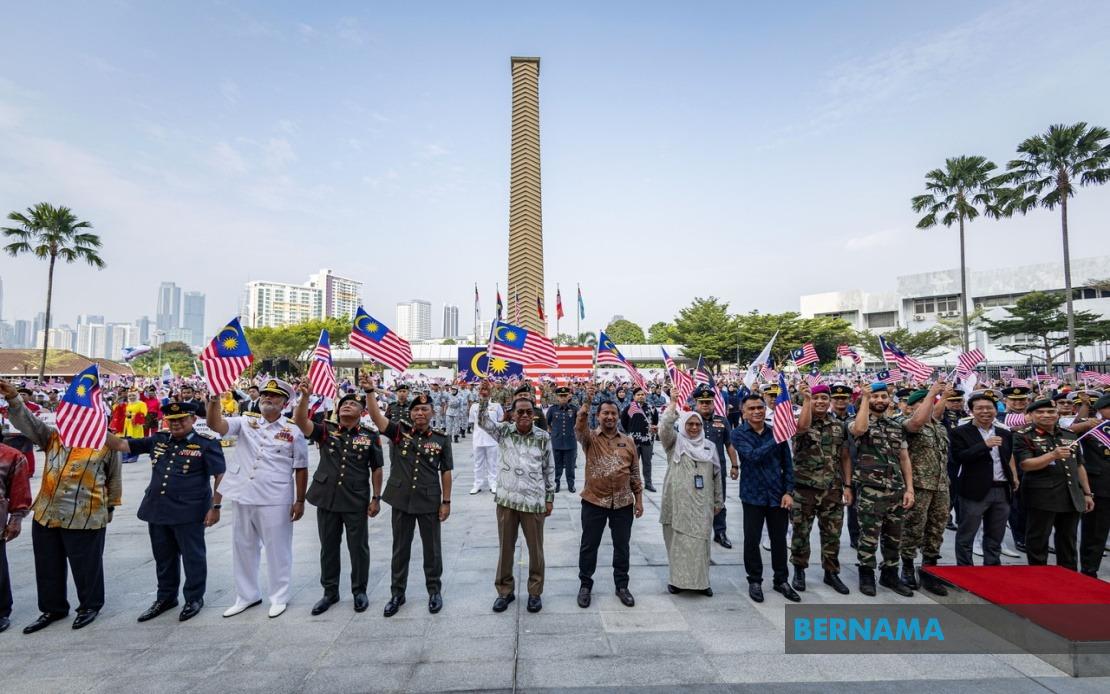
Defence Minister Datuk Seri Mohamed Khaled Nordin has urged Malaysians to approach the upcoming National Day and Malaysia Day observances with patriotism and unity rather than allowing them to become arenas for political grievance and debate. Speaking at the launch of the Defence Ministry-level National Month and Fly the Jalur Gemilang celebration in Kuala Lumpur on August 27, Mohamed Khaled emphasised that these occasions should serve as moments for the nation to celebrate shared values and strengthen collective affection for the country, rather than platforms to air divisive concerns.
The minister's remarks appear to be a pointed response to calls circulating within certain segments of Malaysian society to boycott the celebrations on account of specific policy disagreements. Mohamed Khaled singled out the Rohingya issue as an example of the type of separate political concern that should not, in his view, drive decisions about whether to participate in national festivities. His intervention suggests growing attention within government circles to how social media and activist networks are attempting to reframe Malaysia's patriotic calendar in ways that align with particular political agendas.
Mohamed Khaled's core argument rests on a distinction between patriotism and political activism. He contended that Malaysians should demonstrate their commitment to the nation by flying the Jalur Gemilang with pride and participating fully in celebrations, thereby sending a clear message both domestically and internationally that the country remains unified and strong. This demonstration of national solidarity, in his framing, serves a strategic function—it signals to both internal actors and outside observers that Malaysia will not permit itself to become fractured by partisan dispute or foreign interference. The implication is that boycotts or selective participation undermine this essential signal of cohesion.
The Defence Minister grounded his appeal in Malaysia's foundational principles as a multi-racial, multi-religious nation constructed on deliberate frameworks of mutual respect and understanding. He asserted that these values—which represent hard-won achievements from Malaysia's independence through to the present day—must remain central to how Malaysians relate to one another and approach collective challenges. For Mohamed Khaled, allowing National Day to become entangled with specific grievances risks eroding the delicate social fabric that has enabled Malaysia to navigate diversity without descending into the communal conflict that has afflicted parts of the region.
This perspective reflects an increasingly prominent tension within Malaysian civic life between those who view national occasions primarily as moments for unity building and those who regard them as opportunities to amplify unresolved social justice concerns. Activists and civil society organisations have in recent years sought to use high-profile national events to draw attention to causes ranging from the treatment of displaced Rohingya to broader questions about governance, transparency, and minority rights. For figures like Mohamed Khaled, such appropriation of national symbolism for what he characterises as polemics threatens to undermine the patriotic consensus necessary for national strength.
The Defence Minister's emphasis on security personnel and national sovereignty adds another dimension to his argument. By invoking the sacrifices made by military and paramilitary forces protecting Malaysia's borders, and by calling Malaysians to remember and pray for their wellbeing, Mohamed Khaled frames national celebration as an expression of gratitude toward those who maintain the nation's independence and territorial integrity. In this rendering, boycotting or politicising National Day celebrations becomes not merely disagreement with government policy but potentially a failure to honour those who have given much to preserve the nation itself.
For Malaysian readers and policymakers, Mohamed Khaled's intervention carries several implications. First, it signals that the government and defence establishment are sufficiently concerned about boycott movements that senior ministers feel compelled to address them publicly. Second, it reflects broader questions about how Malaysia—a diverse, democratic nation—should balance space for political dissent and activism against the imperative to maintain social cohesion. Third, it suggests that government messaging during the National Month period will emphasise unity over acknowledgement of particular grievances, with officials likely to characterise such acknowledgement as divisive rather than constructive.
The approach also reveals assumptions about how national identity functions in the Malaysian context. By positioning patriotism and political critique as fundamentally incompatible, Mohamed Khaled implies a particular model of national belonging—one in which love of country necessarily involves setting aside specific complaints during designated moments of collective celebration. This contrasts with alternative models where political participation and criticism might be understood as expressions of deep investment in national wellbeing.
For regional observers, Mohamed Khaled's remarks underscore how Southeast Asian governments are grappling with the challenge of managing nationalism and dissent in the digital age. Unlike previous eras when control of National Day messaging was mediated through traditional media, contemporary civic actors can now directly mobilise support for boycotts and counter-narratives through social platforms. This democratisation of commemoration has created pressure for senior leaders to defend traditional ceremonies and their meanings more explicitly than might previously have been necessary.
The Defence Minister's call for Malaysians to fly the Jalur Gemilang with gratitude and pride, while remembering to pray for the nation's wellbeing and security personnel's safety, represents a comprehensive vision of what National Day should signify. It emphasises not just abstract patriotism but concrete acts—flying the flag, offering prayers, honouring defenders—that bind citizens together in shared ritual and sentiment. Whether this vision will prove sufficient to prevent the politicisation that Mohamed Khaled warns against, however, may ultimately depend less on ministerial appeals than on whether the underlying grievances that motivate boycott calls are addressed through substantive policy changes.

