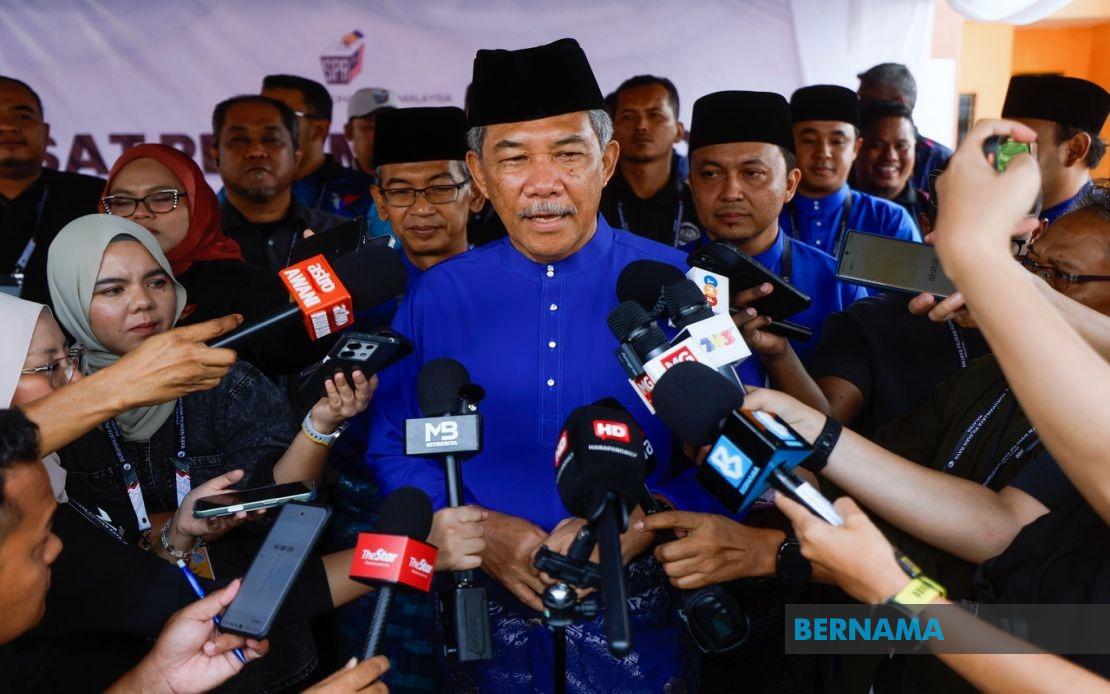
The Barisan Nasional coalition has signalled a clear boundary on campaign tactics ahead of Negeri Sembilan's state election, with senior party leadership explicitly cautioning against dragging customary law and tradition into partisan political messaging. Datuk Seri Mohamad Hasan, serving as both deputy chairman of BN and deputy president of UMNO, made the directive following nomination proceedings in Rembau on July 18, emphasizing that adat—the sultanate's institutional framework of traditional customs—must remain insulated from electoral competition.
The intervention reflects underlying sensitivities around how Malaysia's federal structure accommodates indigenous governance systems within democracy. Negeri Sembilan, like other Malay-majority states, operates under a constitutional arrangement where the Ruler's prerogatives, including stewardship of adat, hold constitutional standing. Party politicisation of such matters can inflame tensions between religious authorities, traditional institutions, and elected government, risking the delicate balance that underpins stability in states with strong sultanate institutions.
Mohamad articulated the concern plainly, asserting that weaponising adat for campaign advantage would only "complicate the situation" in the state and create "unnecessary tensions." His framing suggests BN recognises that while normal electoral competition over development, services, and governance records remains fair game, crossing into institutional and customary domains risks triggering backlash from multiple quarters—not least the palace and traditionalist constituencies who view adat as transcending party politics. The warning carries particular weight given UMNO's historical positioning as custodian of Malay-Muslim interests, which includes deference to sultanate authority.
The timing of this message is strategic. The Negeri Sembilan assembly was dissolved on June 5, setting off a compressed election cycle culminating in polling on August 1, with early voting scheduled for July 28. In such accelerated campaigns, discipline over message discipline becomes harder to enforce across party machinery at federal, state, and grassroots levels. By issuing this caution explicitly during the nomination phase, Mohamad sought to establish clear guardrails before campaigning intensifies.
Mohamad's statement also underscores broader structural realities within Malaysia's electoral framework. Unlike most Westminster democracies, Malaysia's state elections occur within a constitutional architecture that reserves certain domains—particularly those touching on Islam, Malay special rights, and traditional sovereignty—from unfettered democratic contestation. Transgressing these boundaries, even in campaign rhetoric, invites institutional and legal pushback that can undermine a party's electoral narrative. By preemptively distancing BN from such tactics, Mohamad signals disciplined governance and respect for constitutional limits.
On the coalition front, Mohamad confirmed that BN maintains an electoral understanding with Perikatan Nasional, the rival coalition led by opposition forces. Crucially, he characterised this as a tactical "understanding" rather than a formal "coalition," deliberately distinguishing it from the more comprehensive BN-PN merger that took shape in Johor's state election. In Negeri Sembilan, the arrangement amounts to targeted constituency-level coordination: where BN is not contesting, PN candidates receive the implicit backing of BN-aligned voters, and vice versa. This pragmatism reflects electoral mathematics across the 36 state seats.
Such cross-coalition coordination, while tactically logical for marginalising common opponents, remains politically delicate in Malaysia's polarised environment. For BN, predominantly representing established Malay-Muslim institutions including UMNO and its component parties, collaboration with PN—which draws support from Islamist PAS and former UMNO dissidents in Bersatu—signals a recalibration of competitive terrain. The understanding avoids the appearance of formal merger while permitting vote consolidation, allowing both coalitions to frame the arrangement as pragmatic rather than ideological convergence.
For Negeri Sembilan specifically, such arrangements matter because the state has historically been competitive terrain between BN and opposition coalitions, with results often swinging on marginal voter shifts. The 36-seat legislature means that controlling even a handful of seats determines which coalition forms government. By coordinating with PN to avoid splitting anti-BN or anti-opposition votes in specific constituencies, both coalitions optimise their chances of maximising seat count relative to popular vote share.
Mohamad's emphasis on maintaining rather than deepening the PN understanding also signals BN's caution about appearing to cede ground to rivals. Formal merger language invites accusations that BN is desperate or declining; framing it as temporary coordination on specific contests allows BN to maintain its traditional narrative of representing stable, institutional governance while acknowledging electoral realities. For PN, the arrangement provides electoral legitimacy and visibility without requiring formal ideological alignment with BN's establishment orientation.
The adat warning and the coalition coordination statement together reveal how Malaysia's elections operate within distinctive institutional constraints. While campaigns emphasise performance, promises, and personality, they remain bounded by constitutional arrangements protecting sultanate prerogatives, religious authority, and traditional sovereignty. Similarly, coalition dynamics reflect not abstract ideological positioning but granular calculations about seat arithmetic, voter overlap, and institutional leverage.
For Malaysian voters and observers, these dynamics underscore that elections in Malaysia's federal system operate differently than in unitary democracies. Campaigns may appear familiar—candidates, rallies, manifestos—but the underlying terrain includes constitutional red lines and institutional hierarchies that shape what can be legitimately contested. BN's explicit warning to its own machinery exemplifies this: the party leadership is signalling that governing effectively in Malaysia requires respecting these boundaries, not merely winning elections through any available rhetorical means.

