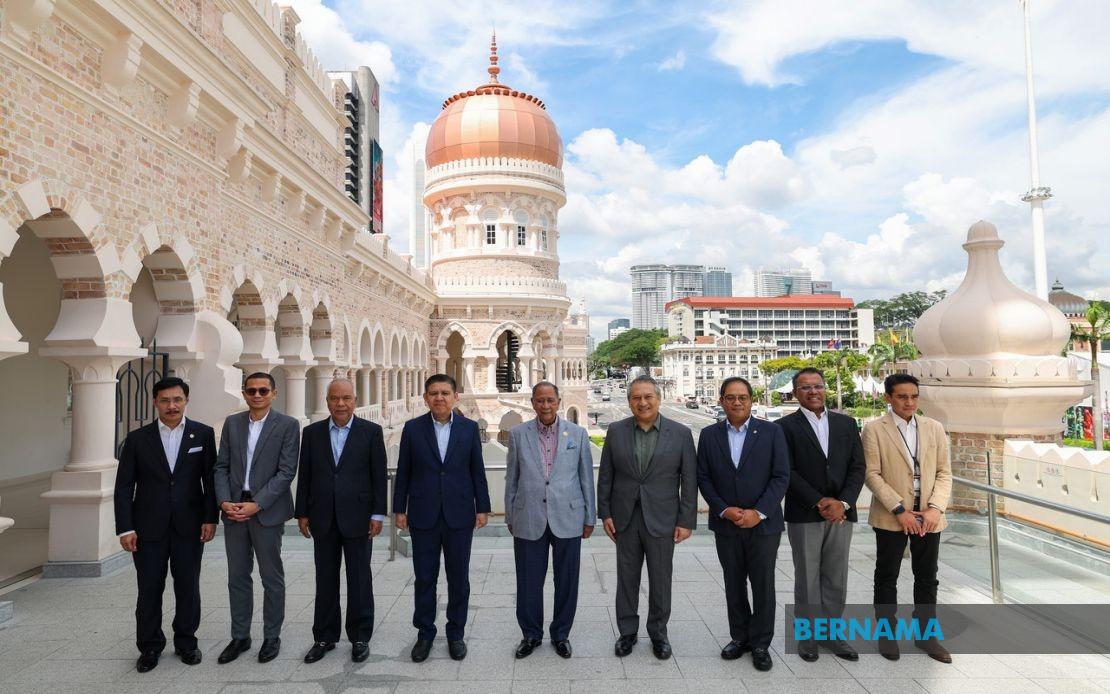
The Sultan of Kedah, Al Aminul Karim Sultan Sallehuddin Sultan Badlishah, conducted an official inspection of the Sultan Abdul Samad Building in Kuala Lumpur on June 24, marking a significant recognition of the heritage restoration project that has drawn considerable public interest since reopening its doors to visitors earlier this year.
Arriving at approximately 10.30 am, His Royal Highness was received by the managing director of Khazanah Nasional, Datuk Amirul Feisal Wan Zahir, along with senior officials including the chief corporate officer and general legal adviser Datuk Mohamed Nasri Sallehuddin and head of real assets Selvendran Katheerayson. The presence of these key figures underscored the importance Khazanah Nasional places on the successful restoration and repositioning of the iconic building as a cultural institution.
The royal tour encompassed several newly developed exhibition spaces within the building. His Royal Highness spent considerable time in the Confluence Hall, which operates as a comprehensive gallery documenting the origins and evolution of Kuala Lumpur from its earliest settlements through its emergence as a major Southeast Asian city. Think City senior manager Mariana Isa guided the Sultan through the exhibits, providing detailed explanations of how the capital developed from a modest tin-mining settlement into the thriving metropolis it is today.
The itinerary also included the Visionary Hall, where visitors encounter scale models and interactive multimedia displays that illustrate various phases of Kuala Lumpur's urban transformation and future development trajectories. This immersive approach to presenting the city's history reflects contemporary museum practices that engage visitors beyond traditional static displays, allowing them to understand the complexity of urban planning decisions and their implications for residents.
During his visit, the Sultan proceeded to the balcony overlooking the Porte Cochere, a significant architectural feature of the building that commands views of the surrounding civic district. He subsequently visited the School of Hard Knocks, an enterprise operated by Royal Selangor, before partaking in a light luncheon before departing the building at approximately 1.15 pm. The inclusion of these cultural and commercial elements in the tour demonstrates how the restored building now functions as a multifaceted venue serving educational, commercial, and ceremonial purposes.
Khazanah Nasional's managing director emphasised the profound significance of receiving royal patronage for the heritage conservation initiative. Amirul Feisal remarked that the Sultan's visit constituted formal recognition of the organisation's commitment to preserving not merely the building's physical structure but also the historical narratives embedded within its walls. He highlighted that the restoration efforts encompass broader objectives related to documenting and celebrating the development journeys of Kuala Lumpur, Selangor, and Malaysia as a nation, thereby connecting architectural conservation to national identity formation.
Since the building opened to public access on February 2 following the completion of Phase One restoration works, approximately 200,000 visitors have passed through its doors, indicating substantial community interest in exploring Malaysia's colonial and post-independence heritage. This visitor volume suggests that the public remains receptive to heritage tourism and that there exists meaningful appetite for understanding the built environment's role in national history.
The Sultan Abdul Samad Building carries particular historical weight in Malaysian collective memory. Originally constructed as the Secretariat Building during the British colonial administration, it functioned as the operational heart of the nation's government apparatus. Its most significant moment occurred in 1957 when the building witnessed the symbolic lowering of the Union Jack flag and the simultaneous raising of the Federation of Malaya flag, marking the formal transition from colonial rule to independent nationhood. For many Malaysians, the building represents the tangible location where sovereignty was reclaimed and a new national chapter commenced.
The restoration project's completion represents the culmination of an eleven-month conservation programme undertaken under the auspices of the Khazanah Heritage Fund. This initiative received prominent endorsement when His Majesty Sultan Ibrahim, King of Malaysia, officially inaugurated the Phase One completion on January 31, validating the project's importance within Malaysia's heritage preservation hierarchy. The involvement of the highest levels of both state and federal royal institutions demonstrates widespread recognition that such conservation efforts carry significance transcending mere architectural preservation.
For Malaysian readers and Southeast Asian observers, the restoration of the Sultan Abdul Samad Building carries implications beyond nostalgia or tourism development. It represents an institutional commitment to maintaining material connections to shared history during a period when rapid modernisation and urban development frequently displace historical landmarks. The building's new incarnation as an educational and cultural venue ensures that future generations encounter the spaces where defining national moments occurred, fostering deeper understanding of how contemporary Malaysia emerged from specific historical circumstances and decisions.
The royal visit's timing and prominence also signal the importance of heritage conservation within Malaysia's cultural policy framework, positioning historical awareness and architectural preservation as matters worthy of sustained investment and high-level political attention. As Southeast Asian nations grapple with balancing development imperatives against heritage preservation, such projects offer instructive models for integrating historical consciousness into contemporary urban life.