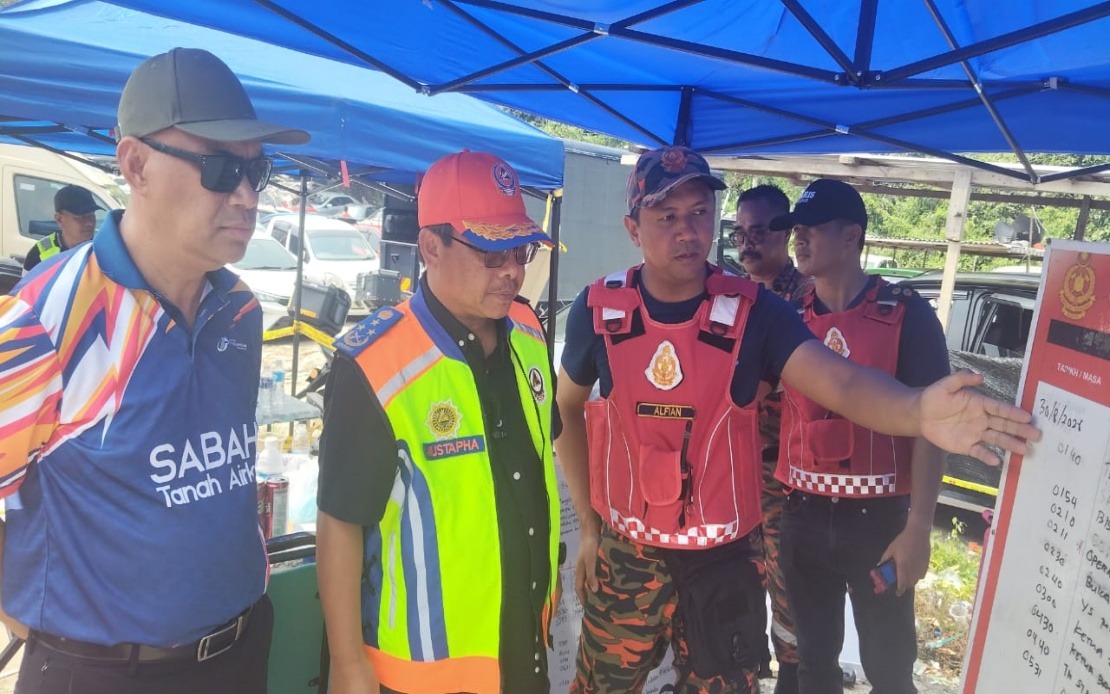
A devastating fire that swept through Kampung Lok Buta in Kota Kinabalu early on August 30 has left more than 200 families homeless and claimed the lives of three young children, prompting authorities to declare the residential area a disaster zone and establish emergency relief infrastructure.
Minister in the Prime Minister's Department (Sabah and Sarawak) Datuk Mustapha Sakmud announced that two temporary relief centres have been activated at Dewan Kampung Likas and Dewan Damai to provide immediate shelter and support for the affected residents. The centres serve a dual purpose: streamlining the registration of victims and coordinating the distribution of relief donations from the public and aid organisations.
The three fatalities have been identified as Nana Abdullah, aged four, her brother Mohd Asrul Abdullah, aged six, and their cousin Nurfarahdilah Mohd Tajihah, aged eight. The tragedy occurred at 1.40 am when the fire, which destroyed more than 200 residential structures, spread rapidly through the densely populated settlement. Mustapha indicated that initial financial assistance would be extended to the bereaved families as part of the government's immediate response.
Kota Kinabalu City Hall (DBKK) has formally declared Kampung Lok Buta a disaster zone in the aftermath of the incident, activating disaster management protocols and resources. DBKK mayor and District Disaster Management Committee chairman Datuk Seri Dr Sabin Samitah accompanied Mustapha during an inspection of the affected area, demonstrating the municipality's commitment to coordinating relief efforts at the local government level.
Recognising the potential disruption to education, Mustapha has pledged to engage the Ministry of Education regarding students affected by the fire. The minister emphasised the importance of identifying those from schools, higher education institutions, and Technical and Vocational Education and Training (TVET) programmes to ensure their educational trajectory remains intact and that appropriate support mechanisms are activated to facilitate their continued learning.
The incident has prompted a coordinated government response beyond immediate relief operations. Mustapha announced plans to brief both Prime Minister Datuk Seri Anwar Ibrahim and Sabah Chief Minister Datuk Seri Hajiji Noor during an upcoming Malaysia Agreement 1963 (MA63) Implementation Action Council meeting. This high-level attention reflects the significance of the disaster and the need for comprehensive, multi-agency solutions to assist the fire-affected community.
The establishment of relief centres represents a structured approach to disaster management, moving beyond ad-hoc assistance to create operational hubs where displaced residents can access services efficiently. Through centralised registration, authorities gain a clear picture of the scale of displacement, enabling targeted interventions tailored to specific household circumstances and vulnerabilities. This systematic approach is particularly crucial in Malaysian disaster response, where coordinating multiple aid channels and ensuring equitable distribution of resources demands robust administrative frameworks.
The tragedy underscores recurring concerns about fire safety and prevention in Malaysia's informal settlements and densely packed residential areas, where rapid urbanisation frequently outpaces infrastructure development and fire safety implementation. Kampung Lok Buta's destruction of over 200 homes in a single incident highlights the catastrophic consequences when fire control mechanisms are inadequate or building standards are not rigorously enforced. For Sabah, a state already grappling with rapid urban expansion in Kota Kinabalu, such incidents necessitate urgent review of building codes, fire safety drills, and emergency response capacity.
Mustapha's commitment to convene stakeholder meetings among DBKK and relevant agencies signals recognition that fire disaster response cannot be compartmentalised into relief phases alone. Reconstruction planning, investigation into the fire's origin, assessment of preventative measures, and systemic improvements to settlement safety must form part of a comprehensive recovery strategy. For residents of similar informal settlements across Southeast Asia, the Kampung Lok Buta fire serves as a sobering reminder of vulnerability to catastrophic loss and the critical importance of proactive fire prevention infrastructure.
The involvement of multiple governance layers—municipal, state, and federal—demonstrates Malaysia's disaster management framework, yet it also reveals potential inefficiencies when coordination between agencies must be established post-incident rather than embedded in preparedness protocols. The promised MA63 Implementation Action Council meeting indicates that the Sabah state government recognises the fire's significance beyond immediate humanitarian response, viewing it as an opportunity to address structural vulnerabilities in settlement planning and safety standards that contributed to such massive destruction.
For Malaysian policymakers and urban planners, the Kampung Lok Buta fire provides empirical evidence supporting investment in fire prevention infrastructure, community safety training, and building standard enforcement in high-density residential areas. The loss of three children particularly underscores the urgency of protecting vulnerable populations through preventative measures rather than relying solely on post-disaster relief, a lesson applicable across Malaysia's rapidly urbanising regions.

