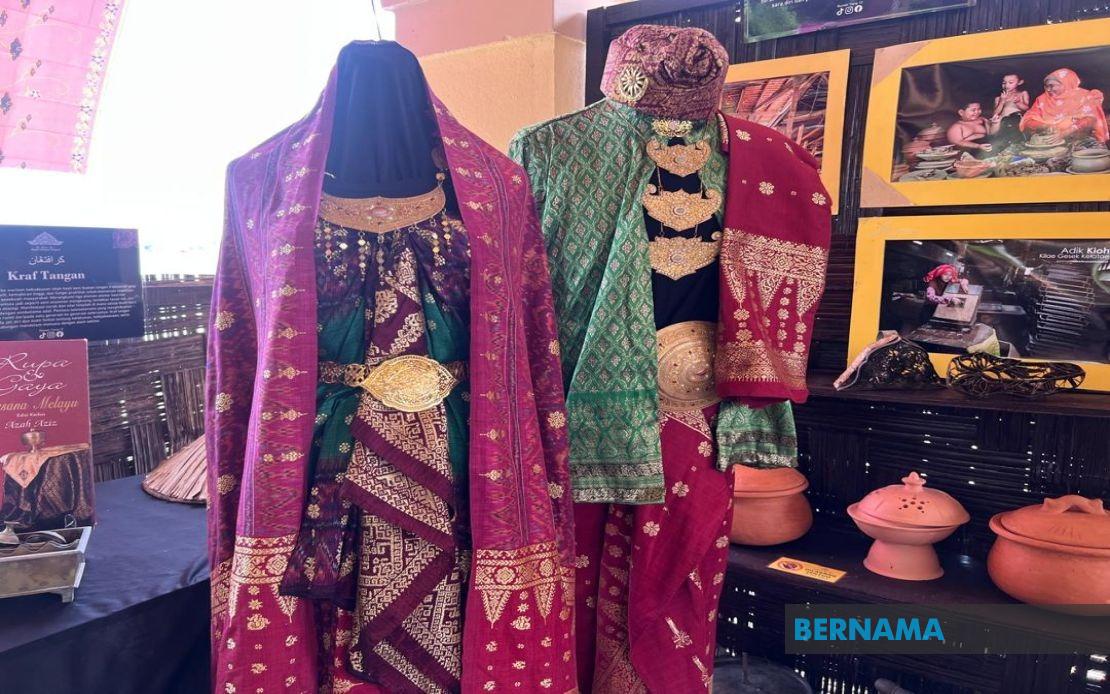
One of Malaysia's most refined textile traditions is quietly disappearing. Kain Lima, an elaborate woven fabric that once adorned royalty and signalled uncompromising luxury, now stands on the precipice of extinction as the artisans who dedicate their lives to the craft continue to dwindle. The alarm is sounding at cultural institutions across the country, particularly in Kelantan, the heartland of this ornamental weaving tradition, where exhibitions are being hastily organised to educate younger generations about what they risk losing forever.
The distinction of Kain Lima lies not in gold and silver threads alone, as casual observers might assume, but in its extraordinarily complex weaving methodology. According to Nik Mohd Murdani Nik Hassan, caretaker of Galeri Rumah Tiang 12, the textile's defining characteristic emerges from a sophisticated technique combining tied or tie-dyed threads with meticulous pattern arrangement. This combination produces motifs of remarkable intricacy and a distinctive colour-reflection effect that cannot be replicated by ordinary songket or standard weaving methods. The process demands immense precision, with every single motif requiring careful placement using multiple coloured threads before the actual weaving commences. This labour-intensive approach is precisely why the craft has become economically unviable for most practitioners in an age of mass production and cheaper alternatives.
Authentic Kain Lima commands substantial prices in today's market, typically ranging between RM3,000 and over RM4,000 per piece, with valuations rising according to age, motif complexity, condition, and the finesse of execution. These sums represent fair compensation for the countless hours of painstaking work involved, yet they also price the fabric beyond reach of ordinary Malaysians, creating a vicious circle where demand withers and fewer weavers find economic incentive to continue their ancestral practice. In centuries past, Kain Lima symbolised the epitome of elegance and was reserved exclusively for royal consumption, worn as sarongs, ceremonial shawls, and formal occasion dress by the Malay nobility. This historical prestige, ironically, has become a burden for the tradition's survival, as it lacks the mass-market appeal necessary to sustain a working community of weavers.
The visual distinctions between Kain Lima and other traditional textiles are apparent to the trained eye but invisible to the uninitiated. While songket emphasises the incorporation of precious metal threads woven into a fabric base, Kain Lima prioritises the architectural integrity of the weaving structure itself, where pattern and colour interplay create sophistication without necessarily relying on gold or silver embellishment. Nik Mohd Murdani emphasises that those genuinely conversant with traditional Malaysian textiles can identify Kain Lima instantly through examination of its patterns, structural composition, and materials used. This technical sophistication, however, remains largely unknown to the general public, meaning the craft's cultural significance and artistic merit rarely receive the recognition or protection they deserve.
In response to this cultural emergency, Galeri Rumah Tiang 12, where Nik Mohd Murdani has worked since 2020, has begun mounting exhibitions that bring together Kain Lima pieces from private collectors throughout Malaysia. These public presentations serve a critical function beyond mere display: they reintroduce Malay textile heritage to audiences who might otherwise remain unaware of these traditions' existence and importance. The gallery's curatorial approach allows visitors to examine authentic examples side-by-side with songket and other traditional fabrics, enabling direct comparison that illuminates what makes Kain Lima distinctive. For many Malaysians, particularly younger citizens disconnected from traditional crafts, such exhibitions represent their only opportunity to witness these textiles and understand why their preservation matters.
The initiative found enthusiastic response at the Festival Kesenian Rakyat Kelantan, where Kain Lima exhibitions drew craftspeople and heritage enthusiasts. Among those attending was Nur Anira Akmal Che Abdul Aziz, a 34-year-old handicraft artisan from Pasir Mas who recognised the exhibitions' value as inspiration and educational resource. Nur Anira described how observing the forms, motifs, and production techniques of heritage textiles directly influences her own creative practice, motivating her to infuse her contemporary work with traditional elements and distinct local identity. She noted that each such exhibition experience deepens her appreciation for Malaysia's textile heritage and reinforces her commitment to ensuring these cultural values do not vanish entirely from contemporary craft practice.
This intergenerational knowledge transfer represents perhaps the most urgent challenge facing Kain Lima's survival. Without younger artisans learning the intricate techniques from experienced masters, the craft faces extinction within one or two generations. The economic reality is stark: aspiring weavers cannot sustain themselves through Kain Lima alone, while simultaneously acquiring the skills requires years of apprenticeship under decreasing numbers of elderly practitioners. Many families that once passed weaving knowledge from parent to child now encourage offspring toward more economically stable careers, severing transmission lines that have endured for centuries.
The broader implications of Kain Lima's potential disappearance extend beyond mere loss of a textile style. It represents the erosion of accumulated cultural knowledge, aesthetic sophistication, and spiritual connection to craft practices that shaped Malay identity and regional significance. For Malaysia to lose Kain Lima would diminish its claim as a custodian of Southeast Asian textile heritage and undermine national efforts to position traditional crafts as culturally valuable and economically viable. The textile also represents Malaysia's place within broader Southeast Asian artistic traditions, where weaving techniques travelled trade routes and influenced neighbouring cultures across the region.
Cultural preservation efforts currently underway remain fragmented and under-resourced. While exhibitions serve awareness functions and institutions like Galeri Rumah Tiang 12 provide exhibition space, these approaches address symptoms rather than the underlying structural problems preventing new generations from engaging with the craft professionally. Sustainable preservation would require coordinated strategies including documentation of techniques, training programmes with living stipends for apprentices, market development initiatives that broaden buyer appeal beyond collectors, and integration of Kain Lima into educational curricula to build cultural appreciation among schoolchildren. Without such comprehensive approaches, exhibitions and appeals to heritage consciousness, while well-intentioned, may ultimately prove insufficient to arrest the tradition's decline.

