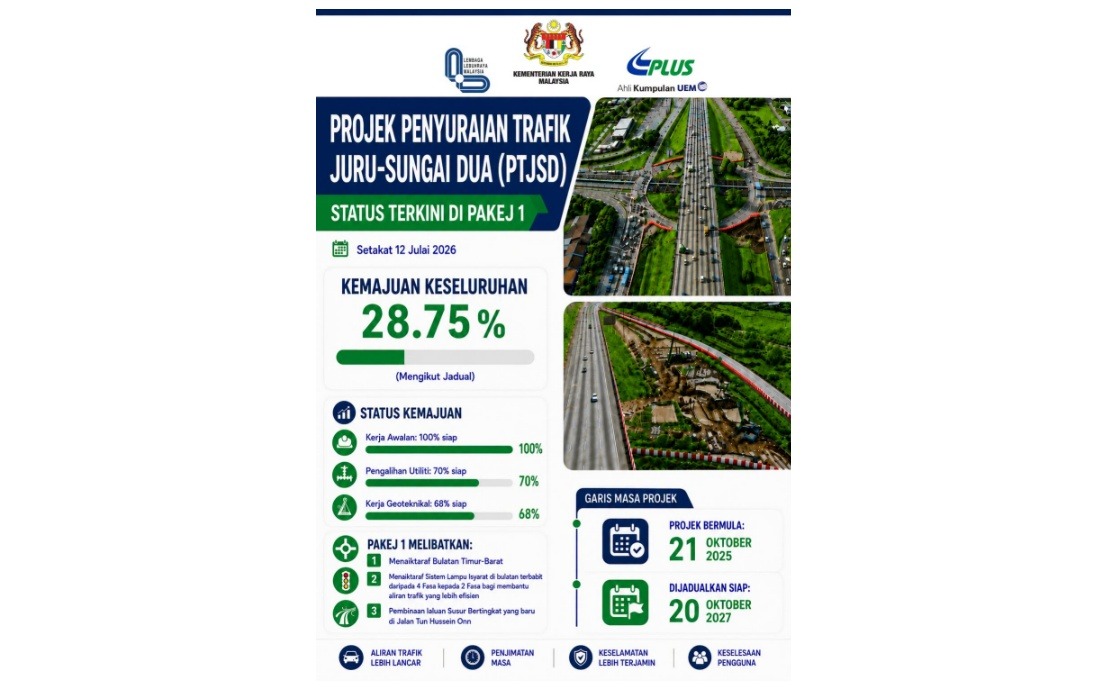
The Juru-Sungai Dua Traffic Dispersal Project (PTJSD) is progressing steadily toward its ambitious goals, with PLUS Malaysia Berhad confirming that Package 1 has achieved 28.75 per cent completion as of mid-July. The milestone demonstrates that the RM3 billion infrastructure initiative remains aligned with its delivery timeline, an increasingly rare achievement in Malaysia's highway expansion landscape.
Among the most substantial accomplishments to date, preliminary works across Package 1 have been entirely finished, clearing the way for more intensive construction phases. Utility relocation work—a critical but often time-consuming component involving the relocation of underground pipes, cables, and telecommunications infrastructure—has progressed to 70 per cent completion. Meanwhile, geotechnical investigations and preparatory ground works have reached 68 per cent, suggesting that the foundation for major structural elements is taking shape as planned.
The project's primary objectives centre on three major interventions within the East-West Roundabout precinct. PLUS announced plans to upgrade the roundabout itself, modernise the traffic light system governing vehicle flow through the intersection, and construct a new elevated slip road at Jalan Tun Hussein Onn. These improvements are specifically designed to untangle one of Penang's most chronically congested traffic corridors and restore functionality to a route that serves as the principal connector between Penang and states across the northern peninsula.
The scope of the undertaking is substantial. The project spans 17.3 kilometres of roadway crossing three major administrative divisions within Seberang Perai—the South, Central, and North districts—making it a genuinely region-wide intervention rather than a localised fix. Upon completion scheduled for October 2027, the infrastructure is projected to serve approximately 200,000 daily users, underscoring the traffic demand pressures facing this particular corridor.
The anticipated traffic management benefits are quantified and compelling. Planners expect that 30 per cent of existing traffic currently using congested alternative routes will migrate to the new direct Juru-Sungai Dua route once it becomes fully operational. This modal shift would translate into dramatic improvements in travel efficiency. Current journey times during peak periods stretch to approximately one hour, but projections suggest this could contract to merely 20 minutes with the new infrastructure in place—a three-fold reduction that would substantially enhance regional connectivity and economic productivity.
For Malaysian and Southeast Asian observers, the significance extends beyond engineering statistics. The Juru-Sungai Dua corridor represents a critical logistics artery for the region's manufacturing and trade sectors. Any bottleneck here ripples through supply chains serving the entire northern peninsular region, affecting industrial zones in Kedah, Perlis, and beyond. The efficiency gains promised by this project therefore carry implications for broader economic competitiveness across multiple states.
The project's implementation framework reflects modern best practices in major infrastructure delivery. PLUS Malaysia Berhad is collaborating with the Ministry of Works and the Malaysian Highways Authority, creating a tri-partite governance structure intended to coordinate technical delivery, regulatory compliance, and stakeholder management. This collaborative approach acknowledges that traffic management in conurbation areas requires coordinated action across multiple government agencies and private highway operators.
The specific focus on safety alongside congestion mitigation also deserves attention. Beyond pure throughput improvements, the project explicitly aims to strengthen safety aspects of the corridor. Improved traffic light systems and better-designed slip roads should reduce accident rates caused by abrupt lane changes, confused navigation, and high-speed merging in congested conditions. For local residents living adjacent to the corridor, safety improvements may prove as valuable as reduced noise and air pollution from stationary traffic.
From a project management perspective, maintaining schedule adherence over a 17.3-kilometre span represents a meaningful accomplishment. Large Malaysian infrastructure projects have historically faced delays stemming from unforeseen ground conditions, utility conflicts, land acquisition complications, and supply chain disruptions. The fact that geotechnical and utility work are progressing at 68 and 70 per cent respectively, with preliminary works completely finished, suggests that major sources of delay have been successfully navigated or avoided altogether.
Looking forward, the remaining 71.25 per cent of work will encompass the most structurally intensive and technically demanding phases—elevated roadway construction, intersection reconfigurations, and traffic system integration. These phases typically present greater complexity and risk than preliminary and utility work. The project's continued adherence to its October 2027 target will therefore provide a meaningful test of PLUS Malaysia's execution capabilities in managing large-scale, multi-component infrastructure delivery.
The project's promise of reducing peak-hour travel times from 60 to 20 minutes would represent transformative improvement for a region where congestion currently imposes substantial economic costs through lost productivity, delayed freight movements, and increased vehicle operating expenses. For the 200,000 daily users of this corridor, completion of PTJSD would mark a significant quality-of-life improvement, alongside the anticipated benefits for regional economic integration and competitiveness.

