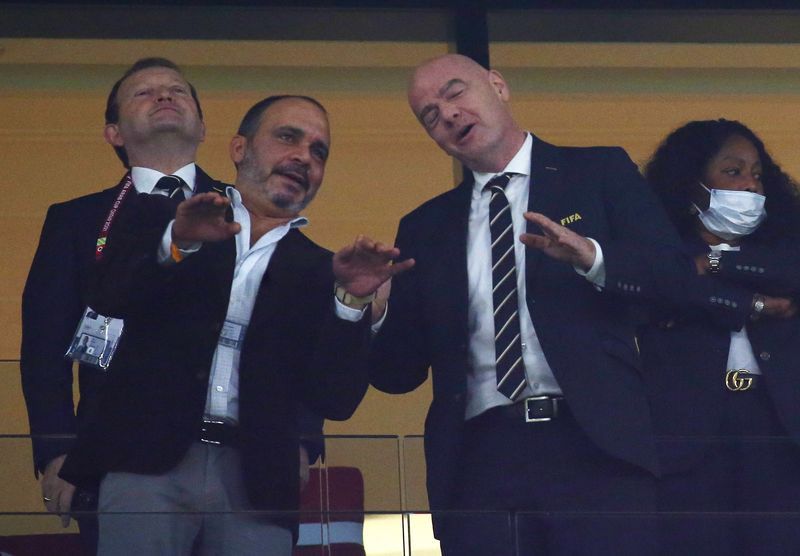
The President of Jordan Football Association, Ali bin Hussein, has levelled serious accusations against FIFA President Gianni Infantino, alleging coercive tactics aimed at securing his endorsement. The allegations, made public on Tuesday, centre on claims that FIFA made verbal commitments during the World Cup period, suggesting that endorsing Infantino would facilitate solutions to longstanding problems affecting Jordan's football administration. Bin Hussein has categorically rejected any suggestion of capitulation to what he characterises as blackmail, emphasising Jordan's commitment to ethical standards in sports governance.
The timing of Bin Hussein's denunciation coincides with mounting internal pressure on Infantino within global football's leadership structures. The Swiss executive has encountered significant resistance to a contentious proposal involving the partial privatisation of FIFA's commercial operations, which would have generated billions of dollars earmarked for sports development initiatives worldwide. The proposal, backed by a September 19 deadline, ultimately failed to gain traction after confederations and national associations voiced their opposition to the transaction.
The fallout from the World Cup stake sale controversy has extended beyond the boardroom. Mattias Grafstrom, FIFA's Secretary General, and renowned football strategist Arsene Wenger both distanced themselves from Infantino's strategic direction, signalling cracks within the organisation's senior management. Bin Hussein's intervention adds significant weight to existing criticisms, framing the leadership challenge as emblematic of broader governance concerns within world football's administrative apparatus.
Jordan's grievances extend far beyond the endorsement controversy, revealing structural disadvantages faced by smaller football nations operating within FIFA's framework. The Jordanian association has grappled with mounting costs and unresolved financial commitments that reflect systemic inequities in how FIFA distributes opportunities and support. These challenges underscore the frustrations that permeate footballing bodies across the developing world, where resource constraints intersect with demanding regulatory environments.
Ticket accessibility represents one substantive complaint, with Bin Hussein highlighting exorbitant pricing that excludes ordinary supporters from attending matches. Compounding this issue, Jordanian fans have been denied visa access to World Cup fixtures despite the team's historic qualification achievement. This administrative barrier prevents supporters from experiencing their national team's participation in sport's premier tournament, creating a disconnect between the players' accomplishment and the home nation's ability to celebrate it collectively.
The outstanding compensation owed for Jordan's participation in the 2025 Arab Cup, a FIFA-sanctioned tournament held in Qatar, exemplifies delayed financial obligations that burden smaller associations. The reward money, which should have been distributed by now, remains outstanding despite FIFA's publicly vaunted financial reserves. Bin Hussein's complaint highlights the disconnect between FIFA's global wealth accumulation and its responsiveness to individual federations' operational needs, particularly those representing nations with constrained budgetary capacity.
A unique grievance concerns differential tax treatment imposed by the United States government, which FIFA has channelled directly through its administrative mechanisms. Jordanian teams participating in the World Cup faced U.S. federal taxation on their presence, costs that were not similarly assessed against Canadian and Mexican squads operating from their respective territories. This unequal fiscal burden, processed through FIFA's financial systems, has diverted resources intended for player welfare and staff remuneration toward government tax obligations—a distinction Bin Hussein argues reveals systematic unfairness in how participation costs are distributed across participating nations.
Jordan's first-ever World Cup qualification in 2022 marked a watershed moment for the nation's football programme, yet the experience has been shadowed by administrative complications and financial difficulties. Despite exiting at the group stage, the team's achievement represented genuine progress for a football programme operating with a minimal budget relative to wealthier football nations. The contrast between this historic accomplishment and the bureaucratic obstacles encountered subsequently illustrates how structural challenges within FIFA's governance can undermine developing nations' football ambitions.
Bin Hussein's public stance reflects broader tensions within global football governance between FIFA's centralised institutional interests and the diverse needs of member associations. Smaller nations, operating with constrained resources and minimal political leverage, frequently find themselves navigating complex regulatory frameworks that appear designed primarily to benefit established football powers. The Jordan FA chief's allegations suggest that governance challenges extend beyond structural inequities to encompass allegedly coercive relationship dynamics at senior administrative levels.
The accusations carry particular significance for Southeast Asian football administrators and emerging football nations watching how FIFA responds to challenges to its leadership and institutional practices. If substantiated, the blackmail allegations would represent a serious departure from the ethical standards FIFA purportedly upholds through its governance frameworks. The absence of immediate FIFA transparency regarding these allegations leaves space for further criticism from member associations harbouring similar concerns about institutional fairness and administrative conduct.
Bin Hussein's refusal to endorse Infantino despite alleged inducements signals that some football administrators prioritise institutional integrity over pragmatic gains. This stance contrasts with the incentive structures FIFA appears to have constructed, whereby smaller federations might be tempted to trade endorsements for institutional support. The Jordan FA president's public dissent effectively amplifies concerns already circulating within football's governance hierarchy, potentially emboldening other associations to voice previously suppressed grievances about how FIFA conducts its business relationships.
The broader implications extend to FIFA's credibility as a neutral governing body capable of administering world football fairly and transparently. As investigations into these allegations unfold and Infantino's position faces continued scrutiny, member associations from developing football nations will likely reassess their relationships with the governing body. The outcome of this conflict may reshape how FIFA balances its institutional interests against member federations' substantive needs, particularly those representing smaller nations with limited bargaining power in global football's hierarchical structure.

