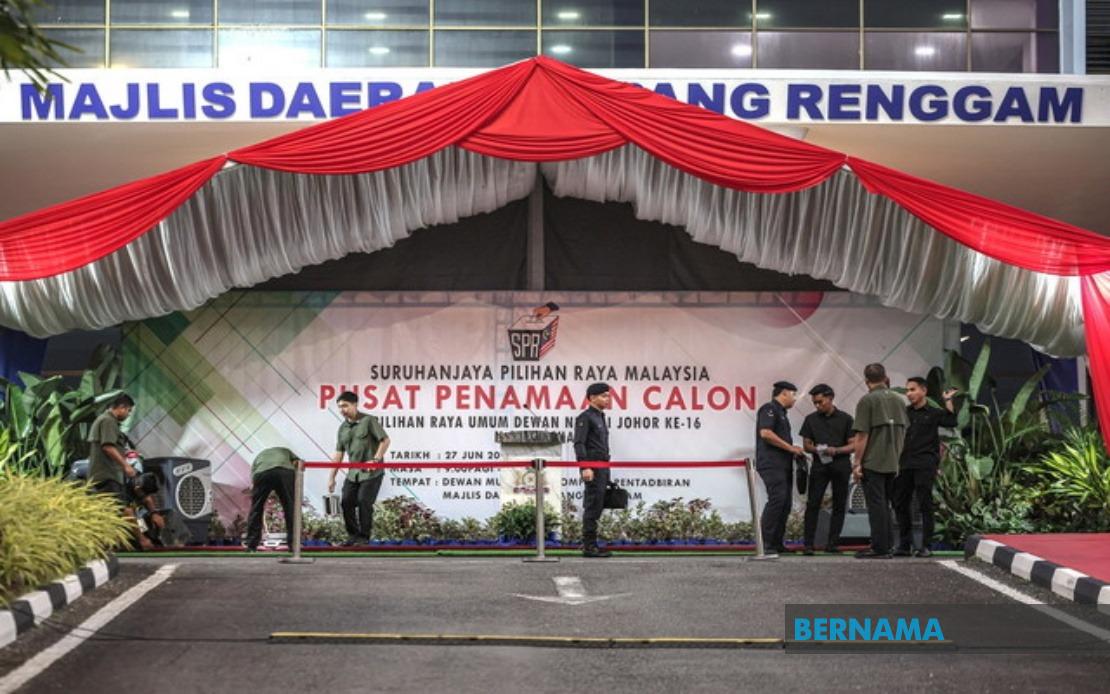
The electoral machinery in Johor swung into motion on June 27 as all 56 nomination centres across the state welcomed candidates for the 16th Johor State Election. The centres opened their doors at 9am sharp, initiating a carefully choreographed process that will ultimately determine who represents the southern state's constituents. Candidates were granted a narrow one-hour window, closing at 10am, to deliver their nomination documents to the respective returning officers—a compressed timeline designed to maintain strict procedural discipline and ensure rapid verification of submissions.
The nomination process itself carries specific requirements that reflect the electoral commission's emphasis on proper documentation and witness verification. Nomination papers must be presented by the candidate themselves, along with both a proposer and seconder, though the Election Commission permits flexibility in this requirement: submission may occur with all three parties present, any combination of two, or even a single representative carrying the completed documentation. This tiered approach accommodates the practical realities of political campaigns while maintaining the integrity of the nomination process through mandatory documentation trails and official scrutiny.
Political activity in Johor intensified considerably ahead of the formal nomination deadline, with party supporters mobilising from the early morning hours. Party faithful began assembling near nomination centres as early as 6:30am, creating a visible demonstration of electoral enthusiasm and party loyalty. This grassroots mobilisation sets the tone for what will prove a closely watched campaign period, particularly given Johor's significance as a major economic and political powerhouse within Malaysia's federation. The presence of organised party supporters also underscores the competitive intensity anticipated throughout the election cycle.
Following successful verification of nomination documents, the Election Commission has mandated a 14-day campaign period commencing immediately after candidate lists are officially published. This campaigning window extends until 11:59pm on July 10, providing political parties with a fortnight to present their manifestos, conduct grassroots engagement, and attempt to sway undecided voters. This standardised campaign duration balances the need for adequate political discourse with electoral efficiency, a formula repeatedly employed across Malaysian elections.
Weather conditions presented a variable backdrop for nomination day activities across Johor's diverse geography. The Malaysian Meteorological Department issued a mixed forecast, predicting rain in seven districts including Johor Bahru, Muar, Batu Pahat, Kota Tinggi, Pontian, Tangkak and Kulai during morning hours, while Segamat, Kluang and Mersing would likely experience clear conditions. Afternoon thunderstorms were expected across most districts, a seasonal pattern typical for Johor during this period. Such meteorological considerations, whilst seemingly routine, influence voter turnout and campaign logistics during the subsequent campaign period.
Security and crowd management emerged as significant operational priorities for nomination day. The Royal Malaysia Police, augmented by personnel from the People's Volunteer Corps (RELA), established comprehensive security protocols around all nomination centres to manage crowds and prevent any potential disturbances. Traffic management systems were deployed to facilitate smooth vehicular flow and prevent congestion in nomination centre vicinities. These security measures reflect the Election Commission's commitment to maintaining public order whilst facilitating unhindered democratic participation.
The electoral register for this contest encompasses a substantial voter population reflecting Johor's demographic weight within Malaysia. Approximately 2.73 million citizens are eligible to participate, comprising 2.7 million ordinary voters alongside 12,041 military personnel and their spouses and 12,710 police personnel and their spouses. This figure underscores Johor's significance as an electoral battleground, with the number of eligible voters representing a substantial bloc capable of influencing state government composition and policy direction. The inclusion of military and police family voters adds another constituency layer to electoral considerations.
The Election Commission has calibrated the election timetable to allow for orderly proceedings across subsequent phases. Early voting has been scheduled for July 7, accommodating those with scheduling conflicts or special circumstances, whilst the main polling day is set for July 11. This two-stage voting structure provides logistical flexibility whilst concentrating the primary electoral exercise within a defined timeframe. The staggered approach also reflects administrative best practices refined through Malaysia's extensive electoral experience.
For Malaysian observers and regional analysts, the Johor state election carries significance beyond local governance considerations. Johor serves as a critical political indicator for the nation's broader political trajectory, given its substantial representation in the federal parliament and its role as a gateway to Singapore with important economic and security implications. The campaign period ahead will likely witness intense political messaging around economic management, cost of living pressures, and development priorities—issues resonating across Malaysia's electorate. Early indications suggest a competitive contest that could reshape Johor's political landscape and provide insights into shifting voter preferences across peninsula Malaysia's southern corridor.

