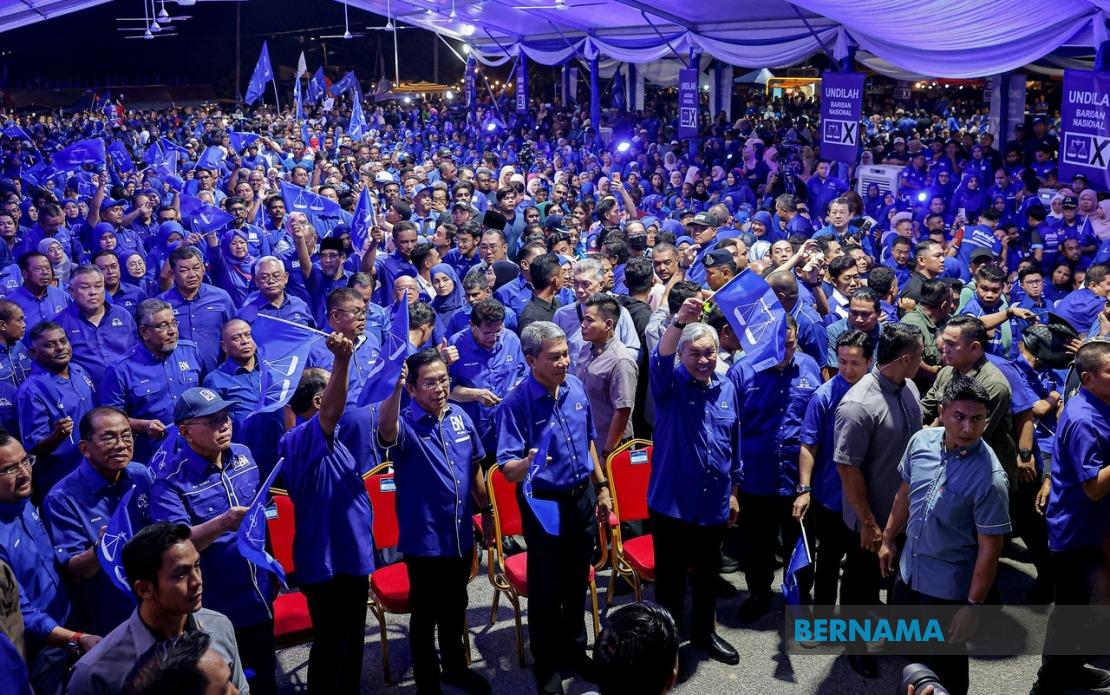
Barisan Nasional's commanding performance in Johor should serve as momentum for the coalition to dominate the upcoming 16th Negeri Sembilan state election, according to BN chairman Datuk Seri Dr Ahmad Zahid Hamidi. Speaking at Tuanku Abdul Rahman Stadium in Paroi during the launch of BN's election machinery and candidate announcement, Ahmad Zahid stressed that the coalition must seize this window of political opportunity to extend its regional dominance and reinforce public confidence in its governance credentials.
The magnitude of BN's Johor triumph cannot be overstated. The coalition captured 48 of the 56 state seats whilst securing nearly 60 per cent of the popular vote, marking the largest victory in the state's electoral history. Ahmad Zahid framed this outcome as evidence that Malaysian voters trust BN to provide the political stability, economic development, and responsible administration that competing coalitions struggle to deliver. This narrative positioning is crucial for BN as it prepares for the Negeri Sembilan contest, where rebuilding voter confidence remains a strategic imperative following the coalition's weaker 2023 performance.
The path to replicating Johor's success in Negeri Sembilan, Ahmad Zahid contended, lies fundamentally in maintaining cohesion within the BN framework. He attributed Johor's victory directly to unprecedented unity among coalition members who worked as a coherent force, trusted one another implicitly, and leveraged complementary organizational strengths. This emphasis on internal solidarity carries particular significance for Negeri Sembilan, where factional tensions have periodically surfaced within UMNO and other BN components. The message appeared deliberately crafted to neutralize potential grievances among candidates who might feel overlooked during the selection process.
Acknowledging the emotional dimensions of candidacy politics, Ahmad Zahid explicitly appealed to party cadres to subordinate personal ambitions to the collective mission of securing electoral victory. He urged members not to become consumed by debates over who receives the Menteri Besar nomination or individual candidacies, cautioning that such preoccupation risks diverting energy and focus from the ground-level work necessary to win voter support. This intervention suggests BN leadership anticipated potential friction during the candidate selection phase and sought proactively to contain dissatisfaction by reframing the stakes beyond individual advancement.
The operational mandate Ahmad Zahid outlined for BN's election machinery emphasizes intensified grassroots engagement. Party members were instructed to conduct immediate door-to-door canvassing campaigns, maintain consistent voter contact, and cultivate direct relationships with constituents across their respective electoral divisions. This intensive ground strategy represents the practical translation of BN's broader strategic confidence, reflecting calculations that sustained organizational presence and personal voter contact remain decisive factors in Malaysian state elections.
The Electoral Commission's tight timeline for the Negeri Sembilan election adds urgency to BN's mobilization efforts. Nomination day was scheduled for the Saturday immediately following Ahmad Zahid's remarks, with early voting set for July 28 and general polling for August 1. This compressed calendar compresses the campaign window substantially, placing a premium on pre-positioned organizational capacity and immediate activation of party machinery. BN's decision to launch its election operations simultaneously with candidate announcement indicates a determination to minimize administrative delays and maximize the active campaigning period.
Context surrounding the Negeri Sembilan contest reveals both opportunity and vulnerability for BN. In the 2023 state election, the coalition secured only 14 seats, a result Ahmad Zahid explicitly committed to improving. The three-year interval since that election has witnessed evolution in voter sentiment and shifts in state-level political dynamics. Negeri Sembilan's electorate has demonstrated willingness to distribute support across competing coalitions, suggesting the outcome remains genuinely competitive rather than predetermined. BN's campaign will need to synthesize messaging around economic management, development delivery, and political stability with targeted responses to state-specific concerns and community priorities.
The presence of BN deputy chairman Datuk Seri Mohamad Hasan and other coalition leaders at the Paroi stadium event underscored the significance BN leadership attaches to this election. Such senior-level participation signals that Negeri Sembilan occupies strategic importance within BN's broader regional calculations. A decisive victory would reinforce narrative momentum following Johor, whilst a disappointing result would complicate BN's positioning heading toward potential federal political developments. The stakes extend beyond Negeri Sembilan itself into the broader competition for public perception regarding which coalition offers superior governance and economic stewardship.
Ahmad Zahid's characterization of Johor's result as reflecting public confidence in BN leadership carries implicit comparison to opposition coalition governance models. This framing positions the election as a referendum on competing visions of administration and development strategy. For Malaysian voters, particularly in states where BN previously dominated before recent electoral setbacks, the Johor outcome may well influence assessments of which coalition offers more reliable economic management and political continuity. The Negeri Sembilan campaign will likely amplify these comparative judgments through targeted messaging about regional development projects, fiscal management records, and institutional competence.
The cohesion narrative Ahmad Zahid emphasized deserves particular attention given Malaysian coalition politics' historical susceptibility to internal tensions. By explicitly calling for members to subordinate factional interests and personal ambitions to collective success, he acknowledged that such temptations exist within BN's structure. The appeal for unity "under one banner of struggle" carried undertones suggesting that maintaining coalition discipline remains an ongoing challenge requiring regular reinforcement. Success in Negeri Sembilan would vindicate this unity emphasis and provide evidence that BN can govern its internal tensions constructively during electoral campaigns.
For Southeast Asian observers tracking Malaysian political developments, the Negeri Sembilan election provides insight into how BN consolidates electoral gains and manages the transition from regional triumph to broader political momentum. The election occurs within a context where Malaysian state-level politics increasingly operates semi-independently from federal alignments, creating distinct local dynamics that candidates and parties must navigate. BN's performance in Negeri Sembilan will test whether Johor's organizational effectiveness and messaging resonance prove transferable across different state contexts or represent more localized advantage.

