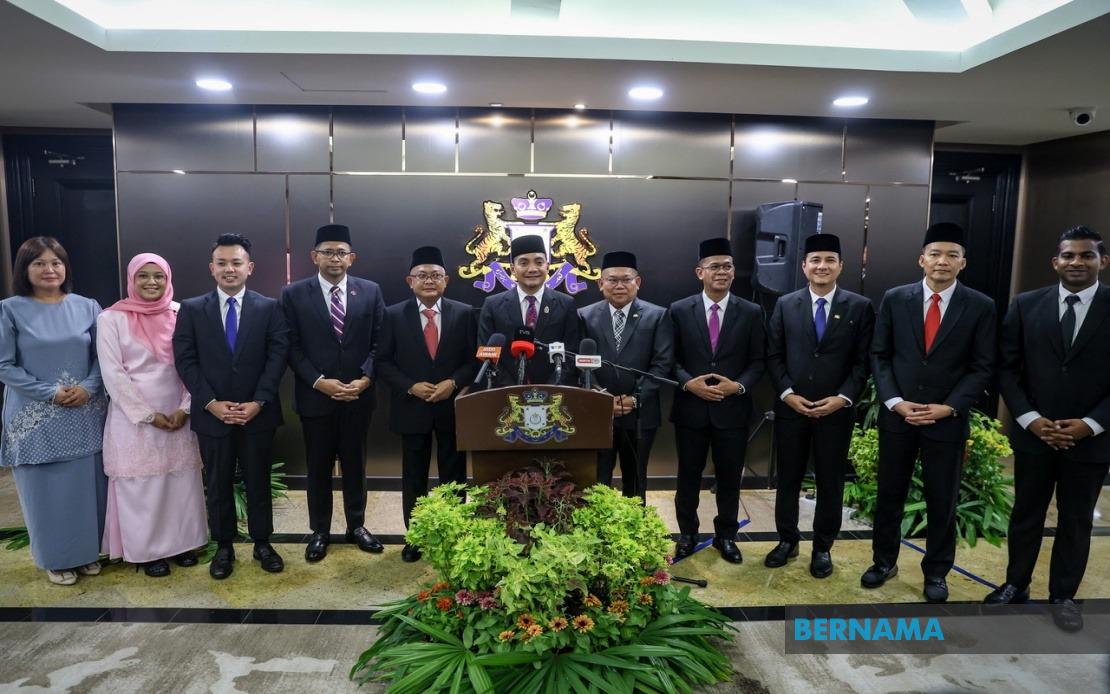
Johor has taken a significant administrative step by appointing 10 deputy committee chairmen to its State Executive Council, a move designed to strengthen governance structures as the southern state intensifies efforts to achieve developed nation status by 2030. Menteri Besar Datuk Onn Hafiz Ghazi unveiled the appointments during a press conference at Kota Iskandar on July 22, framing the expansion of leadership roles as a necessary response to accelerating development demands and the complexity of implementing statewide initiatives across multiple districts.
The appointments come with the formal consent of Johor's Regent, Tunku Mahkota Ismail, and reflect the government's commitment to distributing administrative responsibilities more widely to improve operational efficiency. This restructuring underscores a broader strategic approach where the state seeks to embed greater oversight capacity at multiple levels of decision-making, particularly as Johor pursues concurrent policy objectives that span economic transformation, infrastructure development, and social service delivery.
According to Onn Hafiz, the expanded leadership framework serves multiple complementary objectives. The primary aim is to enhance the state administration's overall capacity to implement policies, projects, and programmes with greater speed and precision. By introducing deputy committee chairmen, the state government intends to create additional checkpoints for quality assurance and project monitoring, reducing bottlenecks that might otherwise delay development work or create service gaps.
The appointments are explicitly linked to two major developmental blueprints guiding Johor's trajectory: the Maju Johor 2030 framework and the Johor Economic Transformation Plan (JETP). These ambitious planning documents outline how the state aims to transition to developed status, requiring coordinated action across infrastructure, human capital, industrial policy, and environmental sectors. The inclusion of deputy committee chairmen is positioned as an operational tool to translate these strategic visions into tangible district-level outcomes.
Onn Hafiz emphasised that the new office-holders will bear substantive responsibilities beyond ceremonial duties. Each deputy chairman is expected to work in tandem with their corresponding committee chairman, maintaining close coordination with relevant government departments and agencies. Their remit extends to monitoring capital projects, supervising field operations, and ensuring that government programmes penetrate to grassroots communities rather than remaining confined to state-level planning documents.
From a governance perspective, this expansion reflects a widely recognised challenge in Malaysian public administration: the difficulty of translating policy intentions into consistent, equitable implementation across geographically dispersed communities with varying capacity levels. Johor, like other Malaysian states, comprises multiple districts with distinct economic profiles, demographic compositions, and infrastructure needs. Deputy committee positions can serve as dedicated liaison points ensuring that development benefits reach peripheral areas equitably rather than concentrating in state capitals or commercially dominant zones.
The emphasis on expediting public issue resolution also carries significance for Malaysian citizens, who frequently experience administrative delays in permit processing, complaint resolution, and project delivery. By introducing additional supervisory layers, Johor's government implicitly acknowledges that current structures may face bandwidth limitations during periods of rapid development activity. Deputy committee chairmen can potentially reduce processing timeframes by maintaining real-time visibility over multiple initiatives rather than relying on periodic reporting schedules.
For Southeast Asian observers, Johor's administrative restructuring represents a case study in responsive governance. Unlike rigid, unchanging bureaucratic structures, the state government demonstrates willingness to modify institutional arrangements when performance benchmarks or contextual changes demand adaptation. This flexibility can be valuable in federal systems where states operate with considerable autonomy, as successful administrative models in one jurisdiction may influence neighbouring or peer states.
The appointment process itself carries implications for Malaysian political dynamics. Senior positions within state executive councils typically reflect considerations of party balance, geographic representation, and factional interests within ruling coalitions. The relatively large cohort of 10 appointments suggests that the current administration has secured sufficient consensus or control to distribute positions without triggering internal conflicts that might paralyse decision-making. This political stability, in turn, can facilitate coherent policy implementation across the state bureaucracy.
Onn Hafiz's public framing of these appointments emphasises teamwork and shared responsibility rather than hierarchical command structures. This rhetorical emphasis suggests that Johor's administration is attempting to foster a collaborative culture within government, where multiple officials at different levels contribute to problem-solving rather than waiting for instructions from a single decision-maker. Such organisational cultures, when genuinely embedded, tend to produce more responsive and innovative public services.
The timing of the announcements—in July 2024—places these appointments within Johor's longer-term strategic calendar. As the state approaches the midpoint of its journey toward 2030 targets, consolidating administrative capacity now allows time to pilot new approaches, gather performance data, and adjust course if emerging evidence suggests that current structures remain inadequate. This mid-course positioning enables learning rather than committing irreversibly to administrative designs that subsequent experience might prove flawed.
For Malaysian citizens and investors monitoring Johor's development trajectory, the appointment of deputy committee chairmen represents a tangible signal of governmental seriousness regarding implementation. Beyond budget allocations and policy papers, adding identifiable officials accountable for coordinating specific government priorities creates reputational incentives for delivery. Named individuals are harder to ignore than anonymous bureaucracies, potentially creating improved transparency in how public resources are deployed and whether promised development materialises across districts.
Looking forward, the success of this restructuring will ultimately depend on whether deputy committee chairmen possess adequate authority, resources, and protected time to execute their mandates. Administrative positions lacking real decision-making power become decorative rather than functional. Johor's government will need to ensure that these newly appointed officials receive genuine delegated authority, sufficient secretarial support, and protection from competing demands that might dilute their focus on assigned committees. The coming months will reveal whether the appointments translate formal structures into improved service delivery or remain largely ceremonial adjustments to the state administration.

