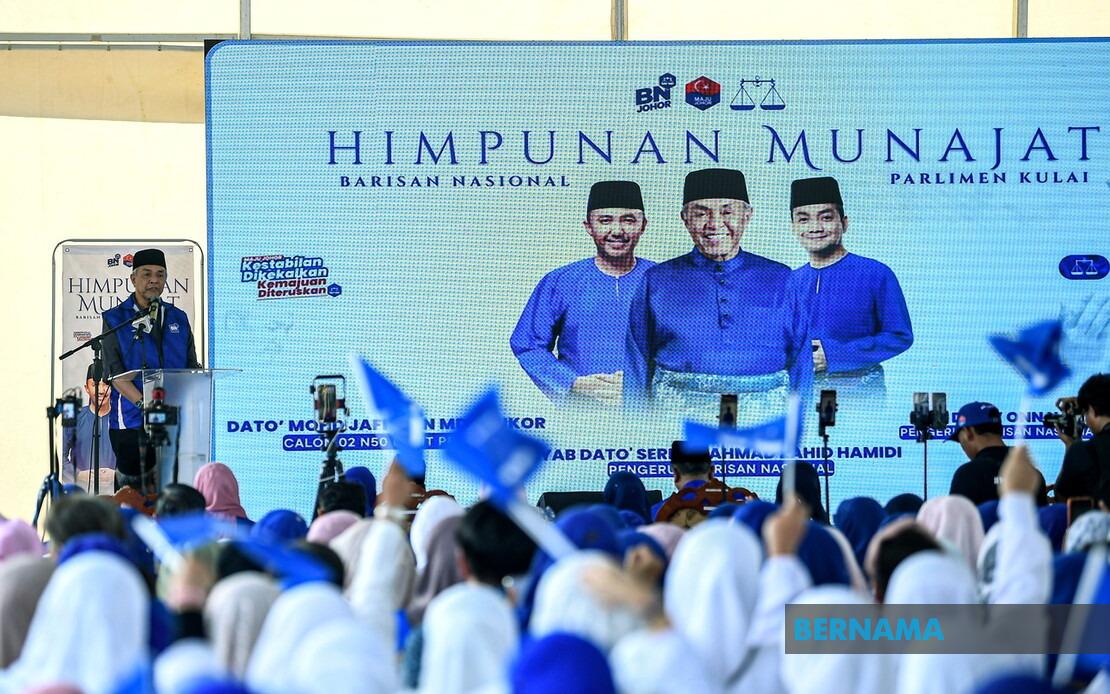
The Barisan Nasional leadership has moved to reassure the nation ahead of tomorrow's Johor state election, insisting that regardless of the outcome, the federal government will remain stable and the coalition relationships holding up Putrajaya will not be strained. Datuk Seri Dr Ahmad Zahid Hamidi, who leads BN as its chairman and serves as Deputy Prime Minister, delivered this message during a rally in Kulai on Tuesday, seeking to calm any concerns about potential political fallout from the contest in Malaysia's second-largest state.
Ahmad Zahid's statement carries particular weight given that BN and Pakatan Harapan are both fielding candidates across all 56 state seats, creating a competitive environment that could theoretically generate friction within federal arrangements. The Deputy Prime Minister appeared intent on drawing a clear distinction between healthy political competition at the state level and the operational requirements of federal governance, arguing that these two spheres can and must operate independently. His remarks suggest that BN strategists have mapped out internal messaging to prevent state-level animosities from bleeding into Cabinet discussions or inter-coalition negotiations at the federal centre.
The stability narrative carries strategic importance for Malaysia's current political architecture. Since the 2022 federal election, the federal government has been cobbled together through delicate negotiations involving multiple parties with divergent interests. Any perception that state elections could destabilise these arrangements would undermine investor confidence and parliamentary coherence. By pre-emptively addressing concerns about federal spillover effects, BN is attempting to signal that Malaysia's top policymakers possess the sophistication to compartmentalise political rivalries. This framing also reflects learning from earlier episodes when state-level results triggered shifts in federal coalitions or forced recalibrations of ministerial positions.
Ahmad Zahid elaborated that ministers and deputy ministers across the federal administration have demonstrated consistent professionalism in executing their portfolios without allowing Johor electoral competition to intrude into their day-to-day duties. He noted that cooperation within the Cabinet has so far remained uninterrupted and expressed optimism that this momentum would persist through the election period and beyond. This assertion amounts to a tacit acknowledgment that tension exists beneath the surface, but that institutional discipline remains intact. His emphasis on Cabinet professionalism suggests that party leadership has issued clear directives to ministers to maintain collegial working relationships regardless of their political affiliations or electoral interests.
The distinction Ahmad Zahid drew between private party competition and public Cabinet operations reflects broader expectations within Malaysian political culture. Ministers are expected to compartmentalise their political loyalties when entering Cabinet chambers, focusing on portfolio management and collective decision-making. This norm has been tested repeatedly when BN and PH competed in recent elections while simultaneously sharing federal power. The Deputy Prime Minister's statement can be read as both reassuring and cautionary—reassuring that norms hold, cautionary that maintaining them requires deliberate effort and leadership commitment from the top tier. His willingness to address the issue publicly suggests that party whips have been working behind the scenes to ensure compliance.
The Johor election represents a particularly sensitive contest because the state has historically served as an important power base for multiple political factions. Control of state government brings patronage resources, administrative machinery, and symbolic authority that can influence intra-coalition dynamics. Both BN and PH will be fighting intensely for victory, with campaign rhetoric and ground-level mobilisation potentially reaching aggressive levels. The very fact that BN's top leadership felt compelled to frontload messaging about federal stability indicates strategic concern about election-season rhetoric spiralling into federal-level confrontation. By establishing early guardrails on expectations, Ahmad Zahid appears to be trying to prevent a scenario where state election tensions translate into Cabinet paralysis or coalition breakdown.
Ahmad Zahid also appealed to party members and grassroots supporters from both BN and PH to exercise emotional restraint once results are announced. This suggestion acknowledges that electoral outcomes can generate intense feelings among rank-and-file members, and that unmanaged expressions of disappointment or triumphalism could strain relations between coalition partners. His reference to the maturity demonstrated by senior leaders in both political blocs—implicitly suggesting that their professionalism should cascade downward—represents an attempt to establish a leadership narrative around democratic competition conducted with dignity. Whether grassroots activists will heed this message depends partly on the election's closeness and partly on whether party leadership continues to reinforce these expectations in post-election messaging.
The broader context involves Malaysia's evolving approach to coalition governance in the post-2022 era. The nation has experienced significant political volatility in recent years, with elections sometimes precipitating sudden shifts in federal arrangements. The current federal coalition reflects hard-won compromises between ideologically different partners. Protecting this arrangement from electoral disruption requires clear communication that state-level results, while important for state governance, will not automatically trigger federal recalibration. Ahmad Zahid's statement essentially argues for the professionalism to maintain federal commitments even when state-level fortunes change—a position that requires commitment from both BN and PH leadership.
For Southeast Asian observers, Malaysia's approach to managing state elections within federal coalitions offers a case study in political negotiation complexity. The ability to compartmentalise state and federal political competition while maintaining coalition discipline represents a test of institutional maturity. If BN and PH successfully weather the Johor election without federal spillover, it would suggest that Malaysian political actors have learned from earlier tumultuous transitions. If the election generates federal tensions, it would indicate that state-level stakes remain too high for clean separation from federal dynamics. The coming weeks will test whether Ahmad Zahid's assurances reflect genuine institutional confidence or hopeful wishes.
Looking forward, the Johor election outcome will likely influence the trajectory of both state and federal politics, but perhaps not through the direct mechanisms observers typically anticipate. Rather than immediate coalition breakdowns, any shift in state control could gradually alter factional balances within parties, affect resource allocation to certain regions, or influence how constituent groups perceive their respective parties' competence. These gradual shifts could eventually influence federal calculations, but not through dramatic rupture. Ahmad Zahid's messaging suggests that BN strategists believe they have the political tools to manage such evolution without allowing it to destabilise the federal project. Whether this confidence proves justified will become apparent in coming months as state results are digested and their implications absorbed into Malaysia's complex political ecosystem.

