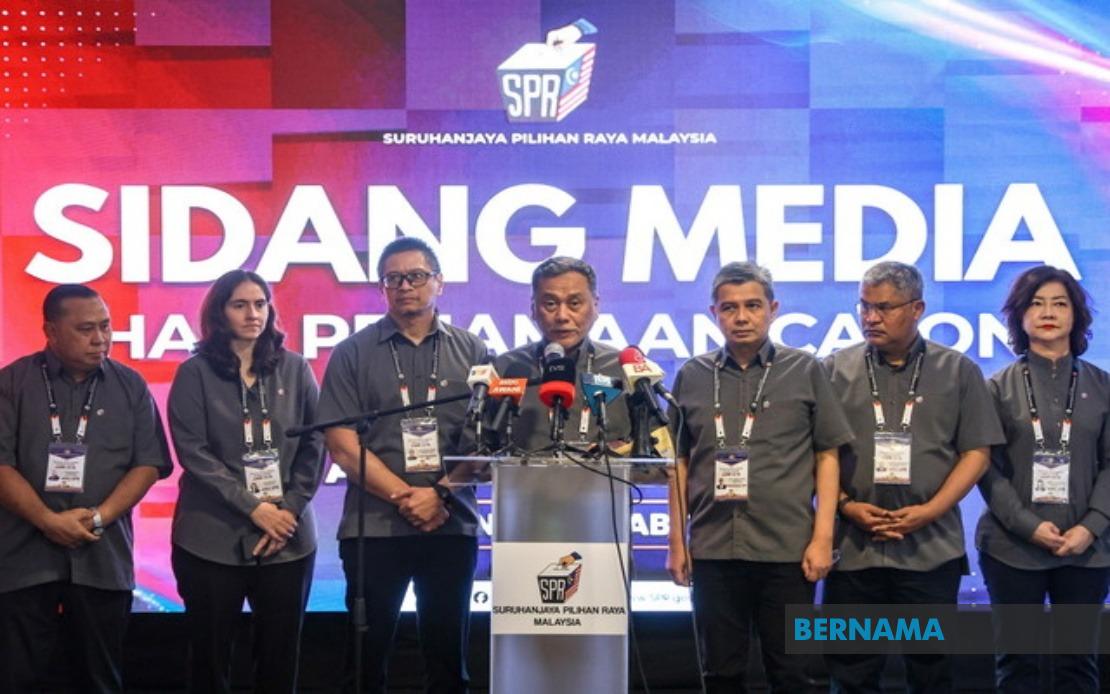
The Election Commission has formally announced that 172 candidates representing a diverse array of political parties will vie for seats in the 16th Johor state election, following the conclusion of nomination proceedings across all 56 nomination centres. EC chairman Datuk Seri Ramlan Harun confirmed that every nomination submission received approval, with zero candidates rejected during the process that wrapped up at 10 am on June 27.
The gender composition of the candidate pool reflects ongoing efforts to expand female representation in electoral contests, with women accounting for approximately 20 per cent of the total field. Of the 172 candidates, 138 are male while 34 are female, presenting both a measure of progress and a reminder of the substantial underrepresentation women continue to experience in Malaysian electoral politics. This ratio mirrors broader patterns across the nation, where women candidates remain a minority despite comprising half the voting population and increasingly dominating tertiary education outcomes.
Barisan Nasional maintains its traditional dominance by fielding the maximum possible slate of 56 candidates, one for each state constituency. Pakatan Harapan matches this showing with an identical 56-candidate contingent, reflecting the two major coalitions' determination to contest every available seat. This comprehensive coverage underscores the intensity of competition between these established political blocs and their confidence in their respective support bases across Johor's diverse constituencies.
Perikatan Nasional's deployment of 33 candidates positions it as the third significant contender in this electoral contest. The coalition's participation in Johor carries particular significance given the state's historical importance as a BN stronghold and its role in determining regional political direction. Perikatan's competitive showing suggests it has identified constituencies where it believes its messaging around particular governance issues or coalition partners carries resonance with local voters.
Smaller parties and political entities round out the contest, reflecting Malaysia's maturing multi-party ecosystem. Parti Bersama Malaysia fields 15 candidates, while MUDA contributes four aspirants. Parti Orang Asli Malaysia and Parti Sosialis Malaysia each sponsor a single candidate, testifying to the breadth of political voices seeking representation, even where organizational resources and incumbent advantages severely constrain electoral prospects. Additionally, six independent candidates will pursue victory without party affiliation, choosing to rely on personal profiles and community standing rather than party machinery.
The contest structure reveals considerable variation in competitive intensity across constituencies. Fourteen seats will witness straight fights between two candidates, creating clear binary choices for voters in those areas. By contrast, twenty-seven constituencies will feature three-cornered contests, introducing strategic voting calculus and potentially fragmenting support bases. Twelve seats involve four-way races, while three constituencies draw five candidates, generating highly complex electoral dynamics where victory margins may narrow significantly and coalition-building among candidates becomes conceivable.
This fragmented contest structure carries implications for both campaign strategy and governance outcomes. In multi-candidate constituencies, parties must invest heavily in ground organization to distinguish their candidates and mobilize supporters effectively. The presence of credible independent candidates or smaller-party contenders can fundamentally reshape electoral mathematics, as candidates who might otherwise win under two-party competition could fall to third place when the opposition vote splits among multiple aspirants.
Johor's election arrives at a critical juncture for Malaysian politics, where state-level contests increasingly serve as bellwethers for national sentiment. The state's ethnic and religious diversity, encompassing substantial Malay-Muslim, Chinese, Indian, and indigenous populations, makes it representative of Malaysia's broader demographic tapestry. Electoral outcomes here frequently presage shifts in national political alignment and can embolden or constrain federal-level coalitions depending on their performance.
For Pakatan Harapan, the Johor contest represents an opportunity to consolidate influence in a state where it gained ground in recent national elections but must overcome deep-rooted BN organizational networks. Perikatan Nasional's participation complicates matters further, potentially fracturing opposition votes in constituencies where multiple non-BN candidates divide anti-government support. The strategic calculus for smaller parties involves determining which constituencies offer realistic pathways to victory or meaningful vote-share growth, potentially influencing their bargaining position in future coalition negotiations.
The confirmation of all 172 nominations without disqualifications indicates that the Election Commission found no substantive irregularities in candidate documentation or eligibility. This smooth administrative process contrasts with some previous electoral cycles where nomination rejections sparked controversy and legal challenges. The absence of disqualifications suggests candidates successfully navigated complex procedural requirements and that the EC exercised its discretionary authority judiciously.
With nominations finalized, Johor's electoral campaign enters its formal phase, with candidates now authorized to conduct public engagements and solicit voter support. The compressed timeframe between nomination closure and polling day typically limits campaign duration in Malaysian state elections, placing emphasis on party organizational strength and media reach. Johor's media landscape, encompassing national broadcasters, vernacular outlets, and social media platforms, will amplify competing messages reaching voters across diverse linguistic and cultural communities.

