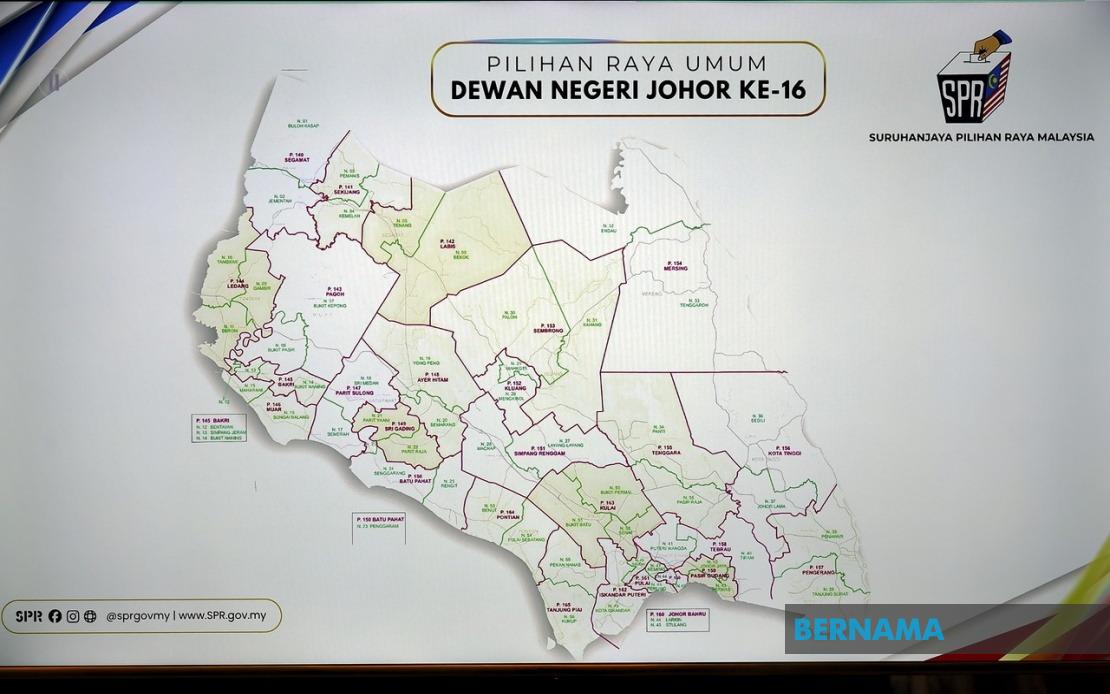
The 16th Johor state election formally begins tomorrow when nomination day marks the opening of what is shaping up to be a fiercely contested electoral battle. Registration of candidates will take place between 9 am and 10 am at designated nomination centres across the state, after which election officials will screen submissions and release the official roster of contenders. Polling is scheduled for July 11, with an earlier voting opportunity available on July 7 for those who cannot vote on the primary election day.
The electorate participating in this election encompasses nearly 2.73 million registered voters according to figures released by the Election Commission. This figure includes more than 2.7 million ordinary civilian voters, along with 12,041 military personnel and their spouses, and 12,710 police officers and their spouses. The substantial voter base reflects Johor's significance as one of Malaysia's most important states, and the turnout during this election will be closely watched as an indicator of broader political sentiment in the country.
All major political coalitions have signalled their intention to contest comprehensively, with candidates nominated across all 56 state assembly seats. Pakatan Harapan is fielding a complete slate comprising 20 candidates from Parti Keadilan Rakyat, 19 from Amanah, and 17 from DAP, representing the opposition coalition's strongest showing in the state. Barisan Nasional has similarly committed to the full contest with 36 UMNO candidates, 16 from MCA, and four from MIC, leveraging the ruling coalition's organisational machinery and incumbent advantages.
Perikatan Nasional has also thrown its weight behind the election with PAS contesting 11 seats, Bersatu fielding 16 candidates, and the Malaysian Indian People's Party contributing five more. This represents a significant investment by the coalition in what many view as a crucial battleground. Meanwhile, smaller parties and newer political movements are also participating, with the Malaysian United Democratic Alliance running four candidates, the Socialist Party of Malaysia fielding one, and Parti Bersama Malaysia making its debut with 15 candidates across the state.
The composition of candidate lists reveals how Malaysian political parties are balancing experience with renewal. While major parties have retained established politicians who performed well in the previous 2022 election, they have also introduced new faces to appeal to younger voters and demonstrate adaptability to changing political circumstances. Some former candidates who lost their seats previously have also secured nominations for another attempt, reflecting the cyclical nature of Malaysian electoral competition.
The Election Commission has issued guidance to prospective candidates to ensure smooth nomination procedures tomorrow. Candidates are being urged to verify their nomination forms in advance at either the Returning Officer's Office or the State Election Office to avoid procedural complications at the last moment. Additionally, deposit payments should be settled early, with candidates advised to retain their receipts as proof when formally submitting their nomination papers. These administrative steps, while routine, can prove critical when margins of error are minimal.
Anti-corruption enforcement will receive heightened attention throughout the election period. The Malaysian Anti-Corruption Commission has issued explicit warnings to all candidates and political parties regarding prohibited conduct under the MACC Act 2009 and the Election Offences Act 1954 as amended in 2012. The commission has established five dedicated 24-hour operations rooms in Tampoi, Batu Pahat, Kluang, Segamat and Mersing, providing members of the public with direct channels to report suspected corruption or abuse of power. This multi-location approach underscores the seriousness with which authorities are treating potential misconduct.
The dissolution of the Johor State Legislative Assembly on June 1 formally set in motion the electoral process that culminates in tomorrow's nomination day. This timeline has given parties roughly four weeks to prepare campaigns, finalise candidate selections, and mobilise their ground organisations. For the ruling Barisan Nasional, which controls the state government, the election represents an opportunity to consolidate power and strengthen its mandate. For opposition coalitions, it offers a chance to reclaim lost ground and demonstrate growing electoral appeal.
The 2022 state election provides the most immediate context for understanding the current contest. In that election, Barisan Nasional secured a commanding 40 seats, Pakatan Harapan won 12 seats, Perikatan Nasional captured three seats, and Malaysian United Democratic Alliance obtained one seat. These results gave BN clear control of the state assembly, though the margin was narrower than in previous cycles. The intervening two years have witnessed significant shifts in Malaysian politics, including changes in federal government composition and evolving voter preferences in key demographic groups.
Johor's political significance extends beyond state-level implications. As one of Malaysia's largest and most economically developed states, electoral outcomes here are scrutinised nationally as potential indicators of broader political trends. A strong performance by any coalition in Johor could signal momentum heading into future federal elections, while a swing in voting patterns might suggest shifts in regional or demographic preferences. The state's diverse population, encompassing urban, semi-urban and rural areas with varying economic profiles, makes it representative of broader Malaysian political dynamics.
The campaign period ahead will likely see intensive competition across several categories of seats. Traditional battlegrounds in urban centres will attract particular focus, especially in constituencies with mixed demographics where the vote is genuinely competitive. Rural constituencies in the interior regions traditionally show different voting patterns and may receive less media attention despite their electoral significance. Incumbent advantages will likely play a role, though anti-incumbency sentiment could also emerge in constituencies where voters feel neglected or poorly served by current representatives.
The inclusion of military and police voters in this election underscores the inclusive nature of Malaysia's electoral system, which extends suffrage even to uniformed service personnel subject to specific voting procedures. The participation of these groups, though numerically small, can prove decisive in closely contested constituencies. Their voting patterns have occasionally surprised observers, sometimes aligning with broader public sentiment and sometimes reflecting specific concerns affecting the armed forces and law enforcement communities.
With nomination day tomorrow formally commencing the electoral process, the coming weeks will determine which candidates and political movements succeed in representing Johor's diverse constituencies. The contest promises to engage fundamental questions about the state's economic direction, development priorities, and governance philosophy. The results will reverberate through Malaysian politics well beyond Johor's borders, offering insights into voter sentiment across different regions and demographic categories as the nation approaches its broader political future.

