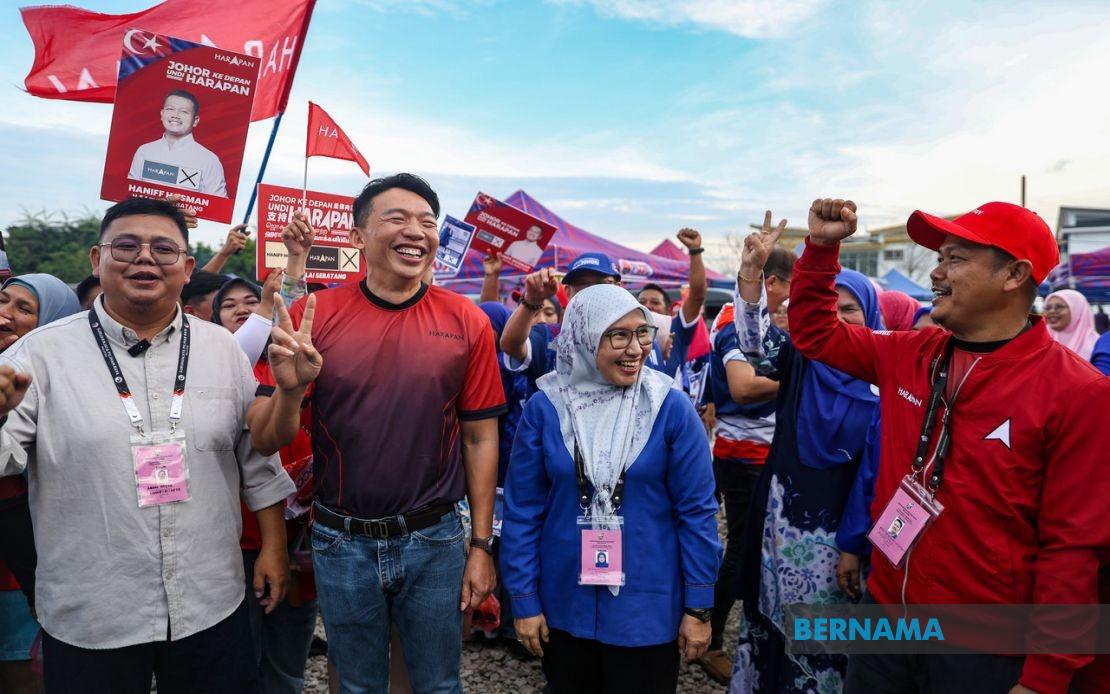
The Johor state election campaign is taking place under a notably calm and respectful atmosphere, as demonstrated when opposing candidates encountered each other while engaging voters at the Taman Megah night market in Pontian recently. The chance meeting highlighted the capacity for political rivals to conduct their campaigns in a spirit of cordiality, even as they compete vigorously for electoral support.
Three Pakatan Harapan representatives—Haniff @ Ghazali Hosman contesting Pulai Sebatang, Abd Razak Ismail in Benut, and Cheah Chee Hong in Kukup—were conducting a joint campaign walkabout when they encountered Hasrunizah Hassan, the Barisan Nasional candidate for Pulai Sebatang. What could have been an awkward collision between teams carrying opposing party colours instead unfolded as a courteous and straightforward exchange of greetings. The interaction attracted the curiosity of night market patrons, many of whom paused to observe the moment before the candidates resumed their separate engagement efforts with traders and voters.
For Malaysian political observers, such scenes carry significance beyond the immediate pleasantries exchanged. They suggest that despite intensifying competition as polling day approaches, the fundamental norms of democratic conduct remain intact in Johor. Haniff characterised the encounter as reflective of healthy democratic practice, emphasising that peaceful campaigning and mutual respect between candidates do not diminish their commitment to their respective political movements. He underscored that the Pontian constituency's electoral process has remained orderly and free from the tensions that occasionally mar campaign periods elsewhere.
The maturity of Malaysia's democratic institutions has long been tested by the intensity of electoral competition, particularly in high-stakes state contests. Johor's current election period appears to be validating the assertion that candidates and supporters can maintain civility while pursuing divergent political objectives. This distinction matters for a nation where concerns about electoral conduct and inter-party relations periodically surface in public discourse. The willingness of politicians from opposing camps to acknowledge one another publicly and exchange pleasantries sends a message about the health of democratic institutions and norms.
Cheah expressed his pride in campaigning alongside coalition colleagues and made a direct appeal to voters in the three constituencies represented at the encounter. His focus remained firmly on mobilising Pakatan Harapan supporters, even as he acknowledged the courtesy extended by the opposing candidate. The approach reflects a balancing act familiar to election strategists: maintaining enthusiasm among party supporters while avoiding rhetoric that might inflame tensions or breach norms of acceptable conduct.
Hasharunizah framed such encounters as entirely ordinary occurrences within Malaysia's political landscape, suggesting they are neither remarkable nor problematic. Her perspective reinforces the notion that physical proximity and personal interaction between rivals can strengthen rather than undermine the electoral process. She noted that despite the competitive intensity of the campaign, the broader situation across Johor remains stable without significant incidents or disturbances. Her comments indicated confidence that parties and candidates have demonstrated sufficient discipline and maturity to conduct their campaigns without triggering security concerns or social disruption.
The composition of candidates meeting at Taman Megah represents the broader political configuration in Johor, where Pakatan Harapan and Barisan Nasional compete for control of state constituencies. The presence of multiple candidates from Pakatan Harapan campaigning jointly reflects coalition strategy, while the singular appearance of the Barisan Nasional candidate demonstrates the competitive dynamics within constituencies. Each coalition brings distinct messaging and organisational approaches to their ground operations.
For voters and observers in other Malaysian states, the Johor campaign offers a case study in how electoral competition can proceed without sacrificing civility or democratic norms. The July 11 polling date marks a significant moment for Johor's political trajectory, with implications extending beyond the state itself. The manner in which candidates and supporters conduct themselves during this period influences perceptions of Malaysia's democratic health and the willingness of political actors to accept competitive outcomes.
The night market setting itself carries cultural and social significance in Malaysia. These informal commercial spaces serve as traditional venues for political engagement, where candidates interact with constituents in relaxed, everyday environments rather than formal halls or staged events. The encounter at Taman Megah demonstrates that even in such informal spaces, where emotions and tensions might run higher, candidates have managed to maintain appropriate conduct. This suggests that investment in democratic norms and expectations of civility has permeated campaign culture across different settings and contexts.
As the campaign progresses toward early voting on July 7 and general polling on July 11, the tone established in encounters like the Pontian meeting will likely shape the overall character of this electoral exercise. For Malaysian democracy, which has weathered various challenges to its legitimacy and stability, such demonstrations of candidate civility and mutual respect provide reassurance that competitive politics need not compromise social cohesion. The electorate will ultimately determine outcomes through their votes, but the pathway to that determination remains open and free from the acrimony that sometimes accompanies electoral contests.

