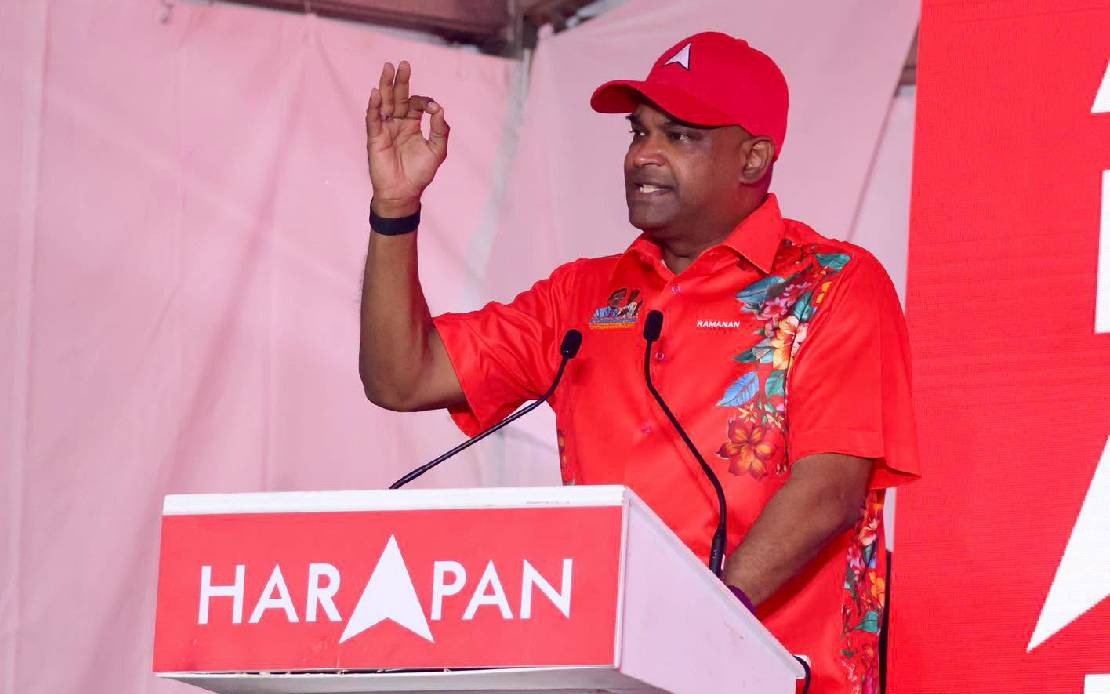
The Federal Government has reaffirmed its commitment to advancing Johor as a key economic and social development hub, with senior government officials stressing that the state remains integral to national prosperity plans. Speaking at a Pakatan Harapan campaign event in Simpang Renggam, PKR Vice-President Datuk Seri R Ramanan underscored the administration's determination to channel substantial investments and large-scale infrastructure initiatives throughout Johor, with the ultimate objective of raising living standards across all communities in the state.
Ramanan's remarks come as the state prepares for elections scheduled for July 11, a crucial political moment that has prompted heightened messaging from federal leadership about their track record and vision for Johor's future. The emphasis on development continuity appears designed to build confidence among voters that Johor will benefit from seamless coordination between state and federal authorities if Pakatan Harapan maintains control of both levels of governance.
Beyond major infrastructure undertakings, the Federal Government has deployed a comprehensive suite of welfare and assistance schemes targeting Johor families, according to Ramanan's statement. These programmes span multiple sectors and are intended to ensure equitable distribution of national economic gains across the state, addressing concerns among voters about whether development benefits reach all segments of the population fairly. The breadth of these initiatives suggests recognition that infrastructure alone cannot satisfy public expectations; tangible household support mechanisms carry significant electoral weight.
The Johor Ke Depan, Undi Harapan roadshow featured a constellation of senior coalition figures, including PKR Vice-President Datuk Seri Amirudin Shari, Amanah Secretary-General Faiz Fadzil, and three Pakatan Harapan candidates contesting state seats in Machap, Benut, and Layang-Layang. This concentration of political leadership at a single event underscores the coalition's strategic focus on Johor, which historically commands substantial parliamentary and state assembly seats and thus significantly influences broader electoral outcomes in Malaysia.
For Malaysian observers, Ramanan's articulation of federal commitment to Johor reflects broader dynamics within Pakatan Harapan's governing strategy. Since returning to power federally in 2022, the coalition has sought to demonstrate that unified federal-state control accelerates development delivery. Johor, where DAP and PKR hold considerable influence within the state government apparatus, represents a testing ground for this theory. If voters perceive genuine acceleration in projects and programmes, it could vindicate the coalition's argument for administrative coherence.
The significance of Johor within Malaysia's economic framework cannot be overstated. As the second-largest state by population and a crucial manufacturing and trade hub, particularly given its proximity to Singapore, Johor's economic performance directly influences national GDP growth and employment figures. Federal investment there carries multiplier effects across supply chains, port operations, and labour markets. This economic weight explains why both ruling and opposition coalitions prioritise Johor messaging during campaign periods.
Ramanan's appeal for voters to grant Pakatan Harapan the state election mandate reflects coalition calculations that administrative alignment between Putrajaya and Johor Bahru enhances bureaucratic efficiency and reduces inter-governmental friction. When opposition parties control state governments while federal administrations belong to rival coalitions, development approvals, funding disbursements, and project coordination often face delays and political obstruction. The coalition's argument that unified governance accelerates progress has intuitive appeal, particularly among voters prioritising economic growth over ideological positioning.
The election mechanics warrant attention: 172 candidates will contest across Johor state seats, with early voting scheduled for July 7 and main polling on July 11. This distribution of candidates and compressed campaign period creates a concentrated political environment where messaging discipline becomes critical. Federal government officials' prominent presence at coalition campaign events signals confidence in their electoral prospects, though internal coalition dynamics regarding seat allocations and candidate selection occasionally generate tensions that could influence voter sentiment.
For Southeast Asian readers, Johor's election carries implications beyond Malaysia's borders. Investment decisions, particularly from Singapore, Thailand, and Vietnam, partially hinge on political stability and the consistency of governance frameworks. Investors monitor whether Malaysian state-federal coordination functions smoothly, as administrative unpredictability can deter foreign direct investment. A Pakatan Harapan victory in Johor would reinforce federal-state unity and potentially improve Malaysia's attractiveness to regional capital flows.
The welfare assistance programmes highlighted by Ramanan merit scrutiny regarding their fiscal sustainability and targeting effectiveness. As Malaysia navigates post-pandemic economic recovery alongside inflationary pressures and elevated public debt servicing costs, the balance between populist programme expansion and budgetary discipline remains contested. Voter expectations for enhanced assistance may collide with fiscal realities, creating political difficulties for whichever coalition governs post-election.
Historically, Johor has oscillated between different governing coalitions, reflecting its position as a political bellwether. The state's diverse demographic composition—encompassing Malay-Muslim majorities, substantial Chinese and Indian communities, and substantial migrant populations—requires coalition messaging that addresses multiple community priorities simultaneously. Infrastructure and development appeals carry broad resonance, yet targeted programmes addressing specific community concerns often prove electorally decisive in closely contested contests.

