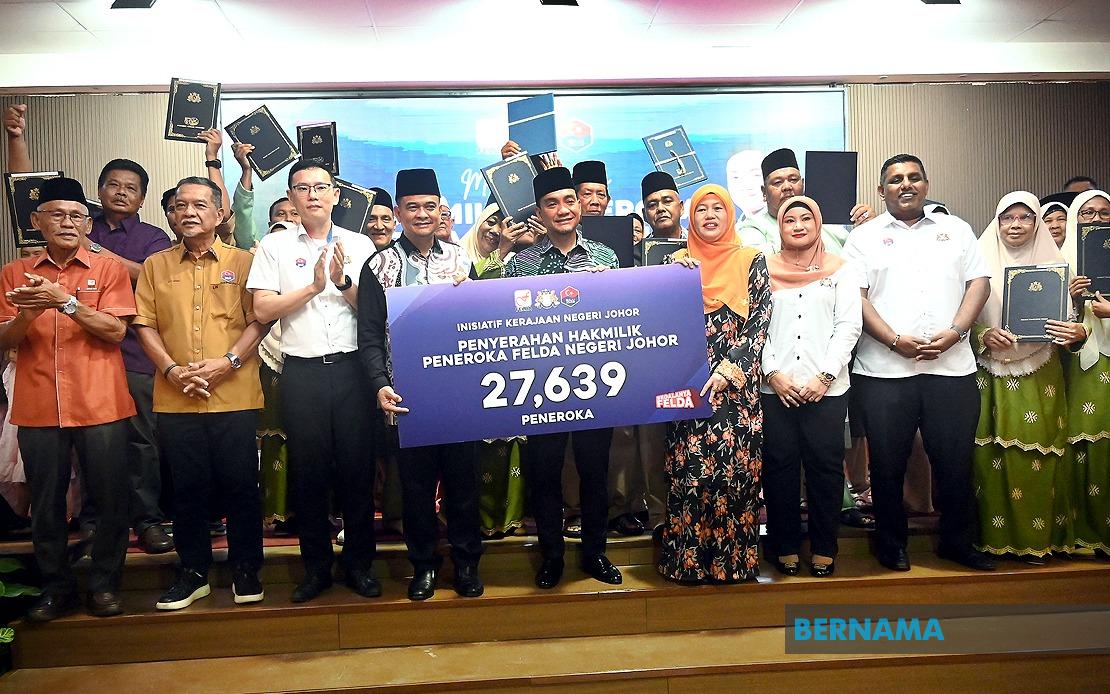
A protracted land tenure crisis affecting Federal Land Development Authority settlers in Johor has effectively come to an end, with the state government achieving a 99.99 per cent resolution rate on disputed title applications. The milestone marks a significant conclusion to bureaucratic complications that have persisted across multiple FELDA schemes in the southern state, finally granting long-awaited ownership certainty to thousands of agricultural workers and their families. Johor Menteri Besar Datuk Onn Hafiz Ghazi announced the breakthrough during a formal land title presentation ceremony in Kluang on June 23, where 210 settlers received official documentation confirming their land rights.
The numerical achievement represents 27,639 resolved applications out of a total 27,642 cases, leaving merely three applications outstanding. This completion rate signals not merely a bureaucratic victory but a restoration of property rights to communities that have historically occupied and worked the allocated land. The settlers had long faced uncertainty regarding ownership legitimacy, a situation that complicated succession planning, collateral arrangements for agricultural credit, and broader family security. The resolution process required sustained coordination between state land administration offices, FELDA management, and local district authorities to verify claims, update records, and issue formal title deeds.
The three districts benefiting from today's presentation—Kluang, Kota Tinggi, and Mersing—encompass some of Johor's most significant FELDA concentrations, where rubber and palm oil cultivation remain integral to local economies. These settlements represent substantial population clusters, and the land title resolution carries implications beyond individual property rights. Formalization of ownership strengthens the legal foundation for agricultural development projects, facilitates environmental management protocols, and enables settlers to exercise fuller economic participation through legitimate asset-based transactions. The ceremony itself served as both a public acknowledgement of government commitment and a practical distribution point where settlers could receive their certificates directly.
Menteri Besar Datuk Onn Hafiz Ghazi framed the resolution as integral to the state's broader rural development philosophy, emphasizing that FELDA communities would remain a governance priority for Johor. His remarks reflected recognition that settler welfare extends beyond individual land parcels to encompass broader infrastructure, service delivery, and economic opportunity within these communities. The state government's positioning of land title resolution as a rural development cornerstone suggests deeper consideration of how agricultural settlement areas can transition toward sustainable livelihoods and institutional modernization. This framing also acknowledges historical patterns where FELDA communities experienced policy neglect despite their demographic and economic significance.
The underlying significance of achieving 99.99 per cent completion becomes clearer when considering the administrative complexity inherent in processing 27,642 individual title applications across multiple decades of settlement history. Documentation gaps, boundary disputes, succession complications, and bureaucratic procedural variations across different schemes would naturally create bottlenecks. The sustained effort to resolve nearly all cases demonstrates considerable administrative discipline and perhaps reflects previous institutional failures that finally received corrective attention. For Malaysian administrators in other states confronting similar historical backlogs in land administration, the Johor achievement offers both a procedural model and evidence that comprehensive resolution, while time-intensive, remains achievable.
The presence of Datuk Zahari Sarip, chairman of Johor's Agriculture, Agro-based Industry and Rural Development Committee, underscored departmental coordination necessary for executing such initiatives. Land title resolution intersects multiple administrative portfolios—state land offices, agricultural extension services, local government, and legal departments must synchronize efforts. The committee's involvement suggests that Johor has embedded land title work within broader agricultural policy frameworks rather than treating it as a discrete administrative chore. This integration carries implications for how future FELDA community needs might be addressed through coordinated multi-department responses.
For the 210 settlers receiving titles during the Kluang ceremony, documentation represents culmination of advocacy efforts and bureaucratic navigation. Many may have pursued title applications years or decades earlier, facing repeated requests for additional documentation or clarification. The formal presentation ceremony dignified the resolution process, transforming a technical administrative completion into a public recognition of settler rights. Such ceremonial framing carries psychological and social significance beyond the documentary handover, affirming that state institutions value settler contributions and acknowledge their legitimate claims to land they have worked and inhabited.
The remaining three unresolved applications merit attention as potential indicators of unusual complexity. These cases might involve boundary disputes with neighboring properties, inheritance complications requiring court clarification, or documentation that proved genuinely irretrievable. How the state government addresses these final three applications—whether through expedited special procedures, court intervention, or alternative resolution mechanisms—will determine whether the achievement represents genuinely comprehensive closure or leaves a residual category of persistently disadvantaged claimants. Transparent communication regarding these remaining cases would reinforce public confidence in the overall process.
For Malaysian agricultural communities beyond Johor, the FELDA land title resolution carries lessons regarding state capacity in addressing institutional legacies. Many settlement schemes across Malaysia face similar title documentation challenges, reflecting post-independence bureaucratic patterns and institutional evolution. The Johor achievement suggests that sustained political commitment, adequate resourcing, and administrative persistence can substantially resolve what previously appeared as permanent institutional dysfunction. Other states managing FELDA schemes or similar agricultural settlement programs might draw strategic insights from Johor's methodology and outcomes.
The resolution also reflects shifting recognition among Malaysian policymakers regarding property rights' foundational importance for economic development and social stability. Earlier decades sometimes treated FELDA settler tenure as administratively subordinate to development directives, with land ownership formalization receiving lower priority than production targets. Contemporary governance increasingly emphasizes that legitimate land ownership catalyzes broader development—enabling credit access, intergenerational asset transmission, and community investment. By resolving titles, Johor potentially unlocks economic capacities that were previously constrained by tenure insecurity.
Looking forward, the near-complete resolution creates opportunities for Johor to transition toward forward-looking FELDA policies focused on productivity modernization, environmental sustainability, and market integration rather than remaining consumed by backward-looking title disputes. Settlers freed from ownership anxiety can engage more effectively with agricultural innovation, cooperative development, and diversification strategies. The state government might build on this foundation by establishing frameworks ensuring that FELDA communities remain institutionally connected to evolving agricultural markets and climate adaptation imperatives.