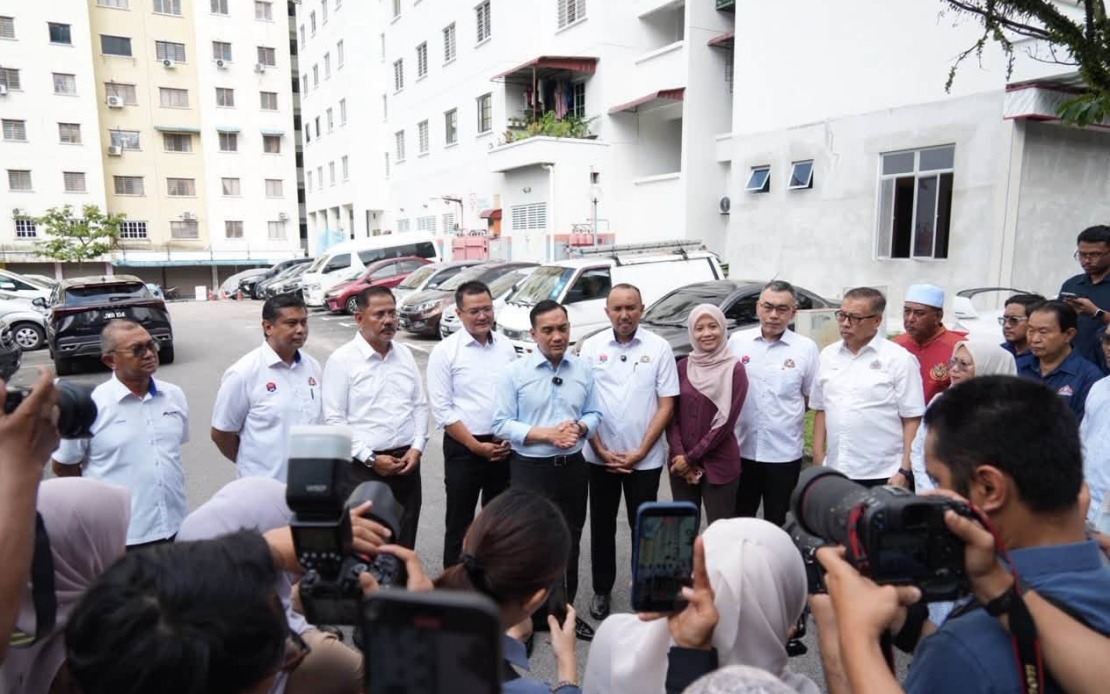
The Johor government has unveiled an ambitious RM50 million initiative to repaint low-cost flats, privately owned low-medium-cost residential units and public housing across the state, signalling a renewed focus on improving the living environment for lower-income households. The large-scale programme encompasses 170 housing blocks comprising 11,693 residential units distributed strategically across 26 locations throughout Johor, with an estimated 46,772 residents set to benefit directly from the upgrading works.
Datak Mohd Jafni Md Shukor, chairman of the Johor Housing and Local Government Committee, emphasised that the repainting project extends far beyond simple aesthetic enhancement. Speaking during an inspection of works at Desa Muafakat Apartments alongside Johor Menteri Besar Datuk Onn Hafiz Ghazi, Mohd Jafni underscored the broader social implications of maintaining well-kept residential spaces. He highlighted that a clean, well-maintained environment fosters greater resident comfort, strengthens community bonds and demonstrates tangible government commitment to residents' quality of life.
The implementation structure involves multiple state-level agencies working in coordinated fashion to ensure consistency and accountability. The Johor State Housing Development Corporation (PKPJ) and the Local Government Division operating under the Johor State Secretary's Office will lead execution efforts, supported by four major local authorities: the Johor Bahru City Council (MBJB), Iskandar Puteri City Council (MBIP), Pasir Gudang City Council (MBPG) and Kulai Municipal Council (MPKu). This multi-agency approach reflects the programme's scale and the need for systematic oversight across different municipal jurisdictions.
The repainting initiative arrives at a critical juncture for Johor's urban development agenda. Low-cost and low-medium-cost housing blocks, while essential for accommodating the state's growing population, often face maintenance challenges due to the wear and tear of tropical weather and intensive use. By channelling substantial resources into preventive maintenance rather than reactive repairs, the state government seeks to extend the lifespan of existing infrastructure while improving resident satisfaction and property values in lower-income neighbourhoods.
During the site visit, state officials also addressed pressing maintenance concerns beyond the painting scope. The inspection revealed issues including slope subsidence near apartment parking facilities and deterioration of internal roadways within the Desa Muafakat complex, problems typical of ageing housing developments. These findings suggest the repainting programme may serve as a preliminary phase in more comprehensive housing rehabilitation efforts, with state authorities now identifying and documenting infrastructure deficiencies that may warrant future intervention.
Quality assurance has emerged as a central concern for Johor's leadership overseeing the project. Mohd Jafni stressed that all implementing agencies and appointed contractors face explicit reminders to maintain the highest standards of workmanship, safety and cleanliness throughout execution. The emphasis reflects lessons learned from previous housing projects where cosmetic improvements deteriorated rapidly or inadvertently created new problems for residents, undermining government credibility and wasting public funds.
The project encompasses not only residential upgrading but also complementary infrastructure development. Officials inspected the ongoing construction of Tabika KEMAS Bangsa Johor facility at Desa Muafakat Apartments, demonstrating integrated planning that combines housing maintenance with provision of early-childhood care services. This multi-faceted approach acknowledges that housing quality improvement must extend beyond physical structures to encompass community services that enhance residents' daily lives.
From a broader Malaysian perspective, the Johor initiative exemplifies state-level responses to housing affordability and maintenance challenges affecting urban lower-income communities nationwide. As property maintenance costs escalate and many low-cost housing blocks age beyond initial design lifecycles, state governments must balance limited budgets against rising infrastructure demands. Johor's substantial allocation signals acknowledgment that deferred maintenance in low-income neighbourhoods carries long-term social and economic costs extending beyond mere property values.
The programme also reflects evolving governance priorities within Johor's administration. By combining housing upgrading with visible government presence and community engagement, the state demonstrates responsiveness to grassroots concerns. Such initiatives carry political significance, particularly in urban constituencies where lower-income voters constitute substantial population segments, though the genuine infrastructure improvements address real resident needs regardless of electoral calculations.
For residents in affected housing blocks, the repainting programme promises immediate environmental improvements and signals state acknowledgment of their communities' legitimacy and importance. In Malaysian housing contexts where socioeconomic segregation often translates into infrastructure disparities, maintaining low-cost housing to comparable standards as middle-income developments reinforces principles of equitable public service delivery. The RM50 million commitment, while substantial, remains modest relative to total housing-related spending, yet represents meaningful resource allocation for this specific maintenance category.
Implementation challenges will likely test the programme's effectiveness. Coordinating work across multiple municipal councils demands clear communication and shared performance metrics. Tropical climate conditions in Johor accelerate paint deterioration, potentially shortening the interval before subsequent repainting becomes necessary. The state's quality assurance emphasis must translate into rigorous contractor oversight and resident complaint mechanisms to ensure promised standards materialise in practice.
Looking forward, the repainting initiative may catalyse broader discussion about preventive maintenance budgeting for ageing public housing stocks across Malaysia. Many states grapple with similar housing maintenance backlogs affecting increasingly vulnerable residents as initial housing stock ages. Johor's approach demonstrates feasibility of large-scale, coordinated maintenance programmes while highlighting the necessity of sustained funding commitments to prevent infrastructure deterioration from undermining housing quality and community cohesion.

