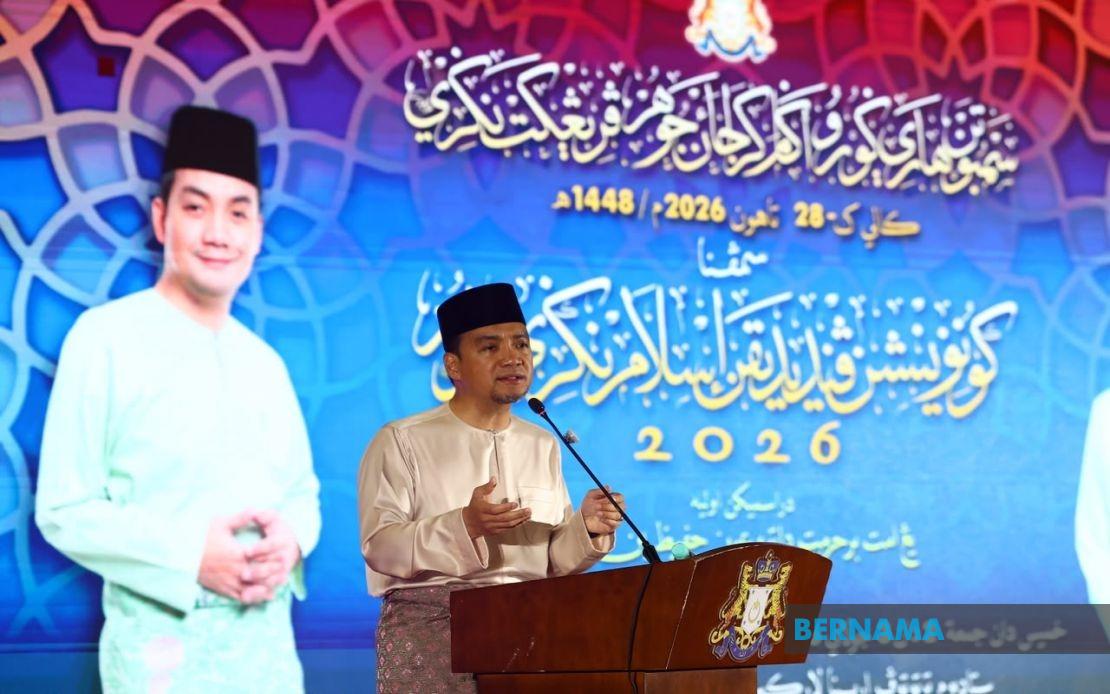
The Johor government is broadening its ambitious education transformation agenda by bringing its proven reform model into the Islamic schooling sector. The state has approved the construction of its inaugural Sekolah Agama Rintis Bangsa Johor (SARBJ) in Kota Iskandar this year, marking a significant step in extending the successful Sekolah Rintis Bangsa Johor (SRBJ) framework beyond conventional schools. The move reflects recognition that comprehensive educational change in Malaysia requires parallel innovation across both secular and religious institutions.
Menteri Besar Datuk Onn Hafiz Ghazi credited the Regent of Johor, Tunku Mahkota Ismail, with conceiving the original SRBJ initiative as a blueprint for systemic education restructuring across the state. This top-level royal patronage underscores the strategic importance attached to overhauling how students learn and develop in Johor, where educational attainment increasingly determines economic competitiveness. The expansion into religious schools suggests that state policymakers view Islamic education not as separate from mainstream reform efforts but as integral to achieving holistic educational excellence.
The existing SRBJ network currently comprises four operational schools: two primary and two secondary institutions. Sekolah Kebangsaan Seri Kota Puteri 4 and Sekolah Menengah Kebangsaan Seri Kota Puteri 2, both located in Pasir Gudang, represent the primary tier, whilst Sekolah Kebangsaan Tasek Utara and Sekolah Menengah Kebangsaan Tasek Utara in Johor Bahru serve secondary students. This distributed geographic footprint across major population centres suggests deliberate scaling rather than token implementation, providing the state with practical experience in rolling out reforms before expanding further.
The SRBJ initiative itself encompasses several interconnected reform pillars designed to address gaps in Malaysia's current education delivery. Digital learning forms the technological foundation, preparing students for an increasingly technology-dependent economy and workforce. Multilingual proficiency—likely encompassing Malay, English, and possibly Mandarin or Arabic—equips graduates for regional and global engagement. Character development and moral education remain central, reflecting Malaysian concerns about values formation alongside academic achievement. Teacher empowerment ensures educators receive adequate professional development and support to implement new pedagogies effectively. Investment in infrastructure and learning facilities completes the picture, removing physical constraints that often limit rural and underfunded schools.
Applying this framework to Islamic schools presents both opportunities and complexities that Malaysian policymakers are navigating. Religious schools operate within specific curricular requirements set by state and federal religious authorities, balancing Islamic knowledge transmission with preparation for national examinations and economic participation. The SARBJ model must therefore integrate these existing expectations with SRBJ innovations, creating hybrid approaches that enhance rather than diminish religious education's distinctive purpose. Success here could demonstrate that modernised delivery methods and traditional knowledge transmission need not conflict.
The timing of this expansion aligns with broader Malaysian educational concerns. Parents increasingly demand schools that combine academic rigor with character formation and language skills, particularly English proficiency. Islamic schools serve approximately one million students nationwide and represent a significant portion of Malaysia's educational infrastructure. Many struggle with resource constraints, aging facilities, and variable teaching quality. Extending proven reforms into this sector could meaningfully improve learning outcomes for a substantial student population, whilst also strengthening the perceived quality and relevance of religious education in contemporary Malaysia.
State Islamic Religious Affairs Committee chairman Mohd Fared Mohd Khalid's announcement of the Kota Iskandar SARBJ signals that Johor intends treating religious school reform with comparable seriousness to its secular counterparts. The choice of Kota Iskandar, the state capital and administrative hub, suggests the institution will serve as a flagship showcase for the new approach, likely receiving enhanced support and scrutiny. Successful establishment here could facilitate replication elsewhere in Johor and potentially inspire similar initiatives in other states, creating a demonstration effect across Malaysia.
Looking beyond the immediate implementation, the Menteri Besar indicated that SRBJ innovations would additionally extend into early childhood education through a pilot kindergarten. This downward expansion acknowledges growing research evidence that foundational learning experiences in the preschool years significantly influence later academic and social outcomes. A reformed kindergarten model aligned with SRBJ principles could shape student trajectories from age five, potentially amplifying the cumulative impact of subsequent school-level reforms. Early childhood intervention also addresses equity concerns, as high-quality early learning disproportionately benefits disadvantaged children who lack home educational resources.
The orchestration of this educational transformation through royal initiative and Menteri Besar endorsement reflects Johor's particular political structure and the personal investment of its leadership in state development. Unlike initiatives driven purely by ministerial bureaucracies, this approach carries symbolic weight and institutional backing that can facilitate resource allocation and sustained commitment across electoral cycles. The religious education expansion particularly benefits from visible leadership support, as Islamic schooling remains politically and socially sensitive in Malaysia, and reforms require confidence from parents, religious authorities, and conservative constituencies.
For Malaysia more broadly, Johor's experiment offers a regional test case for education reform at scale. The country's education system faces persistent challenges in international comparative assessments, particularly regarding reading comprehension, mathematics, and scientific reasoning. Regional disparities in school quality remain pronounced, and the transition between primary and secondary education continues generating high failure rates. If Johor can demonstrate measurable improvements in learning outcomes, student retention, graduate employment prospects, or examination performance through this integrated SRBJ and SARBJ approach, the model becomes potentially exportable to other states seeking to address similar deficits.
The inclusion of Johor's police chief at the religious teachers' celebration, alongside religious affairs officials, also hints at official recognition of education's connection to broader social cohesion objectives. Improved school quality, character development, and student engagement can contribute to reduced youth delinquency and strengthened community connections. This multidimensional benefit calculation—academic, economic, social, and moral—likely underpins political support for allocating resources to education reform when budget pressures elsewhere remain intense.
As implementation proceeds, several factors will determine whether extending SRBJ principles to religious schools succeeds. Teacher recruitment and training for SARBJ requires identifying educators who combine Islamic knowledge expertise with comfort using digital tools and modern pedagogies—a potentially scarce combination. Curriculum development must navigate requirements imposed by state Islamic councils without diluting the reforms' intended impact. Funding mechanisms need clarification, particularly whether SARBJ schools receive comparable resources to their SRBJ counterparts. Parent expectations management also matters, as communities accustomed to traditional religious school approaches may require evidence that modern methods serve rather than undermine Islamic education.
The expansion represents both genuine educational opportunity and a subtle acknowledgment of Malaysian policymakers' concerns that religious schools sometimes lag in general educational quality. By bringing proven reform mechanisms into this sector, Johor signals that Islamic institutions can and should benefit from innovation whilst preserving their distinctive character. If successful, this approach could reshape perceptions of religious education in Malaysia—not as separate from but fully integrated with the nation's broader aspirations for educational excellence and graduate competitiveness.

