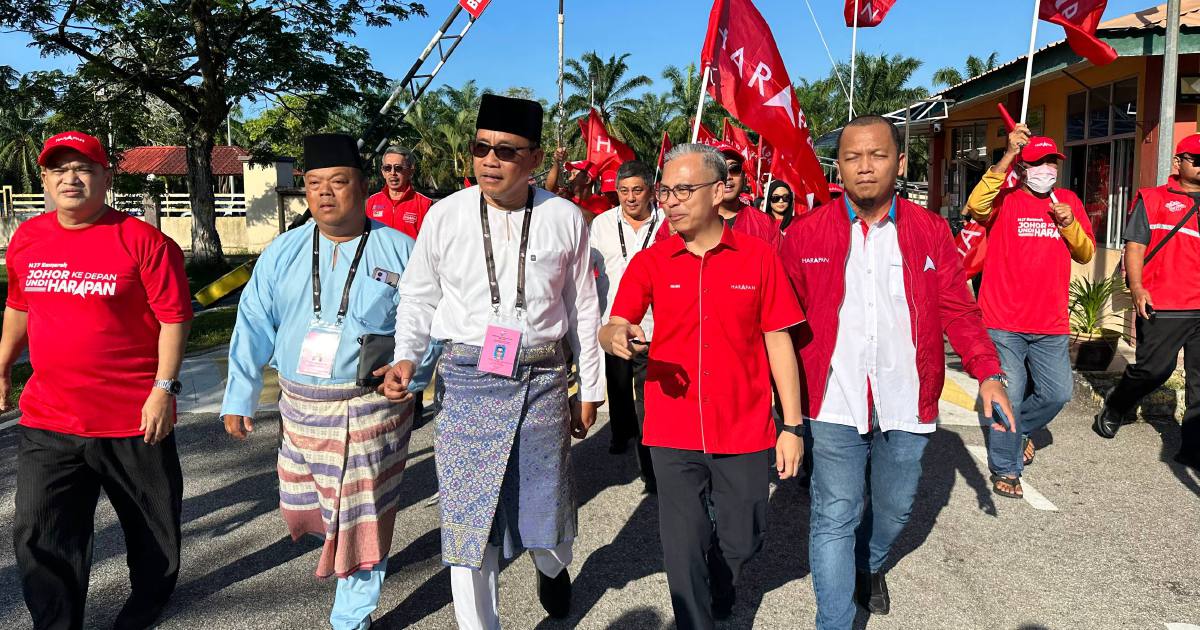
Semerah, one of Johor's competitive electoral battlegrounds, appears poised for a closely fought rematch between the ruling Barisan Nasional coalition and the opposition Pakatan Harapan alliance following nomination day proceedings at the Dewan Mahkota in Batu Pahat this week. The nomination filing, which saw campaign supporters gathering at the education ministry school facility, underscored the mounting political intensity surrounding the seat ahead of polling day.
The constituency has emerged as a key contest within Johor's broader electoral landscape, reflecting deeper national political divisions that continue to reshape Malaysia's subnational politics. Semerah's position as a swing seat—one where multiple parties harbour genuine victory prospects—makes it emblematic of how traditional coalition politics faces mounting pressure from alternative political arrangements across the country. The presence of energised supporters chanting familiar reformasi slogans and religious greetings suggested mobilisation efforts have already gathered considerable momentum on both sides.
Barisan Nasional's dominance in Johor has been a consistent feature of Malaysian politics for decades, yet the coalition has encountered sustained challenges from Pakatan Harapan, particularly following the 2022 general election when Johor emerged as a crucial testing ground for competing visions of governance. The state's political terrain has grown increasingly volatile, with voter preferences shifting between contests and local issues often proving decisive in swaying marginal constituencies like Semerah. Understanding which faction secures this seat could provide meaningful insights into broader state-level sentiment before the general ballot.
The nomination day atmosphere captured something essential about contemporary Malaysian electoral competition: the blend of institutional routine and passionate grassroots engagement that now characterises contested races. Supporters' invocation of reformasi—a rallying cry historically associated with demands for political transformation—indicates how Pakatan Harapan continues anchoring its messaging in appeals to systemic change, whereas Barisan Nasional's traditional machinery relies on incumbent advantage and resource distribution networks built over generations.
Semerah's candidate selections matter significantly because they signal how both coalitions intend to compete for credibility and local representation. The nomination process itself represented an important juncture where formal candidacy became reality, transforming weeks of preparation and internal party deliberations into actual electoral competition. For residents across Semerah's polling districts, the announcement of final candidates provided clarity about who would represent their interests during the campaign proper and, potentially, in the state assembly afterwards.
Johor's electorate has demonstrated increasing sophistication in differentiating between state and federal contests, sometimes delivering contradictory verdicts to national and state-level contests within months. This pattern suggests voters consciously evaluate different leadership teams and policy platforms depending on the administrative level at stake. Semerah voters, in particular, may weigh local development concerns—infrastructure improvements, educational facilities, economic opportunities—against broader philosophical disagreements about governance models and reform agendas that animated the national political debate.
The economic context surrounding this election deserves attention from Malaysian observers. Johor, as the nation's second-largest economy and a crucial industrial hub connecting to Singapore, faces distinct challenges around manufacturing competitiveness, port operations, and attracting high-value investment. Both coalitions will likely position themselves as better custodians of Johor's economic interests, with Barisan Nasional emphasising continuity and institutional relationships while Pakatan Harapan potentially arguing for modernisation and reduced patronage-driven decision-making.
Candidate quality and personal networks often prove decisive in Malaysian swing seats where party affiliation alone fails to guarantee victory. The individuals selected to represent Barisan Nasional and Pakatan Harapan in Semerah will carry distinct personal histories, community connections, and perceptions of integrity that could meaningfully influence voter calculations. Malaysian elections, despite their formal institutional structures, frequently hinge on such interpersonal and local dimensions that national campaign messaging cannot fully predict or control.
The nomination day proceedings also highlighted how Malaysia's electoral administration continues functioning despite periodic political turbulence and constitutional debates about electoral boundaries and franchise rules. The Dewan Mahkota venue in Batu Pahat served as the physical location where democratic procedures unfolded, reminding observers that beneath partisan contestation lies an institutional framework designed to translate voter preferences into representation. This procedural reliability, even when specific outcomes remain uncertain, represents an underappreciated strength of Malaysia's political system compared with more volatile democracies.
As campaigns intensify across Semerah and neighbouring constituencies, local considerations will increasingly crystallise around questions of service delivery, community investment, and which coalition offers more convincing visions for addressing residents' practical concerns. Johor voters have consistently demonstrated they evaluate choices on multiple dimensions simultaneously—not purely ideology or party affiliation, but rather holistic assessments of credibility, competence, and alignment with local priorities. For Semerah specifically, the weeks ahead will determine whether incumbent advantage or reform messaging proves more compelling to an electorate that holds considerable power in shaping Johor's political future and, by extension, the broader national political balance.

