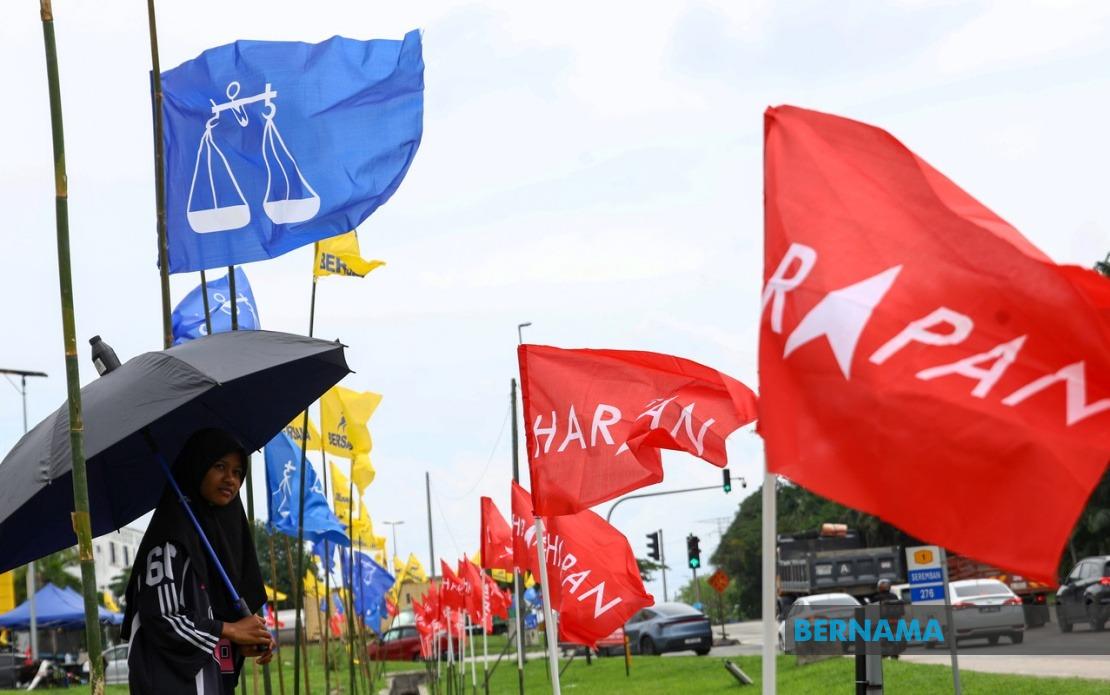
The 16th Johor State Election has intensified into a battle of competing visions as campaigning enters its second week, with Pakatan Harapan and Barisan Nasional deploying fundamentally distinct strategies to secure voter support across all 56 state seats. Rather than mirroring each other's approach, the two coalitions are doubling down on their respective strengths—PH building momentum through comprehensive policy platforms addressing everyday hardship, while BN capitalises on the return of marquee political personalities and deep organisational networks cultivated over decades.
Pakatan Harapan's campaign architecture centres on translating voter grievances into actionable governance solutions. The coalition has framed its campaign narrative around the "Johor For All" manifesto, which positions economic development not merely as headline-grabbing investment inflows or GDP growth figures, but as measurable improvements in household welfare. This approach directly targets the anxieties dominating kitchen-table conversations across Johor—stagnant wage growth, the widening gap between property prices and affordability, and the sense that economic prosperity benefits only a narrow stratum of society. According to political analyst Dr Mohammad Tawfik Yaakub from Universiti Malaya, PH's messaging strategy reflects a sophisticated understanding that contemporary voters demand evidence of how state policies will improve their material circumstances. The coalition's emphasis on integrated wage strategies, ensuring investment returns flow into local employment quality, and targeted welfare improvements suggests an attempt to recapture the narrative that resonated during the 2018 federal election, when bread-and-butter issues proved decisive in mobilising swing voters.
Barisan Nasional's campaign strategy operates from an entirely different playbook, leveraging the organisational superiority and established grassroots infrastructure that have anchored BN's dominance in Johor for nearly seven decades. However, the coalition's recent deployment of two prominent returnees—former UMNO vice-president Datuk Seri Hishammuddin Tun Hussein and former UMNO Youth chief Khairy Jamaluddin—marks a deliberate recalibration aimed at plugging specific demographic vulnerabilities. Both figures rejoined UMNO through the "Rumah Bangsa" initiative, symbolising a reconciliation narrative that BN hopes will resonate with disillusioned party members who drifted away during periods of UMNO's institutional decline.
Hishammuddin's re-emergence into active electoral politics carries particular significance in Johor, where his family's historical prominence and his previous ministerial portfolios have cultivated substantial personal political capital. According to Assoc Prof Dr Mohd Yusry Ibrahim, chief researcher at the Ilham Centre and lecturer at Universiti Malaysia Terengganu, Hishammuddin's visible participation in the campaign could prove instrumental in reconsolidating UMNO support among older voters who maintained party loyalty through decades but became discouraged by recent institutional setbacks. His presence represents more than mere ceremonial campaigning—it signals to traditional BN constituencies that the coalition remains a viable repository of power and influence, capable of fielding proven administrators. This psychological dimension matters enormously in Malaysian electoral politics, where voter calculations often incorporate assessments of which coalition is likely to form government and thereby deliver patronage and development resources.
Khairy Jamaluddin's campaign role addresses a fundamentally different challenge for BN's coalition: the party's chronic difficulty in attracting and retaining younger voters. Voting behaviour analysis consistently demonstrates that younger Malaysians, particularly those under 40, lack the strong party identification that characterised their parents' generation. Instead, contemporary young voters display fluid electoral preferences shaped substantially by personal affinity for individual candidates and public figures. Khairy's consistent popularity among younger demographics—cultivated through active social media engagement, perceived policy progressivism on select issues, and a public persona that emphasises accessibility—offers BN a bridge to a cohort that has historically gravitated toward opposition coalitions or remained disengaged entirely. As Mohd Yusry noted, young voters are increasingly attracted to candidates and figures they recognise and feel connected to, making the personal dimension of electoral politics more decisive for this group than abstract party loyalty.
However, political analysts caution against assuming that prominent personalities automatically translate into electoral gains in an environment where voter sophistication has noticeably increased. Dr Mohammad Tawfik's assessment reflects a broader shift in Malaysian electoral dynamics: voters today simultaneously evaluate multiple dimensions when deciding their ballot, including a party's documented policy coherence, the credibility and track record of individual candidates, and whether stated priorities genuinely address their lived concerns. The mere presence of recognisable figures at campaign ceramah events no longer suffices to sway voters, particularly in urban and semi-urban areas where information access and critical evaluation of political claims have expanded considerably. This sophistication imposes higher evidentiary burdens on both coalitions—generic appeals and personality-driven campaigns yield diminishing returns without substantive policy scaffolding.
The contrasting campaign approaches also reflect deeper organisational realities. Barisan Nasional's integrated party machinery, refined over generations and extended into practically every village and neighbourhood through UMNO's cellular structure, provides unparalleled capacity for sustained ground-level engagement and voter contact. BN can deploy tens of thousands of trained party operatives, access established community networks, and leverage decades of patronage relationships cultivated through state development resources and administrative authority. By contrast, Pakatan Harapan's coalition structure—comprising ideologically distinct parties with varying organisational densities—requires compensating for organisational disadvantages through policy distinctiveness and ability to articulate voter aspirations in compelling language.
The 172 candidates contesting the 56 state seats represent the on-the-ground operationalisation of these contrasting strategies. BN's slate includes both long-serving incumbents commanding local recognition and new candidates selected partly for demographic representativeness and partly to reinvigorate support among specific voter segments. PH's candidate selection presumably reflects its assessment of which individuals can credibly champion the policy agenda and embody the coalition's reform narrative. The quality of candidate recruitment—determining whether nominated representatives possess genuine community standing, administrative competence, and demonstrated commitment to constituent service—often proves as consequential as party machinery and campaign messaging in determining electoral outcomes.
Johor's electoral significance transcends state-level governance considerations. As Malaysia's most economically substantial state outside Selangor and a traditional BN stronghold, the election result will reverberate across national politics. A decisive BN victory would signal coalition recovery and provide momentum for subsequent electoral contests; a PH breakthrough would demonstrate that opposition parties can compete effectively even in traditionally hostile terrain and would reshape calculations about Malaysia's longer-term political trajectory. The campaign's second week intensity foreshadows even more aggressive mobilisation as July 11 approaches, with both coalitions deploying maximum resources to influence the outcome. Early voting on July 7 will provide preliminary indicators of voter inclinations, though the decisive verdict awaits polling day results.
The stark divergence between PH's policy-emphasis strategy and BN's personality-plus-machinery approach encapsulates a fundamental question animating contemporary Malaysian electoral politics: whether voters prioritise concrete proposals addressing material grievances or whether traditional organisational advantages and recognisable leadership figures retain decisive influence. The Johor result will provide clarifying evidence about where Malaysian voter preferences actually rest, information that both coalitions will study intensely as they prepare for the electoral contests inevitably succeeding this state poll.

