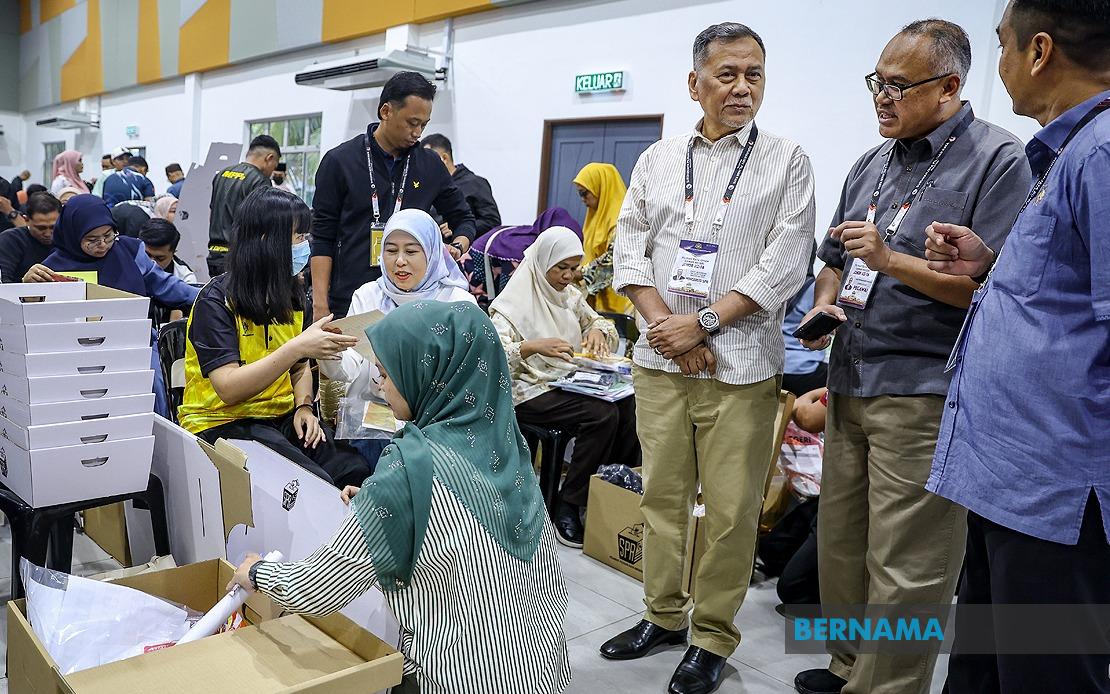
The Election Commission has wrapped up intensive final preparations across Johor ahead of tomorrow's 16th State Election, with personnel at polling and tallying centres conducting comprehensive checks to ensure a seamless voting process for the state's 2.7 million registered voters. Election Commission Chairman Datuk Seri Ramlan Harun confirmed that thorough inspections of ballot boxes and voting equipment across all 56 constituencies had been completed, with Returning Officers finishing their setup work at all 56 centres throughout the state. The chairman underscored the critical importance of these verification procedures, describing them as fundamental to delivering a smooth election day and enabling voters to discharge their democratic responsibilities without impediment.
During site visits to the Sultan Ibrahim Jubilee Hall in Pontian and the Permas Multipurpose Hall in Kukup, Ramlan highlighted that meticulous pre-election verification represents one of the most essential safeguards in election administration. The chairman took the opportunity to remind voters to arrive during their designated voting windows to prevent overcrowding at polling stations, to bring valid identification documents, and to comply with instructions provided by election officials on the day. These guidelines reflect standard election protocols designed to maintain orderly voting procedures while protecting the integrity of the democratic process.
Across Johor, individual polling centres demonstrated the breadth of preparation work underway. At Sekolah Kebangsaan Bukit Mutiara, Election Commission staff were engaged in labelling election materials, arranging furniture, and installing navigation signboards to guide voters through the polling venue. The polling centre supervisor for the Puteri Wangsa state constituency, Mohd Rasib Ngadiman, reported that 12 classrooms were being converted into separate polling streams to manage voter flow efficiently. The operation was being supported by 74 Commission personnel and 12 police officers providing security. Notably, the Commission had also arranged wheelchairs and accessibility provisions for elderly voters and persons with disabilities, reflecting efforts to facilitate inclusive participation.
In Kluang, preparations at Sekolah Kebangsaan Kampong Melayu for the Mahkota state constituency involved a team of 30 personnel setting up five polling streams to handle approximately 3,000 voters from that area. Similar logistical coordination was evident in Batu Pahat, where the facility at Sekolah Menengah Kebangsaan Dato' Seth in Yong Peng placed particular emphasis on ensuring comfortable and accessible voting arrangements for senior citizens, younger voters, and persons with disabilities. These varied approaches across different centres demonstrate the Election Commission's commitment to adapting facilities to meet the diverse needs of Johor's electorate.
The geographical challenges facing election administration in Johor were most apparent in Mersing, where the Tenggaroh state constituency includes four inhabited islands requiring ballot box delivery via sea routes. Pulau Aur, Pulau Pemanggil, Pulau Sibu, and Pulau Tinggi necessitated transporting election materials through Mersing Jetty, involving approximately 50 Commission personnel working alongside tight security coordination from both the Marine Police Force and Mersing district police headquarters. This operation underscores the logistical complexity of conducting democratic elections across geographically dispersed territories within Malaysia's maritime regions, requiring dedicated resources and inter-agency cooperation to guarantee election security and accessibility.
The 16th Johor State Election has attracted substantial political participation, with 172 candidates contesting the 56 state seats across multiple parties. Pakatan Harapan and Barisan Nasional have fielded candidates in all 56 constituencies, representing the two major political coalitions competing for control of the state government. Perikatan Nasional is fielding 33 candidates across selected constituencies, while Parti Bersama Malaysia is running 15 candidates. Smaller parties including MUDA with four candidates, the Malaysian Orang Asli Party with one candidate, and the Socialist Party of Malaysia with one candidate are also participating. Additionally, six independent candidates are running without party affiliation, providing voters with diverse electoral choices.
This electoral contest carries significance for understanding political dynamics in Malaysia's southern region, particularly regarding coalition performance in a state that has experienced considerable political change in recent years. The substantial voter participation expected—drawing from 2.7 million registered voters—reflects the importance Johoreans attach to determining their state's political direction and governance priorities. The Election Commission's meticulous preparation work represents the institutional framework enabling this democratic exercise to proceed fairly and transparently.
From a Malaysian governance perspective, the Election Commission's commitment to comprehensive pre-election verification demonstrates institutional dedication to maintaining election integrity. The visible presence of security personnel alongside Commission staff, and the coordination with police forces and marine authorities, reflects the multi-agency approach necessary for conducting secure elections across diverse geographies. For Southeast Asian readers monitoring Malaysian democratic practice, these preparations illustrate the operational sophistication that regional democracies deploy to facilitate mass participation in electoral processes, even in constituencies with challenging terrain or dispersed populations requiring non-standard logistical solutions.
The election tomorrow will test the Commission's planning and execution across a state with substantial urban, rural, and maritime voting populations. Results will influence not only Johor's state government composition but may also carry implications for national political calculations, given the state's size and demographic weight within Malaysia. The successful completion of these final preparatory measures sets the stage for what is expected to be a well-organised and accessible electoral exercise, enabling Johor's diverse population to participate in deciding their representative government.

