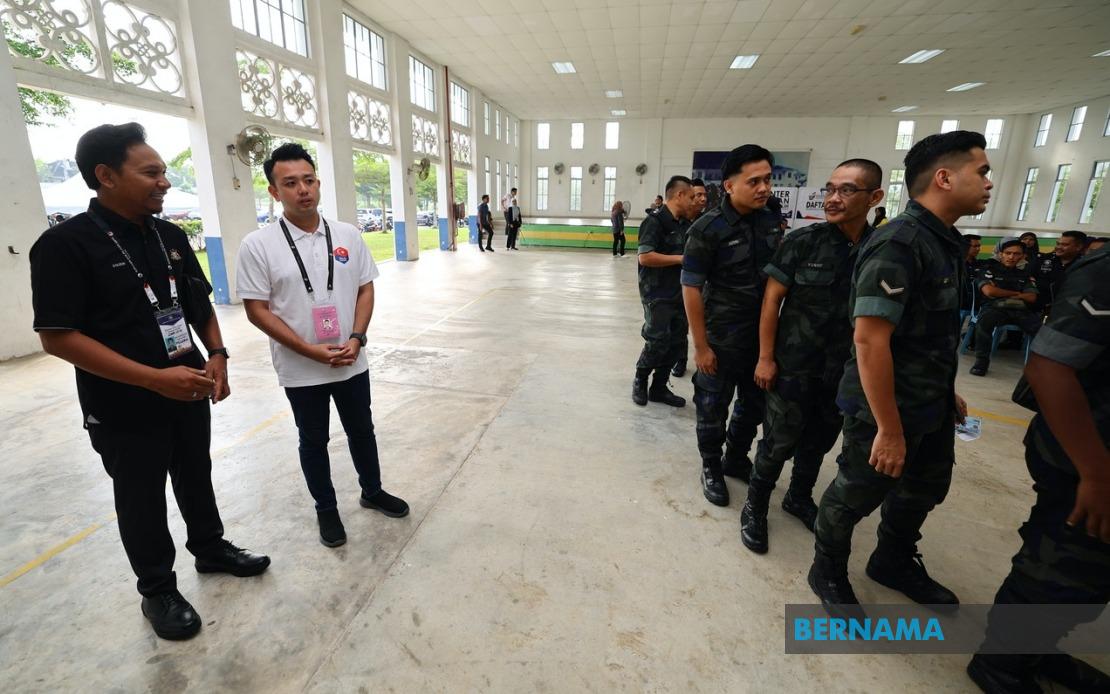
The Johor state election campaign reached a critical juncture on Thursday as rival candidates paused their canvassing efforts to monitor early voting arrangements for armed forces and police personnel, a routine but symbolically important aspect of Malaysia's electoral process. The observation visits underscored the competitive nature of the 16th Johor State Election, with party representatives keen to ensure transparency and fairness in voting procedures that grant security force members ballot access before the general Saturday polling.
In the closely watched Layang-Layang constituency, all three candidates used the opportunity to assess voting operations at the 5th Battalion General Operations Force Camp in Simpang Renggam. Guna Balakrishnan representing Pakatan Harapan, Chua Jian Boon from Barisan Nasional, and Abd Mutalip Abd Rahim of Perikatan Nasional attended the centre, where early voters proceeded through ballot collection in calm, regulated conditions. This three-way contest exemplifies the broader competitive landscape in Johor, where no coalition can claim decisive dominance across all constituencies.
Simultaneously in Tenggaroh, another hotly contested seat saw equal representation from the political spectrum. Muhamad Amerul Muhamad of Perikatan Nasional, Mohd Youzaimi Yusof from Barisan Nasional, and Md Yusof Dawam of Pakatan Harapan converged at the Iskandar Camp early voting facility in Mersing to witness the voting process. The parallel candidacy observations across multiple constituencies demonstrated the coordinated engagement by all major political blocs in scrutinising electoral administration.
Beyond the standard candidate participation, several prominent figures made their presence felt throughout the early voting exercise. Lim Chin Eng, identified as the oldest candidate in the entire Johor contest, attended proceedings at the Johor Contingent Police Headquarters, lending visible gravitas to electoral observance. Muhammad Faezuddin Mohd Puad, Pakatan Harapan's Kempas representative, observed activities at Kempas Police Station, while Datuk Jafni Md Shukor, contesting Bukit Permai for Barisan Nasional, was stationed at Kulai District Police Headquarters. These dispersed observation points reflected the geographical spread of competitive races across Johor's 56 state assembly seats.
Military and security leadership complemented the political representation in monitoring early voting operations. Army Chief General Tan Sri Azhan Md Othman and Major General Datuk Ahmad Shuhaimi Mat Wajab, commander of the 21st Special Service Group, visited the Iskandar Camp facility in Mersing, while Johor police chief Datuk Ab Rahaman Arsad personally cast his ballot at Dewan Dato Onn at the Johor IPK headquarters. These high-level attendances underscored the significance assigned to maintaining orderly and transparent voting procedures, particularly involving uniformed personnel whose ballot participation carries symbolic weight in Malaysia's democratic framework.
The early voting arrangement itself accommodated a substantial electoral bloc that might otherwise face difficulty casting votes on general polling day. A combined total of 20,607 registered early voters comprised 8,544 members of the Malaysian Armed Forces along with their spouses, and 12,063 police personnel with their family members eligible to vote. This substantial population segment—representing both security sector personnel and their immediate families—constitutes a meaningful proportion of the overall Johor electorate and reflects established protocols recognising the operational constraints faced by uniformed services.
The logistics of conducting early voting across multiple locations demonstrated the Election Commission's administrative capacity to implement complex voting procedures. Sixty-four dedicated early voting centres opened their doors from 8 am, with staggered closing times between noon and 6 pm tailored to accommodate voter flows and centre-specific registration numbers. Despite isolated rainfall at certain locations, the voting process proceeded without disruption, with security personnel arriving in systematic waves to fulfil their civic obligations in accordance with established electoral rules. These operational details, while procedural in nature, carry implications for how effectively Malaysia's electoral institutions manage broader voting exercises.
The 16th Johor State Election itself represents a significant political moment, with 172 candidates pursuing representation across the state legislature's 56 seats. The multi-candidate contests evident in Layang-Layang, Tenggaroh, and other constituencies suggest a fragmented political landscape where traditional two-coalition dominance faces sustained challenge from Perikatan Nasional's persistent expansion into state-level contests. For Malaysian observers and particularly those monitoring Johor's political trajectory, the election outcome will signal whether Pakatan Harapan can consolidate post-2018 gains, whether Barisan Nasional continues rebuilding state-level support, or whether Perikatan Nasional succeeds in displacing established competitors.
The early voting process, while routine in procedural terms, carries electoral significance given the sheer number of voters involved and their concentration within security sectors that influence broader public confidence in institutional stability. Candidates' deliberate presence at voting centres communicates commitment to electoral transparency and readiness to accept outcomes determined through fair processes. The observation activities also provide political figures with opportunity to demonstrate engagement with security force constituencies, whose support patterns can influence overall state election dynamics, particularly in constituencies where military or police personnel concentrate residentially.
As Johor heads toward Saturday's general polling, the early voting exercise provided initial operational validation that Election Commission systems function effectively under realistic conditions. The smooth processing of over 20,000 voters across 64 centres within defined timeframes, maintained despite weather challenges, suggests institutional readiness for scaling up to general polling day voting volumes. For regional observers tracking Malaysian electoral management and Southeast Asian democratic practices, such procedural competence contributes to institutional credibility essential for accepting election results regardless of outcomes.

