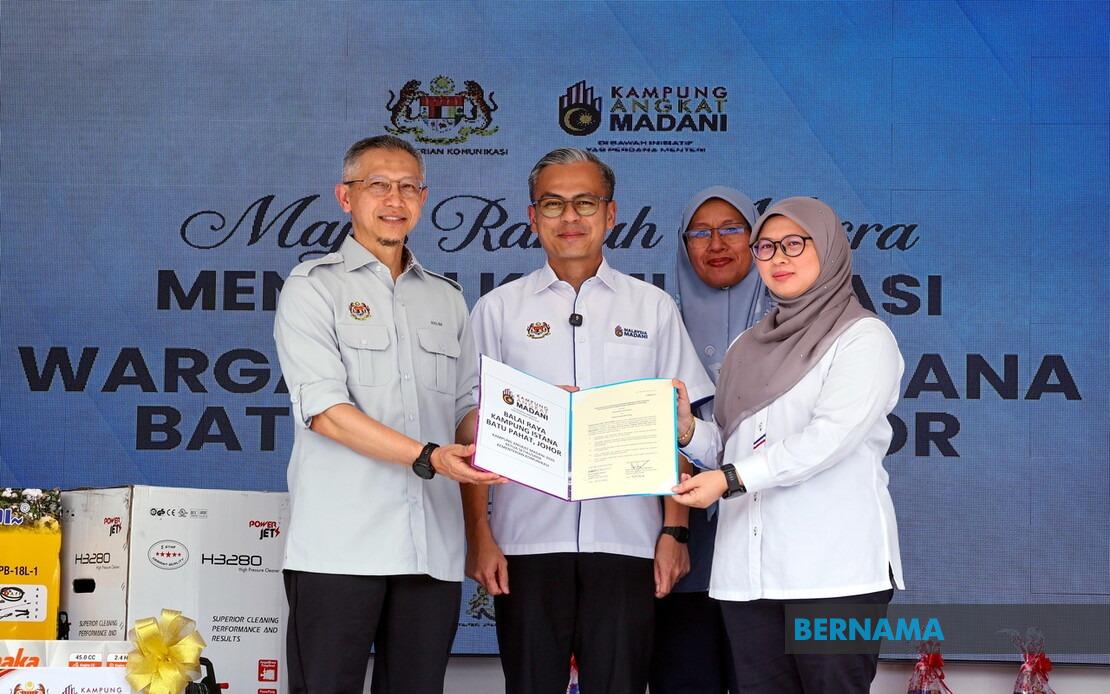
The upcoming Johor state election should be evaluated on its merits as a contest over governance and development, not as a proxy measure of personal political fortunes, according to Pakatan Harapan Communications Director Datuk Fahmi Fadzil. Speaking during a campaign visit to Batu Pahat this week, Fahmi sought to redirect voter attention away from what he characterised as distracting narratives tied to former political figures, insisting instead that the ballot on July 11 represents a fundamental choice about which leadership can deliver tangible improvements for the state's residents.
Fahmi's remarks came in direct response to statements by Datuk Nazifuddin Mohd Najib suggesting that a Barisan Nasional victory would constitute public endorsement for granting a pardon to his father, Datuk Seri Najib Razak. The framing of electoral outcomes as referendums on individual figures, Fahmi argued, reflects a troubling approach to democratic participation that Malaysian voters should recognise and reject. Rather than allowing such personalised interpretations to dominate campaign discourse, voters should understand their electoral choice as fundamentally consequential for Johor's trajectory across issues ranging from economic development to public services and infrastructure.
The Communications Minister articulated a broader argument about democratic accountability and voter autonomy, contending that Malaysians should view their electoral power as transcending personal relationships or factional loyalties. When voters make choices based on individual preferences rather than policy substance, Fahmi suggested, they undermine the principle that elections should centre on competing visions for public welfare. His comments highlighted growing concern within Pakatan Harapan that opposition messaging might successfully leverage personal political narratives to mobilise support, making it essential for the coalition to reclaim the conversation around governance and state development as the election's true stakes.
A significant element of Fahmi's campaign positioning involved challenging what he termed the erosion of traditional political alignments. He referenced the public support extended by former Rengit assemblyman Datuk Dr Mohd Puad Zarkashi to Pakatan Harapan candidates, presenting this as evidence that constituencies previously regarded as reliable Barisan Nasional territory no longer represent guaranteed support for the ruling coalition. The symbolism of such crossovers matters considerably in Malaysian electoral politics, where party loyalties and community alignments have historically proven durable across successive elections. The willingness of established figures with roots in Umno-aligned networks to publicly back opposition candidates suggests genuine shifts in voter sentiment that extend beyond superficial campaign messaging.
Fahmi pointed to additional instances of defection or cross-party support as indicators of Pakatan Harapan's expanding appeal in Johor. The backing provided by Bersatu members for the coalition's Sri Medan candidate, Hishamuddin @ Misrin Ishak, further demonstrated that traditional party structures are becoming more porous. These endorsements acquire particular significance in Malaysian politics because they signal to ordinary voters that switching allegiances carries diminished social or community cost. When figures with established political credentials break from their former parties to support rivals, it effectively legitimises voter movement in the same direction by removing the stigma that once attached to such choices.
The strategic imperative underlying Fahmi's messaging reflects Pakatan Harapan's broader challenge in Johor specifically and Malaysian politics more generally. The coalition must simultaneously defend against narratives emphasising personal political narratives while projecting confidence that it represents the future direction voters wish to embrace. By framing the election as fundamentally about Johor's development and governance quality, Fahmi attempted to shift the conversation onto terrain where incumbent governments typically face scrutiny regarding economic performance, service delivery, and policy responsiveness. This approach presumes that voters, when presented with substantive alternatives, will prioritise governance quality over personal political considerations.
The Communications Minister also addressed the dynamics of voter behaviour and party loyalty in contemporary Malaysian politics, specifically responding to observations that non-Malay support for the Democratic Action Party can no longer be characterised as automatic or unchanging. Fahmi acknowledged that no political party rightfully assumes permanent electoral support, arguing instead that all parties must continuously earn voter confidence through demonstrated performance and policy direction. This framing represented an attempt to forestall the narrative that Pakatan Harapan faces erosion of its electoral coalition. By positioning voter activism as healthy and legitimate, Fahmi sought to normalise the idea that voters evaluate parties dynamically rather than according to inherited loyalties.
The broader context for this campaign positioning involves Johor's political significance for both coalitions. As Malaysia's southernmost peninsular state with substantial economic activity and a large population, Johor outcomes frequently signal broader national electoral trends. A decisive Pakatan Harapan performance would strengthen Prime Minister Anwar Ibrahim's position domestically and internationally, while a Barisan Nasional victory would suggest the opposition coalition faces persistent structural challenges in recovering support it lost during the 2022 general election. The 16th Johor state election consequently matters not merely for state-level governance but as an indicator of national political momentum heading toward the next federal elections.
The election structure itself involves 172 candidates competing for 56 state seats, with polling scheduled for July 11 and early voting on July 7. This scale of competition ensures that local factors—including community grievances, candidate quality, and constituency-specific issues—will influence outcomes alongside national political messaging. Fahmi's emphasis on state development rather than personal political narratives represents one strategic approach to mobilising votes, though the effectiveness of this framing depends significantly on whether voters genuinely perceive meaningful policy differences between coalitions or whether personalised political narratives ultimately prove more persuasive in driving electoral behaviour.
Fahmi's campaign activities included a meet-and-greet session in Kampung Istana that brought together his ministry's senior officials, including Secretary-General Datuk Abdul Halim Hamzah, alongside Pakatan Harapan's Penggaram state seat candidate Felicia Poh Rui Ling. Such events serve multiple functions simultaneously: they showcase party unity and ministerial engagement with constituents, they provide platforms for candidate visibility and personal connection with voters, and they generate media coverage that reinforces campaign messaging. The presence of Communications Ministry personnel alongside political candidates further illustrates the governing coalition's integration of state resources into campaign activities, a practice that raises questions about the boundaries between governmental administration and electoral competition.
Looking forward, Fahmi predicted that additional endorsements from figures associated with opposition parties might materialise before polling day. The articulation of this expectation itself serves a campaign function, signalling to wavering voters that they would not be alone in reconsidering their political allegiances. By highlighting the fluidity of political alignment and the increasing willingness of established figures to cross traditional party boundaries, Fahmi sought to create momentum for Pakatan Harapan and to normalise voter movement toward the coalition. Whether such predictions materialise will substantially shape perceptions of campaign momentum in the final days before voting.
The election unfolds within Malaysia's broader political context of economic recovery and navigating international pressures, factors that Fahmi emphasised in connecting Johor's state-level choice to Prime Minister Anwar Ibrahim's national leadership. This linkage between state and federal politics, while inevitable given Malaysia's parliamentary system, also reflects the extent to which state elections increasingly function as national political events rather than purely local contests. Voters in Johor will simultaneously evaluate state-specific governance quality and register national political preferences, making it difficult to interpret election outcomes as reflecting opinion on any single issue or individual. The complexity of voter motivations and the multiple layers of political consideration at play suggest that claims about what a Johor result signifies politically will remain contested long after voting concludes.

