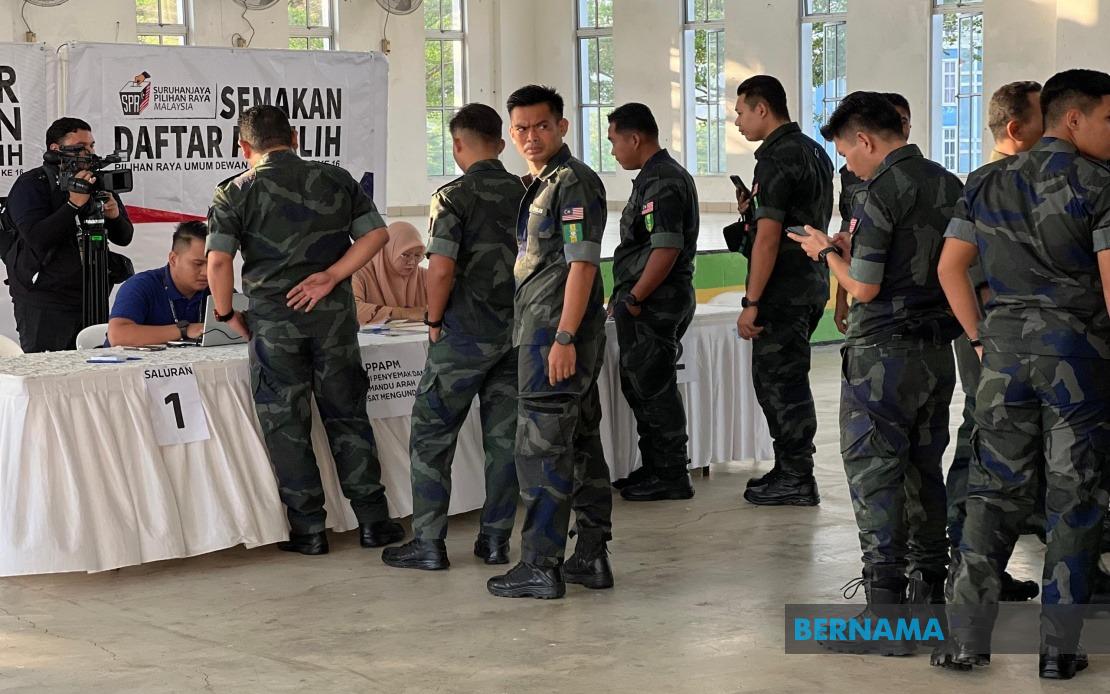
The Johor state election entered its early voting phase this morning as 64 polling centres across the state opened to accommodate members of the security forces and their families, with the process set to conclude by 6 pm. The Election Commission organised the staggered early voting to allow 24,751 eligible voters from the Malaysian Armed Forces, Royal Malaysia Police, and General Operations Force—along with their spouses—to participate ahead of the main polling day on Saturday, ensuring these personnel can fulfil their democratic responsibilities despite operational commitments.
The structure of early voting reflects the logistical demands placed on Malaysia's security agencies during major electoral events. The Malaysian Armed Forces contingent, comprising 12,041 voters including spouses, accessed 11 dedicated polling centres strategically positioned throughout Johor. This arrangement acknowledges that military personnel may face deployment constraints or duty schedules that could otherwise prevent them from voting during the standard polling window, a consideration that has become standard practice in Malaysian elections across federal, state, and local levels.
The remaining voters—12,710 individuals representing the Royal Malaysia Police and General Operations Force personnel and their spouses—utilised 53 separate polling centres. This significantly larger number of centres for the police and paramilitary contingent reflects the broader geographic distribution of these forces across Johor's various districts and the larger personnel base of police and operations force units compared to military concentrations. The Election Commission's decision to establish such differentiated centre counts demonstrates administrative precision in managing logistics for what amounts to a parallel election occurring simultaneously with the state's broader democratic exercise.
Weather monitoring in key districts including Batu Pahat, Muar, Pontian and Tangkak showed predominantly sunny conditions throughout the morning, suggesting polling operations proceeded without weather-related disruptions. Clear weather typically supports higher voter turnout and smoother administrative processes, though the impact on security force voting specifically remains minimal given their professional obligation to vote regardless of conditions. The meteorological observations serve primarily as background context for the broader election environment across the state.
The closure schedule for these early voting centres operated on a staged basis commencing at noon and extending through 6 pm, providing a window of four hours for vote counting and verification processes before results certification. This extended closing period reflects electoral protocols designed to ensure ballot security and accurate tabulation while accommodating the final voters still in queues as the deadline approaches. The staggered approach—rather than simultaneous centre closures—allows the Election Commission to manage the logistics of ballot transportation and preliminary count verification more methodically.
This early voting mechanism represents one of several mechanisms through which Malaysia's electoral system attempts to ensure inclusive participation across diverse demographic and professional segments. Security personnel early voting has become a standard feature of Malaysian elections at all levels, recognising that operational demands on armed forces, police, and paramilitary units during campaigns could otherwise create barriers to voting. The practice acknowledges that citizens in uniform retain fundamental democratic rights even when their professional roles involve heightened security responsibilities during the electoral period.
The Saturday polling day itself will involve approximately 2.7 million ordinary voters determining the composition of the Johor state assembly across 56 state seats. This represents one of the larger state electorates in Malaysia, reflecting Johor's status as the nation's second-most populous state after Selangor. The contrast between the 24,751 early voters and the 2.7 million Saturday voters underscores the relative scale of security force participation in electoral processes—typically less than one percent of total voters, yet requiring proportionately sophisticated logistical arrangements.
For Malaysian observers following the election dynamics, the security force voting represents a politically significant constituency given its unified institutional character and potential bloc voting patterns. While official electoral regulations prohibit any intimidation or institutional pressure on how security personnel vote, the collective participation of these forces has historically attracted political attention given their capacity to influence marginal constituencies. The early voting arrangement ensures these voters participate on equal terms with the broader electorate while maintaining operational readiness for their security duties.
The Johor state election itself carries broader significance for Malaysian politics beyond the state's borders. As one of the nation's most politically contested states and a traditional stronghold for multiple political coalitions across electoral cycles, the outcome influences national political calculations and coalition mathematics in parliament. Security force participation and voting patterns in Johor potentially signal broader trends affecting marginal constituencies nationwide, making the early voting data an early barometer of electoral sentiment among this institutional constituency.
The Election Commission's implementation of early voting across such a substantial voter base—nearly 25,000 individuals—demonstrates the sophistication of Malaysia's electoral administration despite periodic criticism regarding other aspects of election management. The logistical coordination required to establish and operate 64 separate polling centres, maintain ballot security, train poll workers, and manage the tabulation process reflects decades of electoral experience accumulated across federal, state, and local elections. This infrastructure becomes particularly tested during simultaneous state elections or when national elections occur across multiple states simultaneously, as occurred during Malaysia's 2022 general election.
Moving toward Saturday's main polling day, the early voting data will provide the Election Commission with preliminary insights regarding expected turnout rates and potential logistical pressures on the larger contingent of ordinary polling centres. High participation in security force early voting may correlate with elevated turnout expectations among the general electorate, though such projections require careful analysis given the fundamentally different voting demographics and institutional contexts. The coming days will reveal whether the Johor election continues patterns established in previous state contests or whether shifting political dynamics alter historical voting trends.

