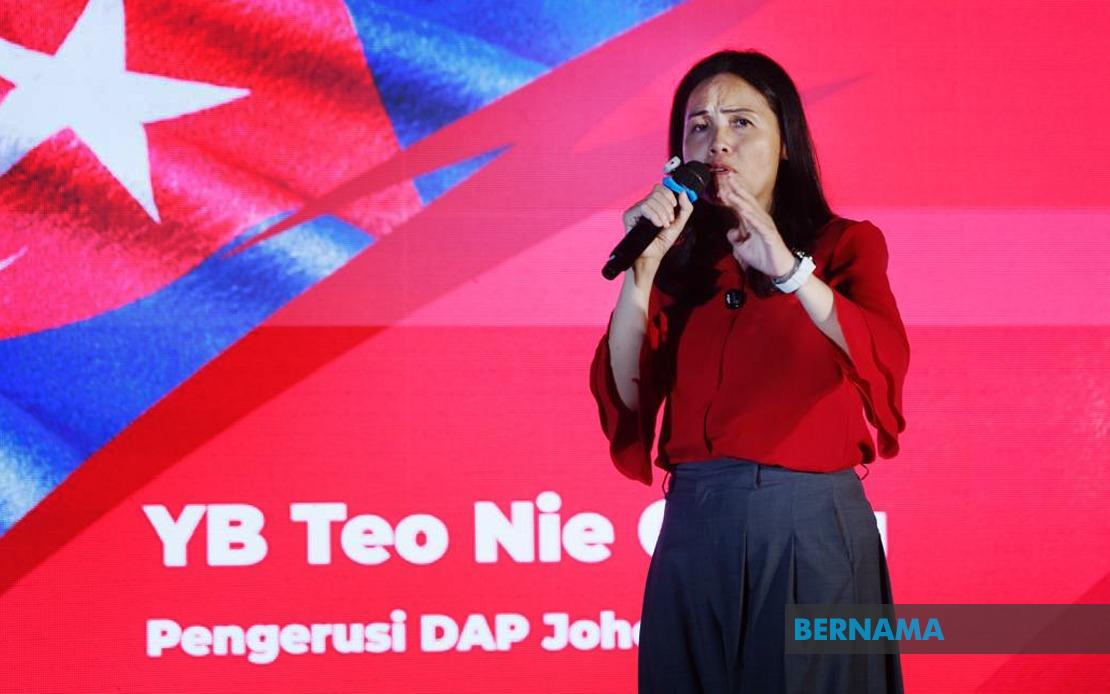
Teo Nie Ching, the Johor DAP chairman and National DAP Wanita chief, has raised pointed questions about the Johor state government's recent decision to introduce appointed state assemblyman positions, warning that such measures risk eroding public confidence in the democratic process. Speaking at a Pakatan Harapan rally in Paloh on July 9, Teo articulated deep reservations about a mechanism that would bypass the electoral process entirely, depriving appointed representatives of the legitimacy that comes from winning votes at the ballot box.
The core of Teo's concern centres on accountability and transparency. When representatives are appointed rather than elected, she argued, they circumvent the crucial democratic checkpoint where voters can evaluate candidates, scrutinise their backgrounds, and make informed choices about who should represent their interests. This absence of electoral scrutiny, in her view, fundamentally weakens the safeguards that keep elected officials responsive and accountable to the communities they serve. She called for the state government to provide comprehensive justification for the new arrangement, asserting that without clear explanation, such decisions invite suspicion and undermine public trust in the administration.
Teo's scepticism gained particular force from the context of Johor's recent political dynamics. The state government had received substantial electoral assistance from PAS in the state elections, which prompted her to pose a pointed rhetorical question: if appointed positions were not intended as rewards for candidates who lost at the ballot box, then exactly who would occupy these seats? The implication was difficult to ignore—that appointed positions might become vehicles for political patronage or coalition management rather than genuine institutional reform. By leaving this question open, Teo invited voters to contemplate the potential misuse of such appointments.
The Johor State Legislative Assembly had already passed the relevant amendment on May 7, authorising the appointment of up to five state assemblymen. The government framed this as a structural improvement designed to enhance the legislative assembly's functionality and overall composition. However, the timing and mechanics of such appointments remain unclear, creating space for exactly the kind of public concern that Teo articulated. In Malaysian politics, where questions about power-sharing and coalition management frequently surface, proposals to expand appointed positions without transparent criteria inevitably invite scrutiny.
Despite her critique of the appointments mechanism, Teo mounted a vigorous defence of the broader Unity Government's record, particularly on matters of education policy and social welfare. She acknowledged candidly that the administration is imperfect—scorecards showing 100 per cent success are unrealistic in complex governance—but contended that meaningful, systemic reforms have been implemented progressively during the current administration's tenure. This balanced approach allowed her to challenge specific government decisions while maintaining support for the broader coalition.
Among the concrete achievements Teo highlighted was the guarantee of matriculation programme placement for all Secondary School Certificate holders who achieved ten A grades, irrespective of their socioeconomic or ethnic background. This represented a significant democratisation of access to a key post-secondary pathway. Equally significant were expanded opportunities for holders of the Unified Examination Certificate, broadening educational access for students from independent Chinese schools. These reforms directly address longstanding concerns within Malaysian minority communities about equitable educational opportunity.
Financial commitment to Chinese independent schools provided another metric of systemic change. The allocation had increased to RM20.16 million for the current year, a substantial rise from the RM12 million available in 2019. While funding for vernacular education remains a politically sensitive topic in Malaysia, this increase demonstrates the government's willingness to direct resources toward educational institutions traditionally associated with specific communities. Teo positioned these changes as components of a broader vision for institutional strengthening that would benefit future generations of Malaysians.
Teo's framing of democratic reform as a long-distance endeavour proved instructive. She emphasised that meaningful change through established systems requires patience and sustained effort, implicitly suggesting that the 2026 elections would be crucial for maintaining momentum on these initiatives. This appeal attempted to reframe the election not merely as a contest for power but as a referendum on whether Malaysians wished to continue the incremental reform agenda. For voters evaluating the Unity Government's performance, the distinction between ambitious promises and pragmatic implementation remains crucial.
The context of the 2.7 million voters expected to participate in the state election highlighted what was at stake. The election would determine which parties controlled the state government and, by extension, had authority to shape education policy, welfare programmes, and administrative procedures over the coming years. Against this backdrop, Teo's dual message—that specific government proposals warrant questioning, yet the broader reform trajectory merits continued support—offered a sophisticated political position that acknowledged both the government's achievements and its shortcomings.
The presence of DAP National Chairman Gobind Singh Deo and the party's Paloh candidate Dr Ruban Arumugam underscored the significance of the event. This was not marginal criticism from isolated dissidents but a coordinated expression of party concerns about governance practices within a coalition government that includes DAP. Such internal coalition criticism, particularly on matters of democratic procedure, sends signals to voters about different political partners' competing priorities and red lines.
For Malaysian observers and regional analysts, Teo's intervention illustrated the complex dynamics within the Unity Government. Despite sharing a common electoral platform and governing coalition, component parties maintain distinct identities and policy positions. DAP's emphasis on transparency and accountability reflects the party's historical positioning around anti-corruption and democratic strengthening. Whether the Johor government ultimately modifies its appointment procedures or proceeds unchanged will test whether such internal coalition dialogue produces tangible policy adjustments or remains largely rhetorical.

