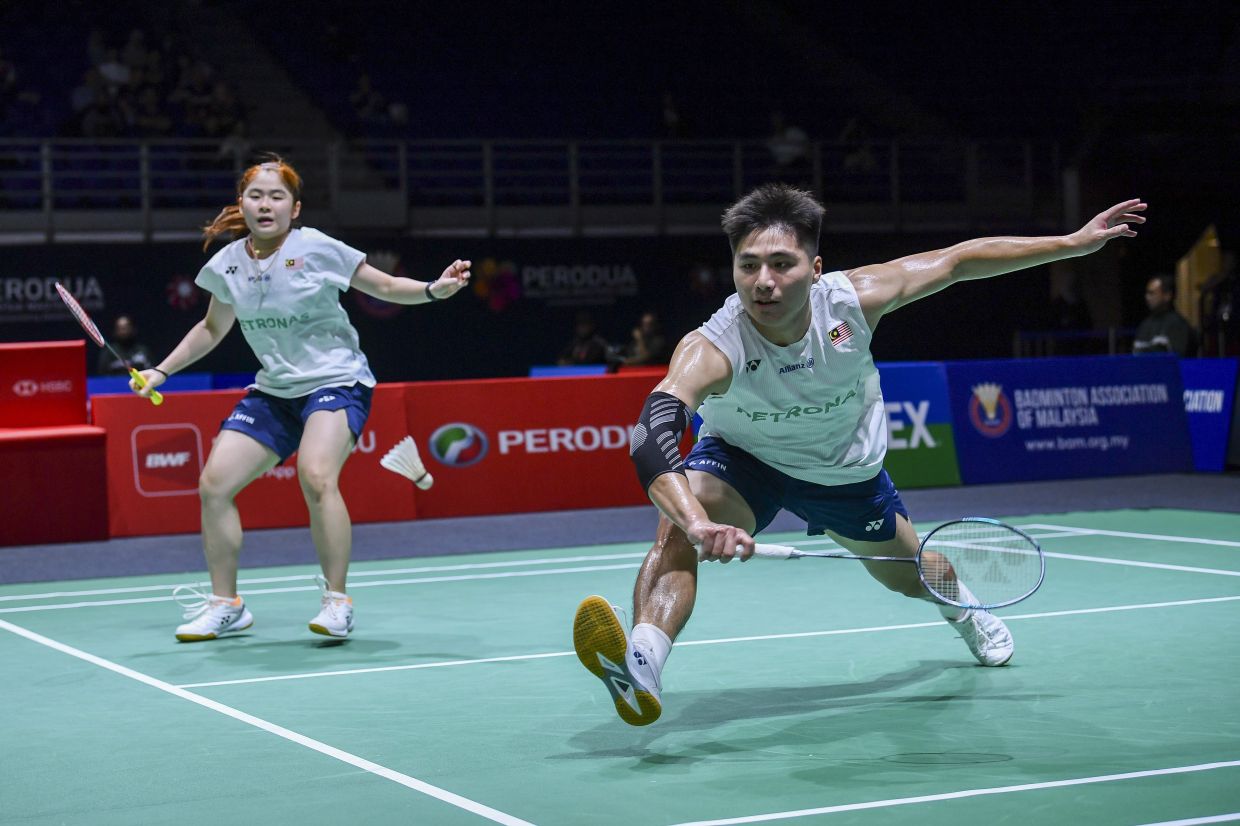
At 23, mixed doubles player Jimmy Wong believes he has positioned himself well to pursue his Olympic aspirations after returning to the Badminton Association of Malaysia's national programme in April. The shuttler's renewed commitment to the structured environment of Malaysia's elite badminton system reflects a calculated strategy to elevate his partnership with Cheng Su Yin toward qualification for the 2028 Los Angeles Olympics, marking a significant milestone in both their careers.
The decision to rejoin BAM represents more than a simple career move for Wong. Within the competitive landscape of Southeast Asian badminton, returning to a federally-backed training structure provides access to world-class coaching, competition opportunities, and the logistical support necessary to compete at Olympic standards. This structural advantage has proven decisive for Malaysian pairs seeking international breakthrough, as demonstrated by previous generations of national champions who leveraged BAM's infrastructure to reach podiums at major tournaments.
Central to Wong's renewed confidence is his collaboration with Nova Widianto, the mixed doubles coach tasked with guiding the pair's development. Widianto's credentials—including an Olympic silver medal and former world championship title—bring tangible experience navigating the psychological and technical demands of elite-level competition. For a relatively young partnership still establishing itself internationally, exposure to such expertise accelerates both tactical refinement and mental resilience, particularly crucial when facing pressure situations during critical match moments.
The coaching relationship extends beyond mechanical skill improvement. Wong acknowledges that Widianto's mentorship encompasses personal development and competitive maturity, areas where experience makes immeasurable difference. A world-class coach's primary contribution often lies not in revolutionising technique but in cultivating the mental fortitude required to execute fundamentals under Olympic-level pressure, a quality that distinguishes consistent international performers from occasionally successful campaigners.
Wong and Su Yin's current trajectory reflects modest but meaningful progress. Their ranking of 118th globally, while outside the immediate tier of frontrunners, places them within realistic distance of the target threshold. By achieving top-32 status before year-end, the pair would unlock access to tournaments in the Super 750 and Super 1000 categories, events populated by the world's most accomplished players and offering exponentially greater ranking points. This staged approach—establishing intermediate targets rather than fixating solely on Olympic qualification—demonstrates strategic thinking that reduces counterproductive pressure whilst maintaining forward momentum.
Recent tournament performances substantiate their upward trajectory. The mixed doubles pair's upset victory over world number one Feng Yanzhe and Huang Dongping during the opening round of the Singapore Open earlier this year provides measurable validation of their potential. Such victories, whilst not guaranteeing sustained success, demonstrate that Wong and Su Yin possess the technical capability and competitive maturity to compete with top-seeded combinations. The subsequent second-round elimination reflects the inconsistency typical of emerging pairs, yet the initial victory indicates the ceiling for their partnership remains considerably higher than their current ranking suggests.
Wong's deliberate approach to target-setting—consciously avoiding excessive ambition that might transform motivation into counterproductive anxiety—reveals maturity beyond his years. Elite athletes frequently struggle with the psychological balance between maintaining hunger and managing pressure, often compensating through rigid goal structures that ultimately undermine performance. Wong's awareness of this pitfall, expressed through his emphasis on consistently delivering his best performance rather than chasing specific outcomes, suggests mental preparation beyond purely technical training.
The partnership dynamic between Wong and Su Yin represents another dimension of their development. Effective mixed doubles partnerships require exceptional communication, complementary skill sets, and mutual trust—qualities that develop over sustained collaboration rather than individual excellence. Wong's assessment that their communication functions effectively whilst acknowledging areas requiring improvement reflects an honest appraisal characteristic of partnerships approaching maturity. This balance—confidence without complacency—typically precedes breakthrough performances in competitive badminton.
For Malaysian badminton broadly, Wong's trajectory holds broader significance. The national federation's emphasis on world-class coaching and structured development has produced several successful partnerships over preceding years. Wong and Su Yin's potential emergence contributes to Malaysia's depth in mixed doubles, historically one of the nation's competitive strengths. Should the pair successfully break into top-32 rankings and subsequently advance toward Olympic qualification, they would reinforce Malaysia's position as a consistent producer of elite-level mixed doubles combinations, a tradition extending across multiple Olympic cycles.
The 2028 Los Angeles Olympics remain approximately three years distant, providing both ample time for the partnership to consolidate improvements yet creating urgency around the next twelve to eighteen months. During this critical window, tournament selection, training intensity, and competition exposure must align to facilitate the ranking progression needed for Olympic consideration. Wong's explicit acknowledgment of this timeline, coupled with the intermediate top-32 target, indicates he and his support team have developed realistic pathways rather than speculative Olympic aspirations.
Wong's experience highlights a broader pattern within elite Malaysian badminton: talented individuals frequently enhance their competitive trajectory through deliberate structural choices. His decision to work within BAM's framework, commit to sustained partnership, and submit to experienced coaching reflects an evolution toward the professionalism increasingly required for international breakthrough. As the pair progresses toward their ranking targets over the coming months, their story will illuminate whether such structured commitment translates into the competitive success Wong envisions.

