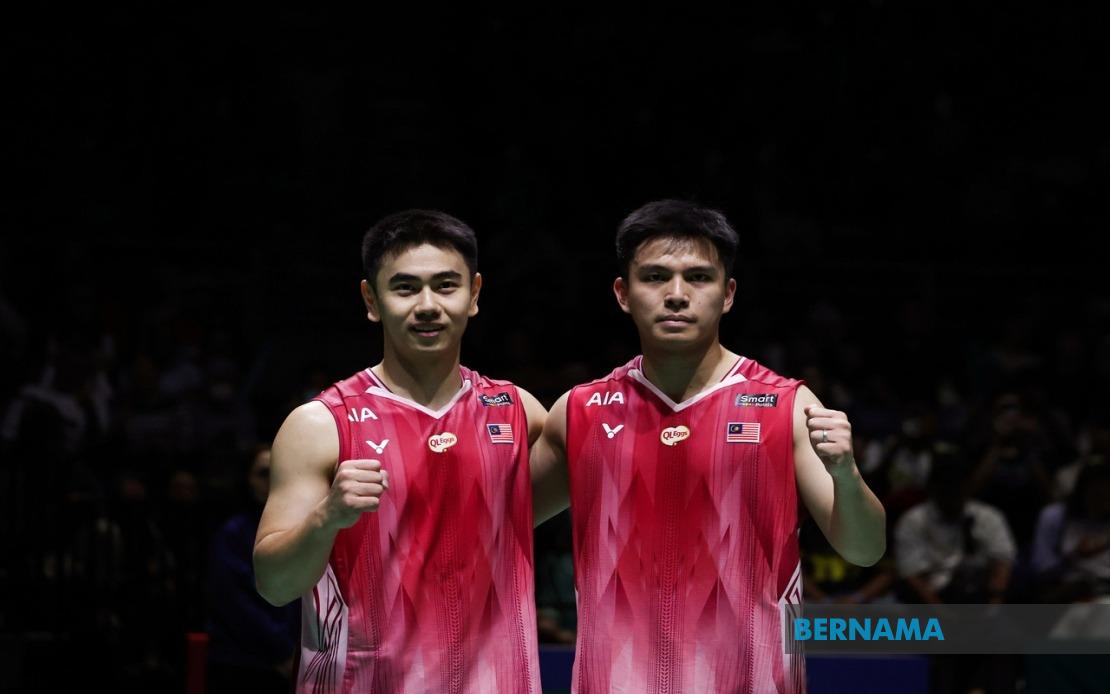
Malaysia's badminton contingent achieved significant progress at the Japan Open 2026 in Tokyo, with two pairs successfully navigating the quarterfinal stage and advancing to the semifinals. The achievements represent a positive showing for Malaysian badminton at one of Asia's premier tournaments, demonstrating the country's continued depth across multiple doubles disciplines.
The unseeded mixed doubles combination of Jimmy Wong and Cheng Su Yin produced one of the day's standout performances by eliminating Denmark's third-seeded pairing of Mathias Christiansen and Alexandra Boje. The Malaysian duo's composed execution throughout the match resulted in a convincing 21-17, 21-17 victory accomplished in 39 minutes, a relatively quick affair that underscored their tactical superiority and consistency. This triumph proved particularly noteworthy given that Christiansen and Boje carried significant seeding advantage as the tournament's third-ranked pair, making the result a genuine upset in the mixed doubles competition.
The head-to-head record between these two pairs now stands level at 1-1, suggesting a competitive dynamic that extends beyond the Japan Open stage. Jimmy and Su Yin's victory provides them with considerable momentum heading into their semifinal assignment, though their next challenge presents an entirely different complexion. They will confront Hong Kong's seventh-seeded combination of Tang Chun Man and Tse Ying Suet in the final four, representing virgin territory as the two pairs have never previously contested each other. The semifinal matchup will require the Malaysians to maintain their quarterfinal form whilst adapting to an opponent whose playing characteristics and tactical approach remain unfamiliar from a competitive standpoint.
Parallel success emerged from the men's doubles draw, where fifth-seeded Malaysian representatives Goh Sze Fei and Nur Izzuddin Rumsani navigated a gruelling quarterfinal encounter against the American duo of Chen Zhi Yi and Presley Smith. The match extended to a full three-game battle requiring 50 minutes of intense play, ultimately concluding with Malaysian victory at 21-18, 15-21, 21-13. This result marked the fourth consecutive occasion on which Sze Fei and Nur Izzuddin have prevailed against the American combination, indicating an established psychological advantage that the Malaysians have constructed through consistent success in head-to-head competition.
However, the path forward for Sze Fei and Nur Izzuddin presents a considerably steeper gradient of difficulty in the semifinal round. Their opponents will be South Korea's tournament-leading pair, Kim Won Ho and Seo Seung Jae, who carry the distinction of being ranked world number one in men's doubles. The contemporary head-to-head record between these pairings sits perfectly balanced at 2-2, preventing either combination from claiming a decisive advantage in historical matchups. Significantly, the Malaysian pair achieved a recent and notable victory over the Korean top seeds at the Indonesia Open 2026, demonstrating their capacity to overcome even the highest-ranked opposition when conditions align favourably.
The Korea Open representatives have themselves advanced through the quarterfinals after dismantling another Malaysian pairing in Kang Khai Xing and Aaron Tai. The Korean duo's straightforward 21-13, 21-10 victory over their Malaysian counterparts was achieved in direct sets without requiring a decider, suggesting Kim Won Ho and Seo Seung Jae are performing at a level of considerable polish and consistency within the tournament. This dominant display indicates the Koreans are generating significant momentum as they progress toward the tournament's final stages.
Malaysia's dual representation in the semifinals underscores the country's established position within Asia's badminton hierarchy, particularly in doubles disciplines where Malaysian players have historically commanded respect. The presence of two pairs advancing from Malaysian representation in the quarterfinals reflects the depth of coaching expertise and player development systems operating within the Malaysian badminton apparatus. Both semifinal fixtures will provide critical examination of Malaysian technical prowess and match temperament against opponents of demonstrated international calibre.
The trajectory of Malaysia's performance at the Japan Open 2026 carries implications extending beyond the immediate tournament outcomes. Semifinal results will influence player ranking points, critical components of world rankings that determine seeding for major competitions throughout the international badminton calendar. For Malaysian players pursuing sustained elevation within global rankings, strong performances at prestigious tournaments such as Japan Open provide essential ranking accumulation opportunities. The Malaysia Open and other home tournaments offer ranking opportunities, yet performances at overseas events against internationally-ranked opposition carry particular weighting within player assessment.
The mixeddoubles and men's doubles advances also reflect strategic investment in these disciplines by Malaysian badminton administration. Women's doubles and mixed doubles have assumed increasing importance within international badminton strategy, with major tournaments offering substantial prize allocations and ranking rewards. Malaysia's competitive positioning across multiple doubles categories suggests resource allocation decisions have generated tangible returns in player performance metrics. The continued presence of Malaysian representatives in major tournament semifinals validates the organisational approach guiding player development and competition preparation.

